Pearl Harbor National Memorial
Site commemorating the 1941 attack on Pearl Harbor that brought the United States into World War II
Site Details
Pin location is approximate.
1 Arizona Memorial Pl
Honolulu, HI 96818
Family Friendly?
Somewhat
Visitors Per Year
1,700,000
The Pearl Harbor National Memorial comprises four principal offerings: the Pearl Harbor Visitors’ Center, the USS Arizona Memorial, the USS Oklahoma Memorial, and the USS Utah Memorial. There are three separate, co-located “site partners” that offer additional related experiences: the Battleship Missouri Memorial, the Pacific Fleet Submarine Museum, and the Pearl Harbor Aviation Museum. All oral presentations are conducted by Park Rangers (or Navy personnel for the boat trips to the Arizona Memorial). Those speakers appear carefully selected, obviously trained, and appropriately respectful and solemn.
Pearl Harbor Visitors’ Center. The Visitors’ Center combines personal narratives, historical artifacts, and multimedia presentations to enrich understanding and connection to the past.
- The Visitors’ Center provides access to the Arizona Memorial and Ford Island Tour as well as useful information. It includes two exhibit galleries, several outdoor exhibits, a theater, and a bookstore. From the center, visitors can also access the adjacent Submarine Museum or take a bus to Ford Island to visit the USS Oklahoma and USS Utah memorials or the Battleship Missouri Memorial and Pearl Harbor Aviation Museum.
- Pearl Harbor Memorial Theater. The theater features an entertaining and informative documentary, shown roughly every half hour, that vividly recounts the historical context and the events of the attack.
- Exhibit Galleries: “Road to War” and “Attack.” These two principal galleries focus on the Japanese attack on Oahu and its aftermath. The galleries contain memorabilia, photographs, battle artifacts, and numerous firsthand accounts from survivors and witnesses.
- Audio tour and virtual reality experience. For a separate fee, visitors can take a self-guided audio tour encompassing the displays throughout the Visitors’ Center and at the USS Arizona Memorial. Similarly, an available virtual reality presentation immerses visitors in the experience of the attack.
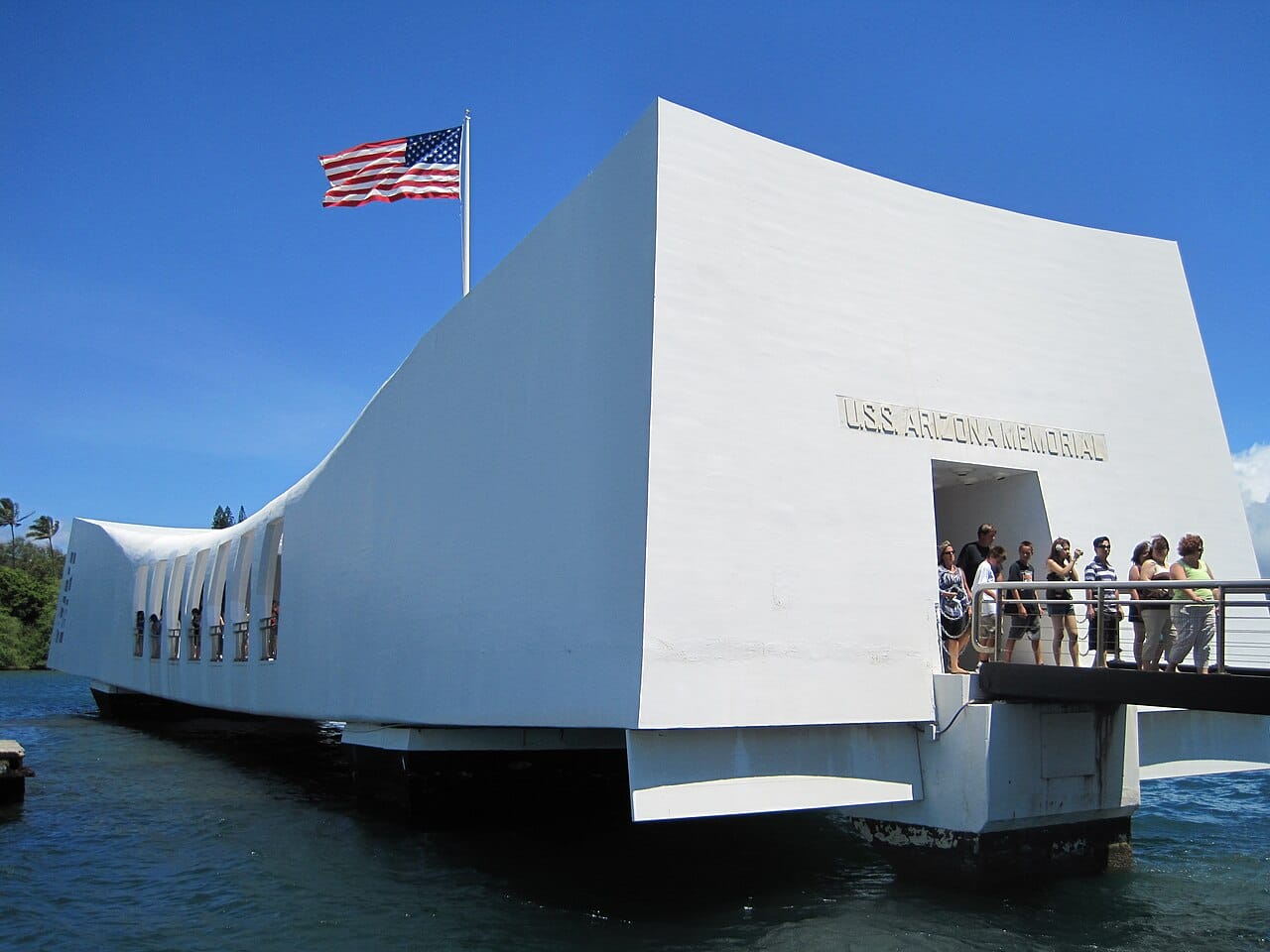
USS Arizona Memorial. Check-in for this tour begins at the Visitors’ Center (reservations are available online and highly recommended, especially during peak visitation periods), followed by a short orientation program adjacent to the Memorial Theater. From there, visitors board Navy-operated shuttle boats to the Arizona Memorial, directly above the sunken remains of the ship, where 1,102 crew members remain entombed.
USS Oklahoma and USS Utah Memorials. Located a short distance from the Visitors’ Center on Ford Island, these memorials commemorate the sinking of two other battleships moored along Battleship Row and serve as memorials to 429 members of the Oklahoma crew and 58 crew members of the Utah who perished in the attack. Visitors can reach these memorials via the Ford Island Bus Tour. (Reservations and tickets are available online but are limited and difficult to obtain).
The Pearl Harbor National Memorial is dedicated to preserving the memory of an important battle and the lives lost during the attack. Overall, the displays and presentations are proper in tone, factually accurate, and appear consistent with scholarly standards.
Serving as both a solemn memorial to those who died in the attack on Pearl Harbor and as an explanation of the importance of this seminal event in American history, the point of view of the presentations, films, and displays is distinctly American. Expectedly, the memorial achieves an overtly patriotic tone.
Japan is depicted as an aggressive enemy in perpetrating the surprise attack. There is also some presentation of pre-attack concerns about espionage or sabotage by the large ethnic Japanese population then living in Hawaii. This is balanced, however, by references to the many important contributions of patriotic Japanese Americans who fought during the war. Similarly, there is an emphasis on the post-war evolution of Japan into a close ally.
The Visitors’ Center, including the boat trip to the USS Arizona Memorial, is accessible for visitors with mobility needs. Strollers are welcome throughout the Visitors’ Center, but not at the Arizona Memorial. A tour of the Visitors’ Center and Arizona Memorial involves significant walking and is likely to last about half a day. Additional touring of the sister sites—Battleship Missouri Memorial, Submarine Museum, and Pearl Harbor Aviation Museum—also involves significant walking, and each takes roughly a couple hours.
A restrictive bag policy is in effect at the Pearl Harbor National Memorial and is strictly enforced. Bags capable of concealing items (i.e., not fully transparent) are excluded. This includes purses, handbags, backpacks, fanny packs, camera bags, diaper bags, and luggage. A bag storage area is available at the entrance for a fee.
Visitors may bring food and non-alcoholic beverages to the site; only water is allowed in the museums, theaters, on Navy transport vessels, and on the USS Arizona Memorial. There are limited options available to purchase food and beverages at the Visitors’ Center.
The attack on Pearl Harbor pulled a reluctant United States into a globe-spanning conflict—World War II. The Empire of Japan planned and stealthily conducted a surprise attack in support of its expanding imperial ambitions in Southeast Asia. Strategically, Japan hoped to quickly neutralize American power. Accordingly, Japan targeted the United States Fleet at Pearl Harbor, in particular its force of battleships, while also destroying aircraft and facilities across the island.
The attack achieved the goal of complete surprise, resulting in an overwhelming tactical victory, damaging or destroying much of the Navy’s fleet. But while the U.S. forces were caught by surprise, American sailors, soldiers, and Marines responded to the attack with courage, valor, and heroism. This fighting spirit united America’s political will and unleashed its industrial capacity. Thus, Japan’s tactical victory led to strategic defeat and unconditional surrender, with the subsequent emergence of the United States as a preeminent world power. The world was changed forever.
Also accessible from the Visitors’ Center are the Battleship Missouri Memorial, the Pacific Fleet Submarine Museum, and the Pearl Harbor Aviation Museum. These are independent sites not managed by the National Park Service. Each offers exhibits and experiences related to Pearl Harbor and World War II history. The Submarine Museum is located on the grounds of the Visitors’ Center. The Battleship Missouri Memorial and Pearl Harbor Aviation Museum are located a short distance away on Ford Island. They may be accessed by shuttle buses leaving frequently from and returning to the Visitors’ Center.
Owned By: The National Park Service
Operated By: The National Park Service
Government Funded: Yes
Did you know?
The memorial is the most visited destination in Hawaii. It is located aboard a military installation, Joint Base Pearl Harbor–Hickam.
Recommended Reading
- Pearl Harbor: From Infamy to Greatness by Craig Nelson
Reviewed By
Kevin Vienna
Captain in the Judge Advocate General’s Corps of the United States Navy (Retired)
The opinions expressed above are those of the Reviewer who is providing a good-faith historical assessment to educate the public. Reasonable opinions can vary, and the Reviewer’s opinion is not necessarily the opinion of The Heritage Foundation or its affiliates.