Martin Luther King Jr. National Historical Park
Birthplace of the influential civil rights leader and a site now dedicated to preserve and honor his legacy
Site Details
Pin location is approximate.
450 Auburn Ave NE
Atlanta, GA 30312
Family Friendly?
Yes
Visitors Per Year
850,000
The park consists of five historically significant sites within a two-block area along Auburn Street in Atlanta. Each site offers self-guided tours. Through photographs and exhibit panels, visitors are introduced to the people, institutions, and ideas that shaped Martin Luther King, Jr.’s moral and intellectual development.
- The Martin Luther King, Jr. National Historical Park Visitors’ Center consists mainly of exhibits, videos, murals, and a few hands-on displays illustrating the racially oppressive environment of the segregated South, particularly its impact on the African American community. The tour highlights Dr. King’s enduring commitment to America’s Founding principles despite these oppressive conditions. It was this commitment that gave birth to the multiracial civil rights movement. At a leisurely pace, the tour lasts about 45 minutes.
- Martin Luther King, Jr.’s birth home is located at 501 Auburn Ave. He was born in an upstairs bedroom on January 15, 1929. Young “M.L.” lived in this home with his parents, maternal grandparents, sister, brother, uncle, and great-aunt for his first 12 years. The Martin Luther King, Jr., birth home has been closed to visitors since 2023 due to an extensive rehabilitation project. The site is surrounded by fencing, which is adorned with large mural-sized pictures and captions depicting the home’s interior.
- Historic Fire Station No. 6 is located just down the street from Dr. King’s childhood home and was frequently visited by him during the 1930s. Built in 1894 in the Romanesque Revival style, the station remained in operation for 100 years. In the 1960s, it became one of Atlanta’s first racially integrated firehouses before closing in 1991. Historic Fire Station No. 6 features a short video about the historic African American commercial district known as “Sweet Auburn.” The video, along with photographs displayed on the station’s walls, highlights various African American businesses and notable figures from 19th-century Atlanta. The family-friendly fire station also showcases a restored 1927 American LaFrance Fire Engine—a model that was standard at the time.
- Ebenezer Baptist Church, built between 1914 and 1922, was the spiritual and community center for the Williams–King family. Over the course of nearly 80 years, first Dr. King’s maternal grandfather, Rev. Adam Daniel “A.D.” Williams, and then his father, Rev. Martin Luther “Daddy” King, Sr., served as pastors. In 1960, Dr. Martin Luther King, Jr., returned to Atlanta to join his father as co-pastor. Ebenezer Baptist Church features the restored 1960s sanctuary, where visitors can sit in the pews, see the pulpit from which Dr. King preached, and listen to his recorded sermons. Exhibits throughout the church tell a compelling story of Dr. King’s optimism and the vital role faith, family, and tradition played in his struggle for justice and color-blind equality in the United States.
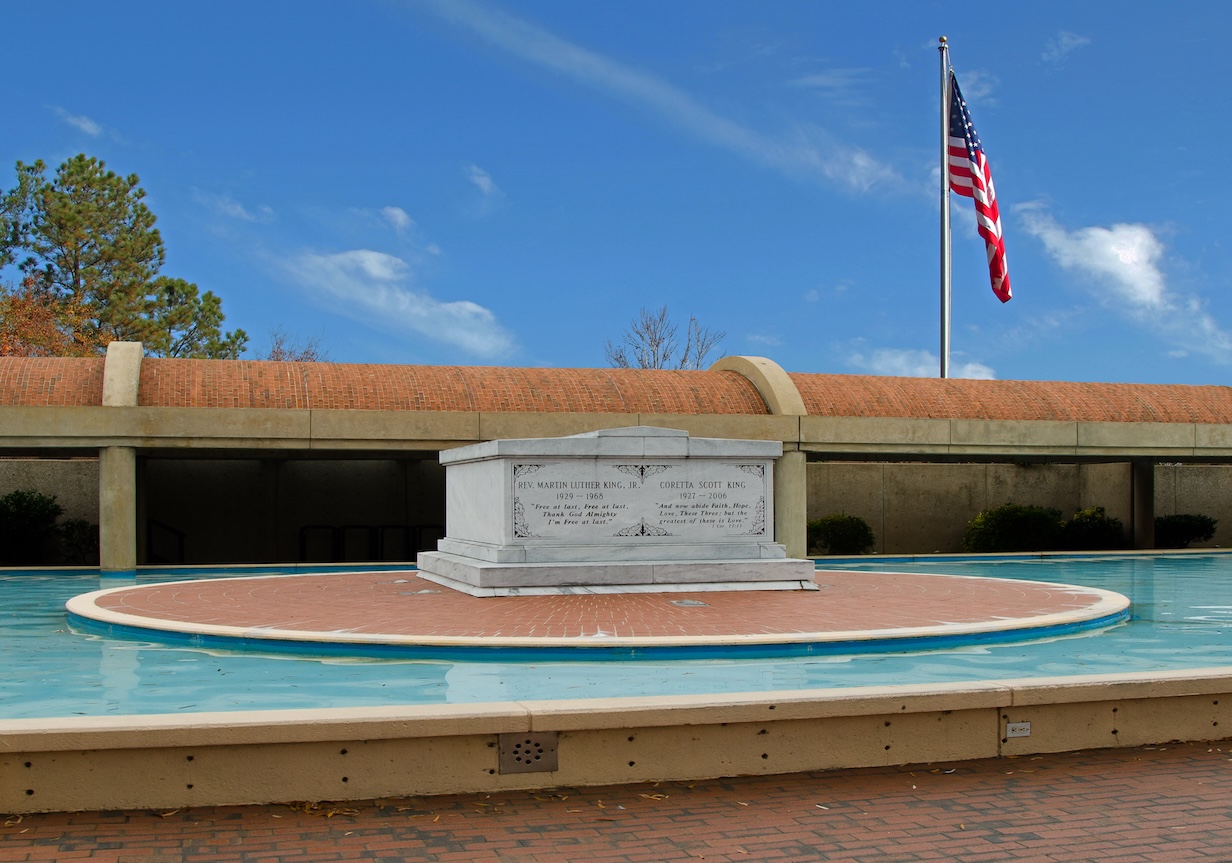
- The King Center’s Freedom Hall features biographical exhibits on Dr. King, Coretta Scott King, Rosa Parks, and Mahatma Gandhi. Adjacent to the center is the reflecting pool that surrounds the tombs of Dr. and Mrs. Martin Luther King, Jr. The King Center’s Freedom Hall houses a gift shop, bookstore, and resource center on the first floor. Upstairs, visitors can view biographical memorabilia of Dr. Martin Luther King, Jr. (including his pastoral robe and sash) and Coretta Scott King. The King Center is an independent nonprofit 501(c)3 and is not owned by the National Park Service. It was established by Coretta Scott King in 1968 as a living memorial to her husband’s legacy.
The Martin Luther King, Jr. National Historical Park is extensive, with comprehensive and accurate exhibits on Dr. King’s life, beliefs, and the civil rights movement.
The park’s book and gift shop, Eastern National Bookstore and Museum Shop, located next to Dr. Martin Luther King, Jr.’s birth home, stands out among the park’s curated offerings. While many of the books on display reflect Dr. King’s color-blind vision and philosophy, a number of them are authored by well-known contemporary writers who oppose the color-blind philosophy expressed in King’s 1963 March on Washington speech, “I Have a Dream.” Prominently featured as face-outs on the shelves are works by authors such as Nikole Hannah-Jones (The 1619 Project), Ibram X. Kendi and Keisha N. Blain (Four Hundred Souls), James W. Loewen (Lies My Teacher Told Me), and Michelle Alexander (The New Jim Crow: Mass Incarceration in the Age of Colorblindness). Each of these authors is well known for arguing that colorblindness and color-blind principles constitute a form of racism.
The Martin Luther King, Jr. National Historical Park consists of five buildings spread over a two-block area within an urban setting. The park features a rose garden and a playground with picnic benches, making it welcoming for families.
Videos of the 1963 bus boycotts in Birmingham, Alabama, may be of concern to parents of young children, as they show young African American boycotters being attacked by German Shepherds and high-pressure fire hoses.
It should be noted that some of Martin Luther King, Jr. National Historical Park’s exhibit panels and facilities could benefit from improved maintenance. For example, at Historic Fire Station No. 6, several panels explaining Booker T. Washington’s controversial 1895 speech at the Cotton States and International Exposition in Atlanta were crooked. The park tells a compelling story about the life and legacy of Dr. King, though it might be worthwhile for the park to review the cleanliness of certain public spaces like the restroom to ensure they are on par with the high quality of the exhibits. The park’s historical sites are ADA compliant, except for bathrooms in the Visitors’ Center, which are not equipped with automatic door openers.
The national Martin Luther King holiday is celebrated annually in the United States to honor Martin Luther King, Jr.’s fight for civil rights on behalf of African Americans. No other private American citizen has a national holiday dedicated in his or her honor. Ultimately, through his Christian faith and his ability to inspire both young and old, black and white Americans alike, Dr. King led the fight against racial inequality and segregation through nonviolent direct action—such as sit-ins and boycotts—reminding the nation that its Founding documents are colorblind and committed to equal justice under the law.
When Martin Luther King, Jr., spoke in 1963 during his march on Washington, he famously said in his “I Have a Dream Speech” that he dreamed that his “four children [would] one day live in a nation where they would not be judged by the color of their skin but by the content of their character.” No other American public figure in modern times has expressed sentiments so resonant with the color-blind tradition in the Western intellectual tradition.
Owned By: The National Park Service
Operated By: The National Park Service
Government Funded: Yes
Did you know?
Martin Luther King, Jr., skipped his final year of high school and entered Morehouse College as a 15-year-old freshman.
Recommended Reading
- A Time to Break Silence: The Essential Works of Martin Luther King, Jr. For Students by Martin Luther King, Jr.
- Daddy King: An Autobiography by the Reverend Martin Luther King, Sr.
- The Virtue of Color-Blindness by Andre Archie
Reviewed By
Andre Archie
Associate Professor of Philosophy at Colorado State University
The opinions expressed above are those of the Reviewer who is providing a good-faith historical assessment to educate the public. Reasonable opinions can vary, and the Reviewer’s opinion is not necessarily the opinion of The Heritage Foundation or its affiliates.