John Dickinson Plantation
Boyhood home and country estate of one of America’s most erudite, influential, and controversial Founders
Site Details
Pin location is approximate.
340 Kitts Hummock Rd
Dover, DE 19901
Family Friendly?
Yes
Visitors Per Year
10,000
The Dickinson Plantation spanned several thousand acres in John Dickinson’s time. Today it is a 450-acre National Historic Landmark and part of Delaware’s First State National Historic Park (which preserves unconnected colonial-era sites). About a dozen acres are maintained and open to visitors.
The site features a Visitors’ Center; the Dickinson Mansion and surrounding outbuildings; and several acres of lawns, gardens, and walkways bounded by woods and agricultural fields. Cars go no further than the Visitors’ Center parking lot. The facilities are “disability accessible” (not including the second floor of the mansion, which is currently closed).
The Visitors’ Center is where the plantation tours begin with an excellent 22-minute video of Dickinson’s life and career, generally screened on the hour. Other than the video, John Dickinson does not loom large. The displays are about the lives and relationships of his family members and particular tenants, indentured servants, slaves, and black freemen. In contrast to most historic homesteads, there are no books or pamphlets about Dickinson himself. A man of Dickinson’s sterling principles and luminous career surely deserves a central place at the Dickinson Plantation.
Following the video and opportunity for questions, visitors are invited to walk to the Dickinson Mansion, about 100 yards away:
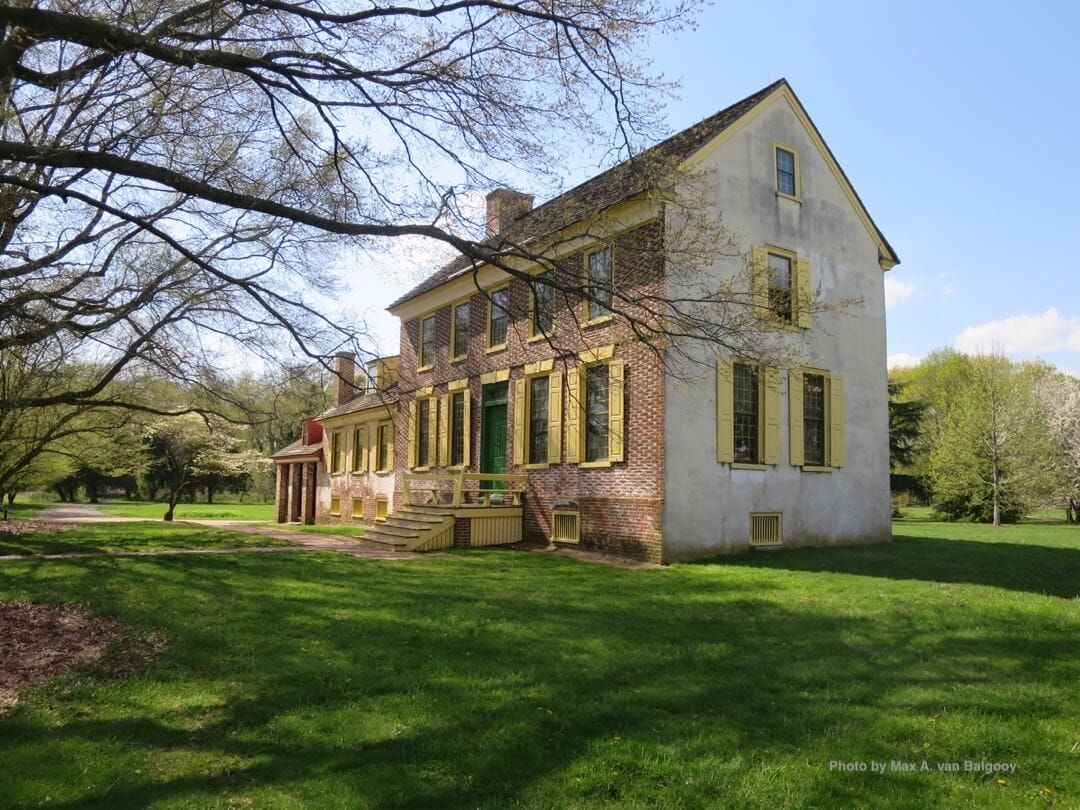
- The mansion is a handsome brick Early Georgian residence built by John’s father, Samuel, in 1729, with two wings added in the 1750s. While called a “mansion,” it is unimposing, with four modest first-floor rooms in the main structure (vestibule, parlor, study, and office) plus dining room and kitchen in the wings. Reflecting the Dickinsons’ Quaker sensibilities, it is much smaller and plainer than the grand homes of the Virginia Founders and even John Adams’s New England clapboard house.
- It features original paintings of Dickinson family members and an array of personal items and mostly original furniture.
- Facsimiles of first-edition Letters from a Farmer in Pennsylvania are everywhere. The rooms are enlivened by four realistic mannequin figures—John Dickinson plus three African servants who were major players in plantation life.
During a 40-minute guided tour, visitors learn that:
- The mansion may seem isolated today, but in the 1700s it overlooked the St. Jones River. Long since redirected, the St. Jones River was at the time a busy thoroughfare of transportation and commerce to and from the Atlantic. The office maps illustrate the river’s centrality to plantation life.
- A family portrait reveals Samuel’s firm defiance in supporting his daughter Betsy (John’s half-sister) when she married outside the Quaker meeting. The Quakers called Betsy’s marriage to an Anglican a “disorderly marriage,” and Samuel withdrew from the meeting, never to return. The father’s costly stand on principle was a family trait, presaging his son’s declining to sign the Declaration of Independence.
- John took pains to keep slave families intact. His eventual manumission of his slaves involved transitional complications for all concerned, in part because several of his tenant farmers continued to own slaves.
Following the Mansion tour, visitors are invited to explore the surroundings, which include several original outbuildings (barn, stable, corn crib, granary, smoke house) and a synthetic cabin and garden representing the plantation’s slave dwellings. Short walks lead to what was once the St. Jones riverfront and to an African burial ground identified in 2021 (currently marked only by stakes, but with a memorial plaque on the way).
The plantation’s exhibits and presentations are factually accurate about the historic property and buildings and about Dickinson and his family and the others who lived there. The Visitor Center’s narrative plaques feature original letters and business documents. They tell of John’s father Samuel, John’s wife Mary, an enslaved woman named Dinah Patten, and four tenant farmers—slaveholders William and Deborah White, and free blacks John Furbee and Peter Patten.
The plantation is careful to note uncertainties, even when aiming for a superlative. The welcoming sign announces that Dickinson “may have been one of” the largest slaveholders in Delaware (a tiny Northern state). On this point and others, including the African Burial Ground, the historical record is admittedly thin. Efforts are afoot to deepen the record. The site’s online “Plantation Stories Project” lists 131 “Enslaved, Indentured, Freedom Seeking, and Free Black Individuals,” but most of the listings include little more than name, rank, and dates of life and enslavement.
The site’s failing is one of omission. The site should certainly pay ample attention to the world of the plantation and its everyday denizens—but that world is not why it is a National Historic Site. John Dickinson’s career was centered in Philadelphia and Wilmington—but he grew up at the plantation, owned and managed it, and visited frequently throughout his life. The neglect of the most interesting and consequential person to have lived there is striking and strange and will come as a disappointment to visitors who are seeking to learn more about him.
The plantation site is free of the racialist ideology and social-justice hectoring that infect many of today’s histories of the American Founding. Its accounts of slavery are matter-of-fact, with sympathetic understanding for all concerned, including the Dickinsons. It is not currently a politicized, history-twisting site such as James Madison’s Montpelier.
But the plantation website, which emphasizes Dickinson the hypocritical enslaver, is a different matter and likely portends changes coming to the plantation proper. The website reports that its “Plantation Stories Project” is part of a larger program that includes “Descendant Community Engagement” and “Ending Erasure: Recognizing African Americans in the Cultural Landscape”—initiatives for “putting DEAI goals [diversity, equity, accessibility, and inclusion] into action.” They employ a “rubric,” developed by James Madison’s Montpelier, that identifies the descendants of a site’s enslaved people to include those from “the surrounding region and anyone who feels connected to the work the institution is doing, regardless of genealogical connection.”
A new Visitors’ Center (estimated completion July 2026) is part of a site expansion that will include several additional features. Postings by the state of Delaware and its contractors suggest that, ahead of America 250, they will shift the site’s emphasis further, and dramatically, to slavery and its continuing injustices. For example, a “Memorial Wall” and a “Circle of Remembrance” will encourage “visitors to remember, reflect, heal, and gather in honor of the enslaved individuals at the John Dickinson Plantation.” There are no evident plans to similarly remember and honor John Dickinson.
Visitors to the Dickinson Plantation are welcome to bring picnics and enjoy them on the lawns. The exhibits are appropriate for all ages but may be of limited interest to youngsters. The plantation website lists group tours on distinct subjects, some with guides in colonial garb, designed for various age groups as young as K–3.
John Dickinson was a leading Founder for nearly 50 years. He was first elected to the Delaware colonial assembly in 1759, at age 27, and was chosen as its speaker a year later. Thereafter he served in the Delaware and Pennsylvania assemblies in the 1760s; in the Continental Congress in the 1770s; as President (the initial term for Governor) of Delaware and of Pennsylvania in the 1780s; as delegate to the Constitutional Convention in 1787; in various official capacities in the 1790s (judge, President of the Delaware Constitutional Convention, and member of the Delaware Senate); and as elder sage and statesman until his death in 1808.
Dickinson’s historical significance, however, is due not to his lengthy résumé but to his singular role in shaping American nationhood. His 1767 Letters from a Farmer set forth carefully reasoned arguments that Parliament’s taxes and other measures were unconstitutional violations of colonial liberties. They were immediately reprinted and debated throughout the colonies (and in Britain and Europe), with galvanizing results. For the first time, the inhabitants of Britain’s North American colonies understood themselves to be a distinct polity, with common interests and a common destiny.
But the Letters advocated new colonial arrangements with Britain, to be secured through civil resistance and diplomacy, and warned of the dangers of violent revolution. In the Second Continental Congress of 1776, Dickinson opposed the Declaration of Independence even after a clear majority favored it, making himself the odd man out among other Founders such as John Adams and Benjamin Franklin. Whereupon he abstained from voting—so that the Declaration would be unanimous—and enlisted for military service in the war he had counseled against. He went on to play leading roles in the new nation’s government and the crafting of its Constitution.
Today, Dickinson’s legacy is claimed by both progressives and conservatives. He was a peacenik who championed the interests of slaves, free blacks, women, and the poor, and who came to be a forthright abolitionist. At the same time, he was a firm traditionalist, declaring at the Constitutional Convention, “Experience must be our only guide. Reason may mislead us.” He valued, above all, incremental reform and conciliation among those of opposing views. When he found his policy proposals to be athwart a political consensus, he withdrew them or settled on a compromise—but he never abandoned his principled political activism and belief in the possibilities of social improvement. His career holds many lessons for today’s fractured politics.
A private group, The Friends of the Dickinson Mansion, offers a robust and balanced website on Dickinson.
Owned By: State of Delaware
Operated By: Delaware Division of Historical and Cultural Affairs
Government Funded: Yes
Did you know?
John Dickinson was the only Founding Father who freed his plantation slaves during his lifetime.
Recommended Reading
- Penman of the Founding: A Biography of John Dickinson by Jane E. Calvert
- The Cost of Liberty: The Life of John Dickinson by William Murchison
- Letters from a Farmer in Pennsylvania to the Inhabitants of the British Colonies by John Dickinson
Reviewed By
Christopher DeMuth
Distinguished Fellow in American Thought in the B. Kenneth Simon Center for American Studies at The Heritage Foundation
The opinions expressed above are those of the Reviewer who is providing a good-faith historical assessment to educate the public. Reasonable opinions can vary, and the Reviewer’s opinion is not necessarily the opinion of The Heritage Foundation or its affiliates.