National Museum of American History
Repository of American historical artifacts, housing over three million objects that trace the country’s social, cultural, political, and scientific development from colonial times to the present
Site Details
Pin location is approximate.
1300 Constitution Ave. NW
Washington, DC 20560
Family Friendly?
Yes
Visitors Per Year
2,100,000
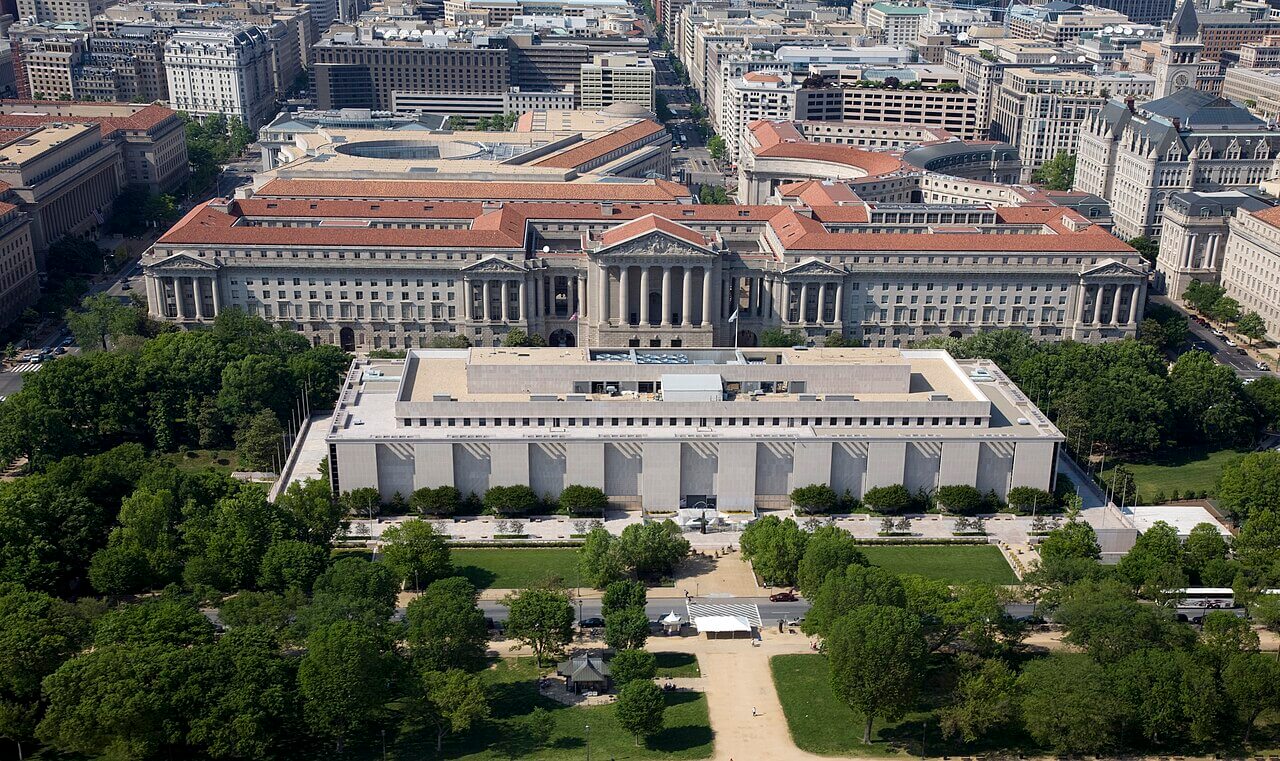
The museum features several galleries on its three floors and owns well over a million historical objects, many of which are on display. Items currently on display cover American history from politics to pop culture. They include the desk on which Thomas Jefferson drafted our Declaration of Independence in 1776, the flag that was “still there” in the morning after the British assault on Baltimore Harbor in the war of 1812 and which inspired our National Anthem, a 1926 Ford Model T car, ball gowns worn by several First Ladies, Dorothy’s Ruby Red Slippers from the movie The Wizard of Oz, and Captain America’s shield from the Avengers movies.
The top floor (3rd Floor) is home to some of the best known exhibits, such as the First Ladies (including a selection of ball gowns they have worn) and the American Presidency, the reconstruction process of the gunboat Philadelphia, “Entertainment Nation,” which has a great collection of American pop culture material, and a very good exhibit on “The Price of Freedom,” about Americans at war from the Founding to today. It also currently hosts in the changing exhibit gallery a bilingual exhibit on Mexican and Chicano “Lowriding Culture.”
“The Price of Freedom” and “American Democracy” do a decent job of introducing the story of American democracy from the Founding to today. However, reflecting the bias of academic historians today, they tend to focus on who was outside rather than the large number who (compared to other places in the world) were included from the start. The expansion of American democracy is presented as fighting with, rather than drawing out the underlying work of the Founding.
The second floor features the Star-Spangled Banner (the exhibit with the actual flag that inspired our National Anthem), “Within These Walls,” an exhibit that describes the lives of five different families who lived in a particular house in Ipswich, Massachusetts. “Many Voices, One Nation,” is another exhibit there about the diverse people who came to the United States, which the website describes as exploring “how the many voices of people in America have shaped our nation.” Across from that is the exhibit on “American Democracy: A Great Leap of Faith,” which, as the museum describes it, “explores the history of citizen participation, debate, and compromise from the nation’s formation to today.” It is moving to see the tattered old Star-Spangled Banner, something not to be missed by visitors.
The first floor has exhibits on such elements of American life as “American Enterprise”; “Food Exhibition,” displaying various foods that Americans eat; “On the Water,” about American maritime life and maritime trade in American history; “America on the Move,” about the history of transportation in America; “Power Machinery,” featuring steam and internal combustion engines, among other artifacts that tell some of the story of the changes in technology; and “Lighting a Revolution,” featuring Edison’s bulb and other like technological wonders that changed how we live, and some that never became popular (like a marshmallow toaster).
Some of this material reaches back to the museum’s original purpose. When it opened in 1964, it was our “Museum of History and Technology.” In 1980, the name was changed to the “Museum of American History,” reflecting a modification of the museum’s mission. The technology exhibits make some effort to encourage visitors to think about how changes in technology impact the way we live and how we relate to each other and to our environment, though they could do that better.
The items on display in the exhibits are often interesting and well presented. The write-ups are informative, although they somehow tend to be both longer than necessary and less thought provoking than they ought to be.
The exhibits at the museum are accurate in that they get all the facts correct. The museum was closed and completely redone in the early 21st century, reopening in late 2008. The new exhibits started coming online then, with some not opening until several years later. The result is that the exhibits reflect concerns that prevailed among America’s academic historians in those years, and the materials are presented from the perspective that prevailed in the field. The trouble is that the typical academic historian has a different understanding of what is important to study in American history, and from what perspective it ought to be presented, compared to the typical American.
The perspective from which the museum chose to present the material it put on display is relatively less political when discussing science and technology, and other similar elements of the American past. Exhibits connected with politics are interesting, but the write-ups are sometimes a bit bland, as if they were trying not to say anything provocative, and yet if one looks there is certainly a political bias in the way the materials are presented.
A political perspective is evident in the displays that are outside the main galleries and in the galleries. Walking from gallery to gallery, one sees a display of Carl Nassib’s NFL jersey, noting that he “was the first openly gay athlete to play in a regular season NFL game.” Why that choice? If one asked Americans which NFL jersey to feature in a very prominent place, that would not be the one to choose. (They do include a Roger Staubach jersey in the sports section of the museum).
The decision to include that display was almost certainly done because the modern academic historian has been trained to focus not on what the common people find interesting, but instead on historic “firsts” that demonstrate “progress” over time. In the sports section, the museum chooses to highlight Allie Reynolds “who used his renown to promote Indian causes.” That’s factually accurate, of course. But he’s hardly a top 10 Yankee star. In other words, the curators view baseball from the perspective of politics, which is not how most Americans view sports.
To cite another even more clearly partisan example, from the discussion of American democracy, the write up under the heading “Keeping the Vote” says that some locales “changed voter registration requirements and Election Day rules in attempts to minimize the political power of newly enfranchised groups.” The cumulative effect of the narrative focus is to present American history from the perspective of the center Left.
The building was renovated in the George W. Bush years, and it is family friendly.
The first floor also features some exhibits specifically for children, including the “Object Project” about how changing things (such as the bicycle) changed our way of life, “Change Your Game,” about technology, rules, and sports interacting and changing over time (some of which is “hands on”), “Spark Lab,” for kids 6-12 (where “kids become inventors”), and “Wonderplace” (an interactive exhibit for kids 0-6). Some of those exhibits are closed some days when the rest of the museum is open, so check the museum website before going.
How does one evaluate the significance of a museum such as this? Is it historically important to see First Ladies’ ball gowns dating back to the 19th century, or the ruby red slippers Dorothy wore in Wizard of Oz? Hard to say. But it can be fun and interesting to see such things. A good American history textbook would certainly present much of the same material on the story of American political and cultural history with more depth and richness.
It is good to see artifacts across time. The lower-level displays about science, technology, modes of transportation, etc. might be the worthiest of taking in and thinking about. Americans don’t always consider how changes in technology and in ways of organizing our working lives change the way we see the world and relate to others.
The Star-Spangled Banner is something every American should see, as is the desk on which Jefferson wrote the Declaration. And every citizen should periodically think about how much it has cost to get and keep freedom over time, as the exhibit on Americans at war from the Founding to today does. The museum is not wrong to note that Americans have been arguing about who is in and who is out, who gets the full rights of citizens and who does not, etc, from the start. But it might be worth pondering them in a perspective of gratitude for our common country, rather than that of an undecided critic. The American people fund museums like this to help Americans, and others, learn about America. Our ability to contend with each other freely and publicly is part of the story of American greatness, and yet it’s presented, in a reductive way, as the story of prejudice versus liberty and inclusiveness.
A coffee shop and bookstore are on the first floor. The cafeteria in the basement is currently closed for renovations.
Owned By: Smithsonian Institution
Operated By: Smithsonian Institution
Government Funded: Yes
Did you know?
The American gunboat Philadelphia that was sunk during the American Revolutionary War and then recovered from the bottom of Lake Champlain in 1935, is being restored in the museum. Visitors can watch the restoration work in progress.
Recommended Reading
- Land of Hope by Wilfred McClay
- American Slavery, American Freedom by Edmund Morgan
- Empire of Liberty: A History of the Republic 1789-1815 by Gordon Wood
- What Hath God Wrought by Daniel Walker Howe
- Nature’s Metropolis by William Cronon
- Battle Cry of Freedom by James McPherson
- Narrative of the Life of Frederick Douglass by Frederick Douglass
Reviewed By
Richard Samuelson
Associate Professor of Government at Hillsdale College
The opinions expressed above are those of the Reviewer who is providing a good-faith historical assessment to educate the public. Reasonable opinions can vary, and the Reviewer’s opinion is not necessarily the opinion of The Heritage Foundation or its affiliates.