National Archives
The National Archives Museum serves as the permanent repository of America’s Founding documents—the Declaration of Independence, the United States Constitution, and the Bill of Rights—collectively known as the Charters of Freedom.
Site Details
Pin location is approximate.
701 Constitution Ave. NW
Washington, DC 20408
Family Friendly?
Yes
Visitors Per Year
2,000,000
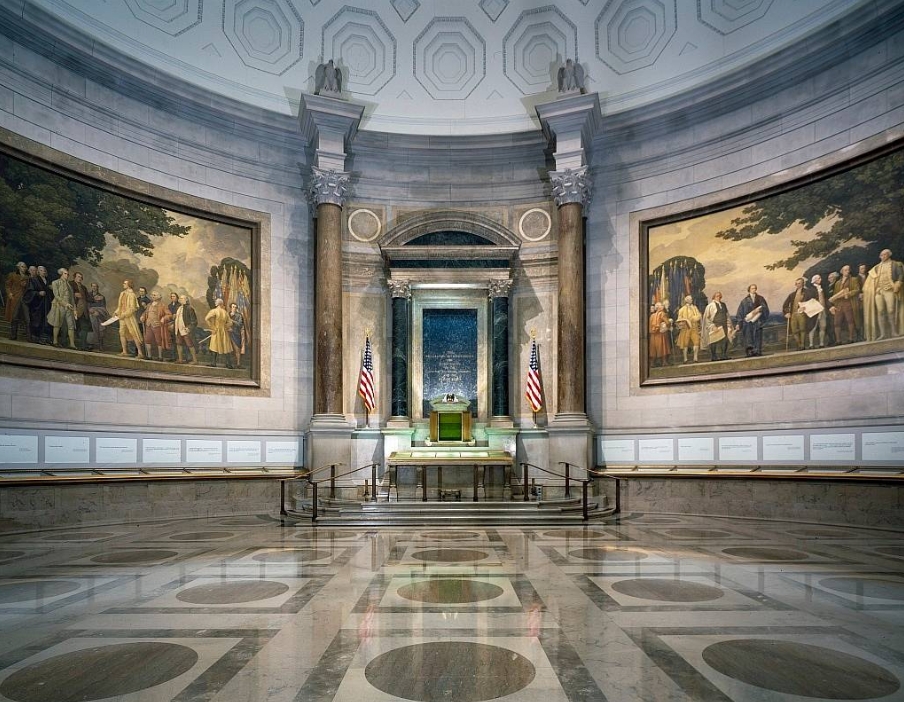
The main attraction of the National Archives Museum is the Rotunda for the Charters of Freedom in which the original parchment copies of the Declaration of Independence, the Constitution, and the Bill of Rights are on display. Alongside these core texts of American freedom are informational exhibits on the drafting, writing, signing, and ratifying of the documents.
Through the summer of 2026, the temporary exhibits to the left and right of the Rotunda, called Road to Revolution and Opening the Vaults, will feature rotating displays related to the American War for Independence and highlight other valuable historical documents and archival materials rarely on display to the public.
The National Archives will unveil its newly renovated interactive museum, set to open in October 2025, with two exhibition galleries—The American Story and a Discovery Center for children—as well as a theater. The American Story will trace the country’s history from its Founding and highlight Americans’ many accomplishments in the spheres of politics, international relations, science, and industry throughout the past 250 years. These topics will be explored in the context of the Constitution, and there will be opportunities for visitors to examine physical documents on display—such as George Washington’s personal copy of the Constitution—as well as to interact with the digital copies shown on kiosks throughout the galleries. The purpose for the interactive museum is twofold: first, to celebrate 250 years of American history, and second, to illustrate the breadth of the records in the National Archives’ collections and the numerous ways the National Archives can be used, allowing Americans to learn about their country and fostering a deeper engagement in civic life.
The Lawrence F. O’Brien Gallery houses temporary exhibits, and the new exhibit, projected to open in March 2026, will focus on the Declaration of Independence in honor of the upcoming 250th anniversary of its adoption and signing.
The Magna Carta & Records of Rights exhibit in the David M. Rubenstein Gallery contains a copy of the Magna Carta from 1297 (one of four copies still in existence) as well as other documents relating to different civil rights movements throughout American history.
Located on the lower level, the Charters Café offers a variety of sandwiches, soups, and salads from 10 a.m. to 2:30 p.m., Monday through Friday.
The museum store, run by the National Archives Foundation, has a wide variety of toys, games, books, shirts, and other patriotic items. It is one of the best gift shops at a historical site in Washington, D.C., for fun and educational souvenirs.
The Magna Carta & Records of Rights is a good exhibit but lacks the necessary undergirding that would provide the educational explanation of the source and meaning of “rights” in the American constitutional tradition. In particular, there is no discussion of rights as understood by the Declaration of Independence (equal rights of all men endowed by man’s Creator under the Laws of Nature and of Nature’s God) and secured by the Constitution. The narrative jumps from the Magna Carta to the emancipation of American slaves and then to various rights movements throughout American history, possibly giving visitors the misguided idea that a right is anything claimed as a right (for example, “reproductive rights”). The significance to this narrative of the Declaration of Independence and the Constitution, both housed in the museum one floor above, is implied rather than stated in the exhibit, and the exclusion of their guidance leaves out the essential grounding of rights supplied by those great documents.
By presenting museum visitors with the choice to curate their own museum experience with state-of-the-art artificial intelligence technologies and to tailor it to the topics that interest them, the National Archives encourages patrons to interact with historical documents in a fun and engaging way. This allows the National Archives to avoid potential interpretative biases in its presentation and encourages visitors to directly interact with the original materials in the collection.
The Discovery Center has a classroom available for large school groups, as well as families and smaller homeschool groups. In addition to a door that leads from The American Story exhibition gallery, there is a separate entrance if parents and educators wish to visit the Discovery Center without walking through the entire museum. The Discovery Center also has a reading nook with age-appropriate books and learning materials. A photo booth allows children to insert themselves into famous historical photographs, while arcade games test their civics knowledge.
Digital kiosks throughout The American Story gallery and in the Discovery Center can “recognize” visitors, using a unique code received upon entry, creating an individually tailored interactive experience. Each kiosk presents records from the National Archives’ collections tailored to that particular visitor’s interests, allowing him or her to examine the text in greater detail. (Parents do have the choice to opt out of the AI element of the museum if they wish to limit children’s screen time.) At the end of the visit, the documents can be received by email for further learning, allowing visitors the opportunity to share their experience at the National Archives.
Leading up to July 4, 2026, the National Archives will have as many as five different exhibitions on the American Revolution and the Founding.
The National Archives Museum is the permanent home of the original, engrossed copies of the Declaration of Independence and the United States Constitution, as well as the original 10 amendments to the Constitution known as the Bill of Rights. These two documents, along with the Bill of Rights, are known collectively as the “Charters of Freedom.” The significance of the Declaration and the Constitution is without parallel, as together these two Founding documents define the meaning and determine the structure of our national existence.
The National Archives building is also of great historical significance. Completed in 1937, the building was designed by American architect John Russell Pope to house and display publicly and together for the first time the Declaration and the Constitution. The architecture is inspired by the famed Pantheon, a marvel of Roman architecture (which would later become a Catholic church). In the domed rotunda of the Archives, our Charters of Freedom can be found encased in an altar of marble. America’s Founding documents were formally transferred in 1952 from the Library of Congress to the National Archives, where they are preserved and protected in sealed display cases that are temperature and light controlled. On the walls of the Rotunda above the documents are two 37.5-foot-long murals painted by Barry Faulkner that depict the presentations of the Declaration of Independence and the Constitution to Congress.
Because the National Archives is the home of the Declaration of Independence, the staff is actively preparing for an increase in foot traffic in the upcoming year and seeking to enhance the visitor experience. Plans are in place to establish a volunteer docent program that will answer patrons’ questions and direct them to the Rotunda and other popular exhibitions.
Admission to the museum is free. To avoid long lines, visitors may reserve tickets for timed-entry, which are available in 15-minute increments from 10 a.m. to 4:45 p.m. daily. Please note that if booking through etix.com, there is a non-refundable $1.00 charge per ticket.
Owned By: U.S. Federal Government; managed by the General Services Administration
Operated By: National Archives and Records Administration
Government Funded: Yes
Did you know?
With its new $40 million renovation, the National Archives is the first museum in Washington, D.C., to utilize advanced artificial intelligence (AI) technologies to produce a personalized experience for visitors. The digital interfaces throughout the new exhibition The American Story as well as the Discovery Center will allow museum patrons to interact with the two million records in the National Archives’ digital collections.
Recommended Reading
- The Making of the American Mind: The Story of Our Declaration by Matthew Spalding
- Miracle at Philadelphia: The Story of the Constitutional Convention May–September 1787 by Catherine Drinker Bowen
- Ratification: The People Debate the Constitution, 1787–1788 by Pauline Maier
- The Bill of Rights: The Fight to Secure America’s Liberties by Carol Berkin
Reviewed By
Matthew Spalding
Kirby Professor in Constitutional Government at Hillsdale College’s Washington, D.C., campus
Anna Clark
Research Coordinator at the Hillsdale College Washington, D.C., campus
The opinions expressed above are those of the Reviewer who is providing a good-faith historical assessment to educate the public. Reasonable opinions can vary, and the Reviewer’s opinion is not necessarily the opinion of The Heritage Foundation or its affiliates.