National Museum of African American History and Culture
Smithsonian devoted to African American history and culture from the era of slavery through the Civil Rights Movement and beyond
Site Details
Pin location is approximate.
1400 Constitution Avenue NW
Washington, DC 20560
Family Friendly?
Somewhat
Visitors Per Year
1,600,000
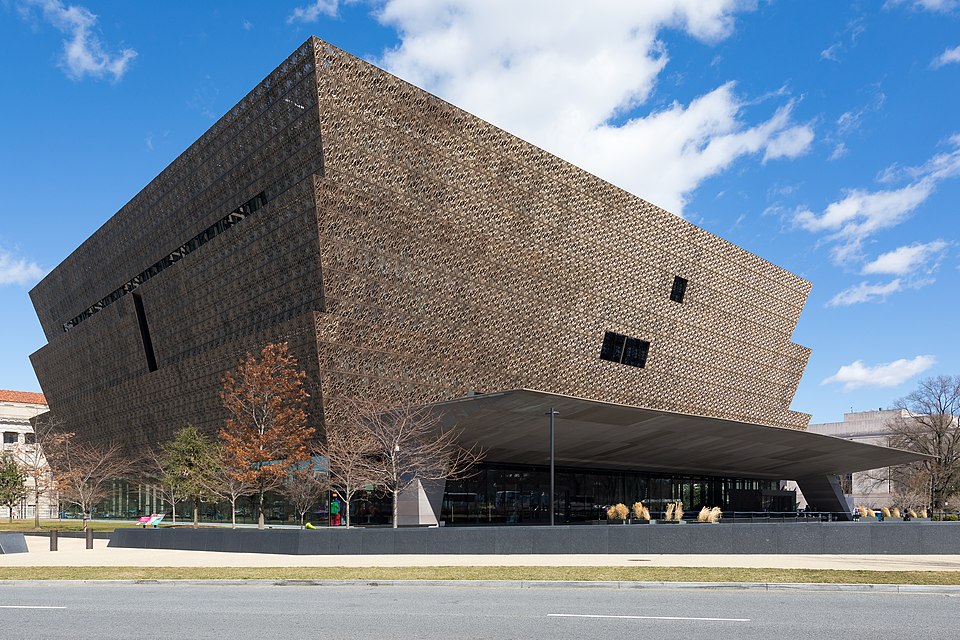
The Museum, located on the National Mall near the Washington Monument, has 10 floors, half below ground and half above.
Below ground one finds history galleries, which take the visitor from the start of the trans-Atlantic slave trade in the North American colonies in the 17th century, the Revolution, the Civil War and Emancipation, Reconstruction, Segregation and the Jim Crow Era, and the Civil Rights Movement.
Above ground, the exhibits focus more on culture and current events, such as the Black Lives Matter demonstrations. It is in the history section where visitors will find some of the worst historical exaggerations or inaccuracies.
There is an issue of cherry picking at the museum. For example, in discussing the case of the Scottsboro Boys (nine young men wrongly accused of rape in 1931 Alabama, who were convicted and almost lynched), the museum credited the Communist Party for coming to their defense. The exhibits do not mention that the Moscow bosses of the Communist Party USA (CPUSA) had just initiated a campaign to create a Soviet-controlled separate black republic in southern states, and the CPUSA was simply using this case for its own purposes, and undermining public support for a legitimate civil rights case.
There is a proportionality problem with the exhibits. For example, there are several representations of Marxists such as Angela Davis and Stokely Carmichael, whose violent actions and rhetoric are downplayed or ignored, while only one of Justice Clarence Thomas. Exhibit after exhibit celebrates “mobiliz[ing] for social change,” “pav[ing] the way for social change,” a “tradition of activism,” and “the fight for change.” And the activists who are honored are almost uniformly left or far-left. Stacey Abrams gets a large section of one exhibit on “black women activists,” though the exhibit does not identify her with any cause other than “black women seeking elected office.” The founders of the Black Lives Matter movement also get special attention. None of their financial mismanagement and reported grift, however, is mentioned. In the very few places where black conservatives do appear, only their non-political achievements are mentioned. For example, Ben Carson’s career as a surgeon is mentioned once, but the museum includes nothing about his service as a conservative Republican politician and pro-life activist.
There are also several inaccuracies. Another museum exhibit indicts the U.S. Constitution, claiming inaccurately that it “defended slavery.” Yet James Madison, often referred to as the Father of the Constitution, wrote that the delegates at the Constitutional Convention refused to include the terms “slave” and “slavery” in the Constitution because, they “thought it wrong to admit in the Constitution the idea that there could be property in men.” One of its main pieces of evidence for this falsehood is that the Constitution stipulates that three-fifths of each slave was to be counted for the purpose of electoral apportionment. The museum extrapolates that the Framers meant that slaves were worth only three-fifths as much as other humans. But the Three-Fifths Clause was a compromise between the northern states and the southern states. The southern states, which had no intention of giving any rights to their slaves, wanted slaves counted to increase their representation in Congress and in the electoral college, thereby increasing their political influence, but did not want slaves counted at all for purposes of taxation (northern states wanted the opposite).
Some of the exhibits seem designed to promote the idea that America, its culture, and economic model are irreparably tainted by association with slavery. Museum exhibits claim, for example, that “the national economy relied upon slavery,” and that “profits from the sale of enslaved humans and their labor laid the economic foundation for Western Europe, the Caribbean and the Americas.” These conclusions, however, all seem to come from a gross overestimation of the value of cotton to the overall U.S. economy. Advocates of Critical Race Theory, like those behind the 1619 Project, associate capitalism with slavery, often through the link of King Cotton. Cotton was indeed slavery’s chief revenue producer, accounting for around 75 percent of the value of the staple crops produced by slaves, and slavery certainly made some select plantation owners very wealthy. But cotton’s share of the U.S. economy in 1836 was just 5 percent, as exports were not a significant part of the U.S. economy at that time. There is, in fact, a negative correlation between the existence of slavery and the growth of a state.
The museum also repeatedly employs a subtle tactic to push a radical race ideology without being explicit about it. Its didactics raise questions on which there is great debate. For example: do communities have an obligation to pay race-based reparations? The museum itself does not give an answer, but it does showcase quotes from radicals answering in the affirmative. Nowhere in the museum can a visitor find conservative or even mainstream liberal answers to any of the questions that the museum raises.
The bookstore is especially egregious. It contains the 1619 Project, an error-filled radical revisionist spin on American history, and myriad books by far-left radicals who oppose treating people equally without regard to skin color, express their hatred of “whiteness,” and demand racial preferences and color-based reparations.
This is not a coincidence, as Smithsonian Secretary Lonnie Bunch ensured that the Smithsonian played a leading role in the 1619 Project. He assigned Mary Elliott, the curator of American slavery at the African American Museum, to curate and co-author the 1619 Project’s special broadsheet section, where many of the project’s worst inaccuracies are located. That is, it was Elliott who selected objects from the museum’s collection to include in the section, and then co-wrote the text.
The exhibit on the Civil Rights Movement is especially biased. It gives visitors the impression that Black Power radicals were the core of the movement rather than at the fringe. And lest anyone should leave that exhibit thinking that the right thing to do is to treat everyone equally without regard to skin color, it ends with a large quote that “the problem of the twenty-first century is the problem of colorblindness.”
At the end of the exhibit on the Civil War is a quote that Abraham Lincoln delivered at the beginning of the War (1861): “I have no purpose, directly or indirectly to interfere with the institution of slavery in the States where it exists.” The implication is that Lincoln was not really interested in freeing slaves and so should not get credit for doing so. But to take that quote out of date and out of context hides Lincoln’s brilliant statesmanship. He knew, as he explained in quotes that do not appear in the museum, that to save the Union was to end slavery. It was not either-or. He intended to have both union and emancipation, and he did.
The exhibits on Emmett Till are somewhat graphic, but otherwise the museum does not put on full display the blood and gore associated with slavery and Jim Crow. There are also plenty of interactive exhibits. However, because of the museum’s pronounced bias to the left, engagement with children who lack the necessary context to question falsehoods or incomplete truths becomes a double-edged sword.
The museum is huge, so set aside a good two and a half hours to see a sizable portion of the exhibits. The didactics, moreover, have small letters and are sometimes far from the crowd, so that the visitor must jockey for a forward position to read them. Since this is really a history museum, reading the didactics is almost indispensable, but this further delays the process of touring all floors open to the public.
Whether America needs a national museum dedicated to African American is not a question here. One exists, with a dedicated building, and thus the only thing to do at the moment is to make it work. The mission of the African American Museum should be to tell the whole story of African Americans, and to explore how they fit into the national fabric and how they have contributed to the nation’s success. An added bonus would be if, in casting that light, it helped heal racial rifts that have characterized that history. People do need to learn about the role of slave labor in building the country and about tragedies like the Scottsboro Boys. But we don’t need to deepen our wounds, which this museum does.
Owned By: The Smithsonian Institution
Operated By: The Smithsonian Institution
Government Funded: Yes
Did you know?
The museum’s bronze-colored exterior and shape are references to three-tiered crowns used by the Yoruba people who live in southwestern Nigeria, Benin and Togo.
Recommended Reading
- Narrative of the Life of Frederick Douglass, an American Slave by Frederick Douglass
- The Quest for Cosmic Justice by Thomas Sowell
- My Grandfather’s Son: A Memoir by Clarence Thomas
Reviewed By
Mike Gonzalez
Angeles T. Arredondo E Pluribus Unum Senior Fellow in the Kathryn and Shelby Cullom Davis Institute for National Security and Foreign Policy at The Heritage Foundation
The opinions expressed above are those of the Reviewer who is providing a good-faith historical assessment to educate the public. Reasonable opinions can vary, and the Reviewer’s opinion is not necessarily the opinion of The Heritage Foundation or its affiliates.