The Tapping Reeve House and Litchfield Law School
Law school founded in 1784, where myriad important state and national leaders underwent legal training
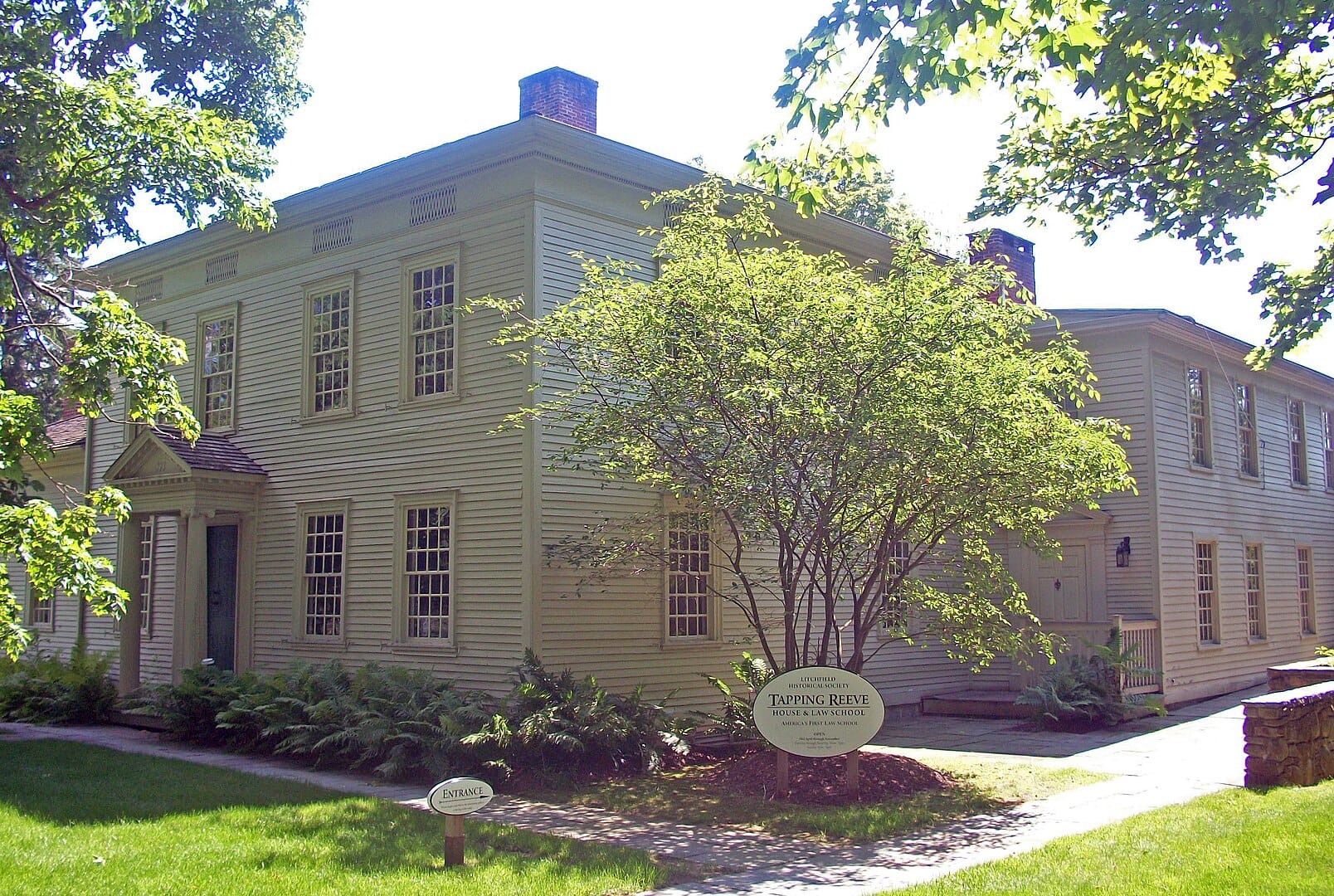
Site Details
Pin location is approximate.
82 South Street
Litchfield, CT 06759
Family Friendly?
Yes
Visitors Per Year
14,000
- Tours of the house and grounds are self-guided, beginning with a movie introducing the place. Actors in period garb portray young men and women heading to Litchfield from around the country for the purposes of undertaking legal training (the men) and, one surmises, attending the Litchfield Female Academy (the women). The film does quite a nice job of acquainting the viewer with the political climate of the early 19th century, relations between the sexes at the time, sectional tensions of those days, and related matters. Exhibits in the museum include a large share of Reeve’s law books, much of the furniture of the house from his day, dishes, and other such material.
- While there is no tour, visitors will find ample signage describing how legal study worked, the reputations Tapping Reeve and his colleagues had among students and former students, where the students lived, how they financed their education, and so on.
Litchfield Law School incorporates recent scholarship and reflects recent interest among academic historians regarding the place of slavery in American life in Reeve’s day, relations between the sexes, economic stratification in the early 19th century, and the like. One notable omission from the displays is Reeve’s role in bringing an end to slavery in Massachusetts. Reeve served as co-counsel in the 1781 case Brom and Bett v. J. Ashley, Esq. Bett (Mumbet) was an enslaved woman who sued her master for her freedom, and the jury ruled in her favor, recognizing her as a free person and ordering her master to pay damages.
Women figure more prominently in this site’s presentation than reality probably reflected. The law school was host to one or two instructors (depending on the year) teaching younger men the law. (On one occasion, one of the students was joined by his wife.) However, despite the fact that the law school educated young men, the focus of the introductory movie is pretty evenly divided between men and women. Also, a few passing negative comments made about slavery in the movie probably would not have been voiced in the original context. In addition, there is an incongruously ideological statement on a placard behind the house about bygone Indian inhabitants of the place.
The place is certainly family friendly, though there are no activities specifically for small kids. The introductory film and the Tapping Reeve Meadow may appeal to the young. The site is of general appeal inasmuch as a law school and its founder’s home can be.
Litchfield Law School was America’s first law school. Numerous prominent politicians—Vice President/Senator/New York Attorney General Aaron Burr and Vice President/Secretary of War/Senator/Representative John C. Calhoun, many members of the U.S. House and Senate, several governors and state supreme court chief justices, among others, learned their profession here. Attentive visitors will come away with an understanding of who studied here, how their studies worked, what their social lives were like, how they financed their education, and—to some degree—how their presence affected Litchfield.
Owned By: Litchfield Historical Society
Operated By: Litchfield Historical Society
Government Funded: Yes
Did you know?
Tapping Reeve, founder of Litchfield Law School, was a brother-in-law of Aaron Burr, who was Thomas Jefferson’s first Vice President and one of the founders of the Jeffersonian Republican Party; Vice President John C. Calhoun, a founder of the Democratic Party, also studied law there.
Recommended Reading
- The Litchfield Law School: Guiding the New Nation by Paul DeForest Hicks
- Tapping Reeve and Mumbet: Abolishing Slavery in Massachusetts by Suzanne Geissler Bowles
Reviewed By
Kevin R. C. Gutzman
Professor of History at Western Connecticut State University
The opinions expressed above are those of the Reviewer who is providing a good-faith historical assessment to educate the public. Reasonable opinions can vary, and the Reviewer’s opinion is not necessarily the opinion of The Heritage Foundation or its affiliates.