Ronald Reagan Presidential Library and Museum
Presidential library and museum of America’s 40th President, featuring the Air Force One that served seven Presidents and a section of the Berlin Wall
Site Details
Pin location is approximate.
40 Presidential Dr #88
Simi Valley, CA 93065
Family Friendly?
Yes
Visitors Per Year
260,000-400,000
The museum’s design maintains a solid focus on Reagan and his core ideas. The physical layout and flow of the museum take visitors through Reagan’s life in chronological order, beginning with his upbringing in Illinois, his early and middle career in radio and then Hollywood movies, and his transition into elective politics as governor of California. Group tours with guides and individual self-guided tours with hand-held audio devices are offered.
Areas of emphasis include:
- Exhibits on Reagan’s 1980 landslide victory and his assumption of office in 1981 as well as the assassination attempt in March 1981. Like most presidential libraries, there is a full-size replica of the Oval Office during his time in office, with accompanying reproductions of the artwork and decorations. Some museum guides will mention that Reagan always wore his coat jacket when he was in the Oval Office because he thought decorum and the majesty of the office required this expression of respect.
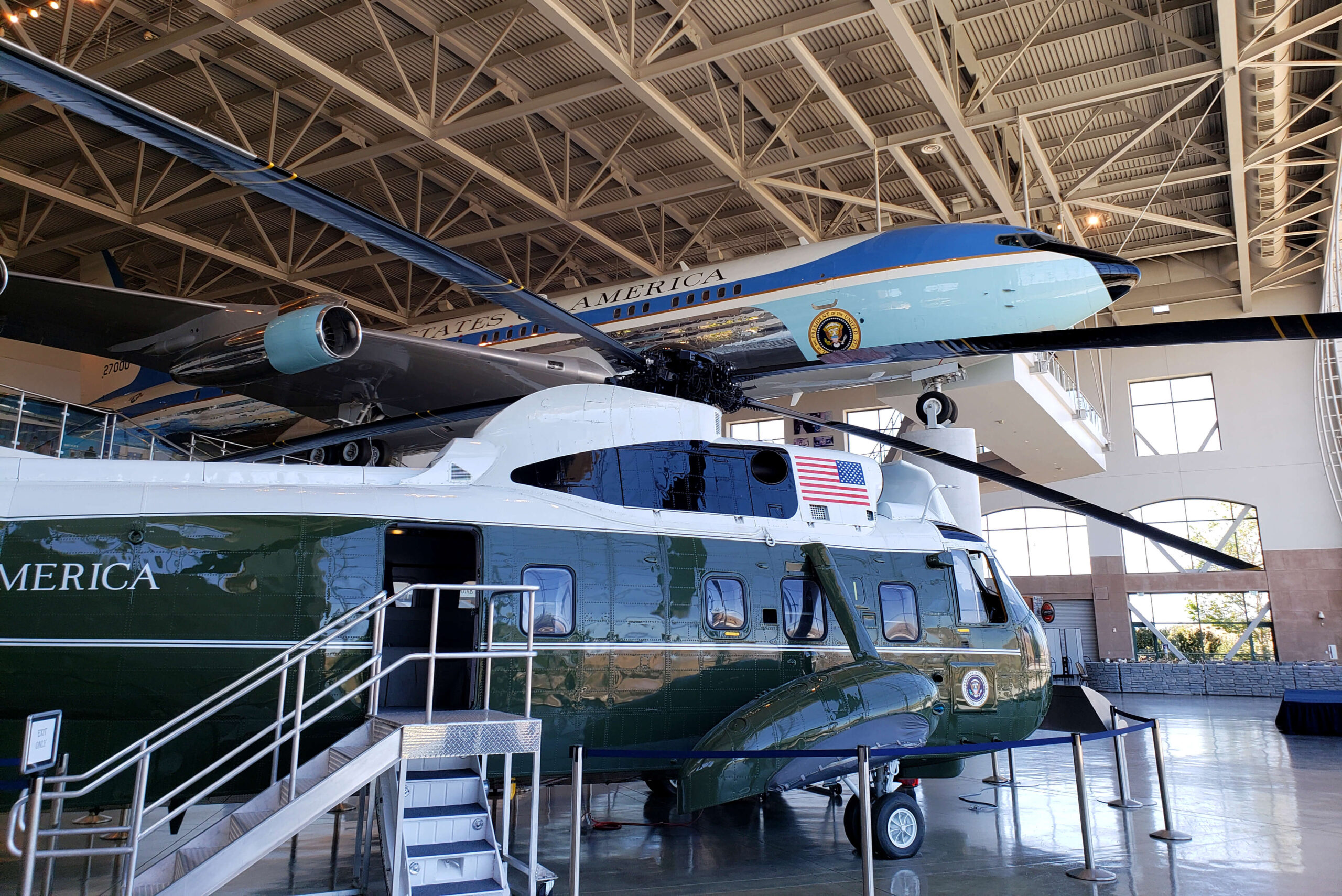
- A 90,000-square-foot, glass-fronted pavilion featuring the Boeing 707 aircraft that was Reagan’s Air Force One. The pavilion, intended to symbolize Reagan’s world travels during his eight years in office, features a progressive display of most of his “face-to-face diplomacy” trips that saw him travel a cumulative 675,000 miles during his two terms. Museum visitors can walk through the length of the plane, the interior of which has been restored to the configuration of Reagan’s time. The Air Force One pavilion has become a favorite location for Republican presidential primary campaign debates, starting with the 2012 campaign.
- A replica of an Irish pub Reagan visited at his ancestral Irish village of Ballyporeen, at which visitors can order lunch and a pint.
- Exhibits on Reagan’s California ranch, use of the presidential retreat at Camp David, Maryland, and his post-presidency culminating with a remembrance of his passing in 2004.
- A large gallery room for visiting exhibits, which the museum has used effectively over the years to attract visitors both new and returning alike. The most recent exhibit in 2025 presented the Dead Sea Scrolls; previous exhibits have featured reflections on the Star Wars films, cowboys in film (one of Reagan’s favorite film genres), and the Holocaust. These special exhibits are usually well-advertised in the greater southern California region.
- The White House Situation Room, used by nine sitting Presidents before being dismantled and reinstalled at the museum. Simulations of crisis management events of the Reagan years are presented to student groups in a role-playing format.
At the Annenberg Presidential Learning Center, attached to the museum, a steady stream of prominent visitors make public appearances, and academic conferences and professional organization meetings are held. The roster of visitors is generally bipartisan, but tends to favor conservatives, including Bret Baier, Ben Shapiro, and Eric Trump, among recent speakers.
Many of the museum exhibit rooms include consideration of the presence and role of First Lady Nancy Reagan, and there is a room dedicated to her own work, including most particularly her “Just say no” anti-drug abuse campaign.
The main two themes of Reagan’s presidency—restoring America’s economy and self-confidence at home and ending the Cold War with a strategy of “peace through strength”—receive focused presentation, with specific rooms dedicated to Reagan’s vision for restoring economic vitality and celebrating American heroes both famous and from the ranks of everyday people. Relating to foreign policy, there is an alcove presenting his famous Berlin Wall speech (“Mr. Gorbachev—tear down this wall!”), a room to mark his four momentous summits with Soviet Communist Party Chairman Mikhail Gorbachev, and an explanation of his “peace through strength” strategy that emphasized both a general military buildup and his proposal for missile defense to make nuclear weapons obsolete. These find their complement in an F-14 Tomcat fighter jet, an F-117 “stealth” Nighthawk jet, and an M-1 Abrams tank on the museum grounds outside, along with a piece of the Berlin Wall.
None. The museum has done a thoughtful job of presenting Reagan as he understood himself.
The Reagan Library is very family friendly and will hold the interest of most young children. In addition, the outdoor grounds and cafes offer welcoming spots for families to enjoy the spectacular views at leisure from the hilltop location before or after formal touring.
As the first “movement conservative” to be elected President, Reagan represents a major milestone in American politics. His election heralded the maturing of the conservative movement, and the decisive end of the dominance of the New Deal Democratic Party coalition.
His four-part economic policy emphasizing tax reform, spending restraint, deregulation, and anti-inflationary monetary policy (which came to be called “Reaganomics”) ended the stagflation of the 1970s and propelled the nation to an economic boom over the next 20 years, led by entrepreneurship and rapid technological innovation.
After two decades of increasing national pessimism, Reagan’s years saw a restoration of the nation’s morale; the 1980s became known as “Morning in America” again. As the first two-term President in two decades, Reagan demonstrated that Presidents can still provide effective leadership in our constitutional system, which had come into doubt at the time he took office.
Overseas, his strategy of “peace through strength” led to the end of the Cold War with the Soviet Union, an expansion of trade, and a new flourishing of democracy in many formerly authoritarian nations. As Reagan’s time in office is now a matter of history rather than firsthand memory for many Americans, the library and museum do an excellent job of presenting the story of Reagan and his enduring significance for American life.
The Ronald Reagan Foundation and Institute has developed an intentional program to preserve, defend, and extend Reagan’s legacy, distinct viewpoint, and leadership style into the future. The Institute hosts an ambitious program of annual events including a National Defense Forum that attracts senior leaders from national government (including cabinet members and senior military officers) and private industry executives. Reagan’s strategy of “peace through strength” is a core theme of these forums. A parallel National Economic Forum brings together top economists and business leaders organized around perpetuating Reagan’s vision for a dynamic entrepreneurial economy based on free markets and sensible fiscal and regulatory policy.
In addition, the Institute has opened a Washington, D.C., office, and is engaging scholars in the study of Reagan, offering research fellowships and year-long post-doctorate positions for young scholars. The Institute sponsors a biennial “Age of Reagan” conference bringing together prominent scholars and up-and-coming historians and political scientists for several days of panel discussions organized around commissioned academic papers. Through these and other efforts, the Reagan Foundation is attracting large interest in working in the adjacent archives, which continues the steady process of organizing Reagan materials and declassifying documents and records related to national security. The archival staff is very helpful and accommodating to visiting scholars, authors, and journalists.
Owned By: Ronald Reagan Presidential Foundation and Institute and The National Archives and Records Administration
Operated By: The National Archives and Records Administration
Government Funded: Yes
Did you know?
Reagan was the first President to hold his inauguration on the west front of the U.S. Capitol. Every President following Reagan has adopted this change.
Recommended Reading
- The Age of Reagan by Steven F. Hayward
- An American Life by Ronald Reagan
Reviewed By
Steven Hayward
Visiting Professor at Pepperdine University’s School of Public Policy, a Fellow of the Public Law and Policy Program at Berkeley Law School and author of The Age of Reagan: The Conservative Counterrevolution: 1980–1989
The opinions expressed above are those of the Reviewer who is providing a good-faith historical assessment to educate the public. Reasonable opinions can vary, and the Reviewer’s opinion is not necessarily the opinion of The Heritage Foundation or its affiliates.