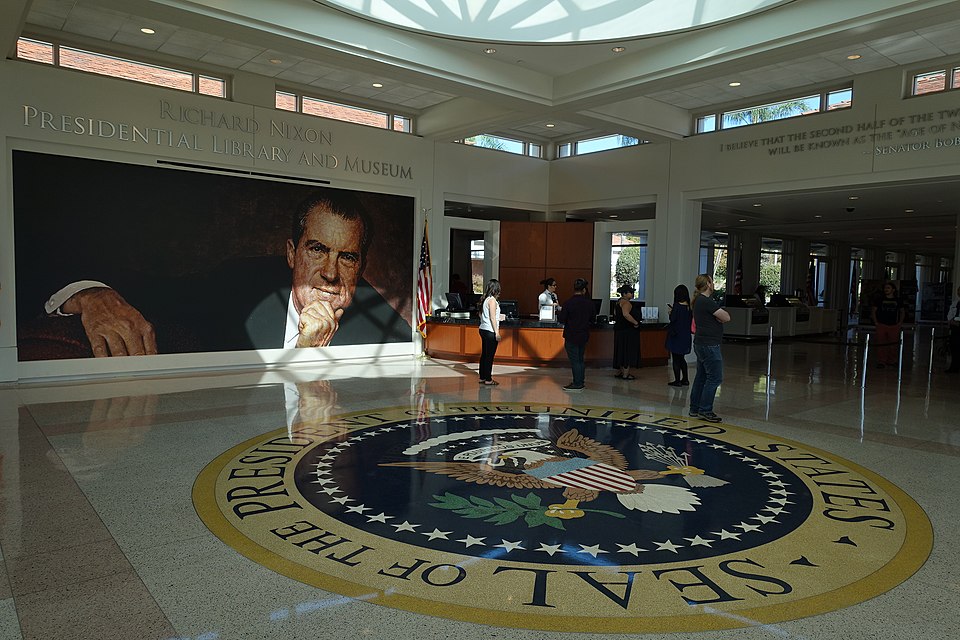
Richard Nixon Presidential Library and Museum
Birthplace of America’s 37th President and the archival center of documents and records of his presidency
Site Details
Pin location is approximate.
18001 Yorba Linda Blvd
Yorba Linda, CA 92886
Family Friendly?
Yes
Visitors Per Year
55,000
- Touring the main museum and library is self-paced, though there is a short 15-minute documentary at the start of the museum’s walkthrough that discusses the nuances of Richard Nixon’s personality, career, and legacy and several audio-visual presentations throughout the museum. The museum offers insights into Nixon’s ideas about foreign policy and strategy, and his own philosophy of leadership. Different exhibits on foreign policy include coverage of Nixon’s work to end the Vietnam War, his legacy in the Middle East conflict and peace process, and his work to separate China from the Soviet Union. Domestic exhibits include coverage of his environmental legacy and conservation efforts, and his work on civil rights and in the ratification of Title IX. The full self-paced tour will take the typical visitor about two hours.
- Visitors are provided with maps of the exhibits, and digital stops with additional explanations are available throughout the museum at different displays.
- Outside of the main museum is Nixon’s birthplace and final resting place, alongside his wife Pat. The outside includes a courtyard, fountain, and garden along with Nixon’s Marine One helicopter.
- The museum often has rotating specialty tours, as well as different scheduled events, throughout the year.
The museum as a whole is well balanced and professional. Artifacts of Nixon’s presidency and personal life are mixed with primary documents and scholarly explanations on display. The museum presents President Nixon as an empathetic human being and leader. Visitors can view photos and personal artifacts from Nixon’s life, ranging from gifts he received from foreign leaders and celebrities to items from his military service and law practice before his entry into politics.
The Watergate scandal is covered in depth through one set of displays, though it does not overwhelm the overall narrative that the museum offers about Nixon’s life.
The site avoids ideological framing; instead, it provides a nuanced interpretation of Nixon’s presidency and his era in American history and politics by covering his legacy in foreign and domestic policy, and by offering presentations about his character and leadership style.
The Nixon Presidential Library and Museum is comfortable in size for easy movement and sits in a single-story complex open to the public. Within the center of the grounds is Nixon’s childhood home and final resting place, along with a garden and fountain that is family friendly and walkable. It must be noted that there are few aspects to the museum and library that are meant for young children, though it is suitable for older children and teenagers. Still, the museum and library do an excellent job of explaining the upheaval of the 1960s and 1970s, an area of American history not commonly studied.
Richard Milhous Nixon (1913–1994) served as America’s 37th President and was in office from 1969 to 1974. Nixon served as Vice President in the Dwight D. Eisenhower Administration (1953–1961) before losing the 1960 presidential election to John F. Kennedy, only to become President years later. Nixon’s time in office not only shaped America’s Cold War legacy in foreign policy but also coincided with one of the most tumultuous periods of American history, characterized by political polarization, the Vietnam War, and the civil rights era.
Born and raised as a Quaker in California, Nixon is one of two Presidents from the Golden State, the other being Ronald Reagan (1911–2004). Nixon served in the U.S. Naval Reserve during World War II in the Pacific, reaching the rank of Commander before his discharge in 1946. After serving in the Eisenhower Administration as Vice President, Nixon lost the 1962 race for governor of California and nearly retired from politics before winning the 1968 presidential election.
Nixon’s foreign and domestic policies remain relevant today. As an opponent of Communism, Nixon pursued a realist foreign policy and is known for his unexpected and historic visit to China, establishing relations with the country, and separating Communist China from its alliance with the Soviet Union. Nixon ended the Vietnam War and transformed the U.S. military into the all-volunteer force we have today. Domestically, Nixon helped enshrine protections for women’s sports when he signed Title IX into law in 1972 and built upon the conservationist legacy of Theodore Roosevelt by establishing the Environmental Protection Agency.
Nixon resigned from office in 1974 as a result of the Watergate scandal. In 1972, a break-in at the Democratic National Committee headquarters at the Watergate Hotel was later found to be tied to Nixon’s re-election campaign. The ensuing scandal and Nixon’s resignation led to an erosion of trust in government. Nixon was succeeded by his Vice President, Gerald R. Ford. After his time in office, Nixon turned to writing extensively about foreign policy and leadership and was consulted by subsequent Republican and Democratic Presidents alike until his death in 1994.
Owned By: Richard Nixon Foundation and the National Archives and Records Administration (NARA)
Operated By: Richard Nixon Foundation and the National Archives and Records Administration (NARA)
Government Funded: Yes
Did you know?
Richard Nixon redesigned the Oval Office in blue and gold to reflect his home state of California.
Recommended Reading
- In the Arena: A Memoir of Victory, Defeat, and Renewal by Richard Nixon
- Leaders: Profiles and Reminiscences of Men Who Have Shaped the Modern World by Richard Nixon
- No More Vietnams by Richard Nixon
Reviewed By
Ian Oxnevad
Senior Fellow for Foreign Affairs and Security Studies at the National Association of Scholars
The opinions expressed above are those of the Reviewer who is providing a good-faith historical assessment to educate the public. Reasonable opinions can vary, and the Reviewer’s opinion is not necessarily the opinion of The Heritage Foundation or its affiliates.