National Constitution Center
Only national museum devoted to the U.S. Constitution, exploring its history, principles, and continuing significance.
Site Details
Pin location is approximate.
525 Arch St
Philadelphia, PA 19106
Family Friendly?
Yes
Visitors Per Year
1,000,000
The NCC is a museum, so at its core are a set of permanent and temporary exhibits devoted to various facets of the Constitution and its history.
A visit begins with a 17-minute film describing the Constitutional Convention, the Framers and their aims, the document they produced, and some key constitutional controversies through our history. The film is celebratory and inspiring, though it emphasizes the 14th Amendment, civil rights, and individual rights in general over the structural Constitution. But it is intended for all ages and will leave young visitors with a strong positive impression of the Framers and their work.
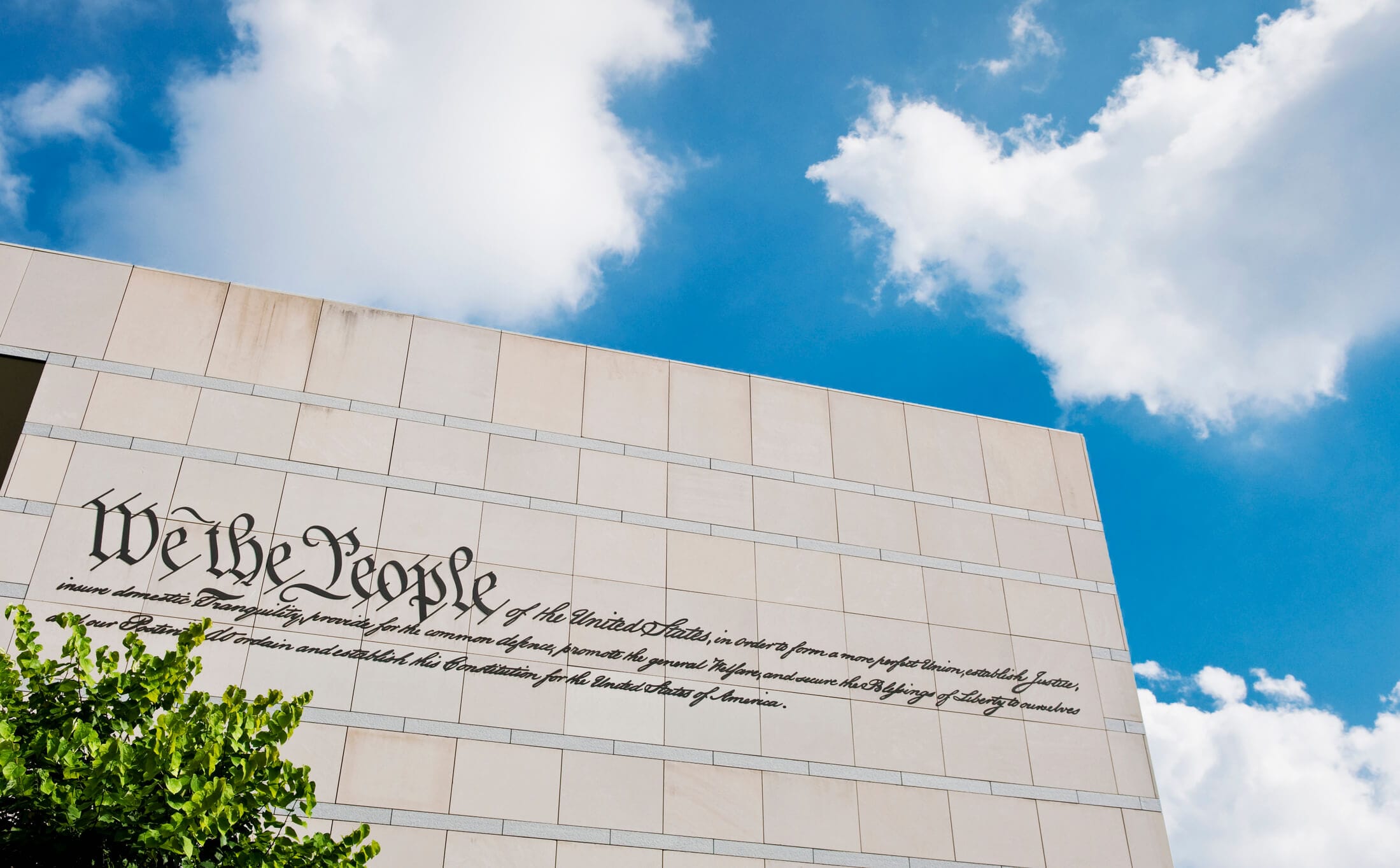
The main permanent exhibit is called “The Story of We the People,” and offers an overview of American history through the lens of the Constitution. Here, too, the emphasis is on civil rights, but generally in a positive and balanced way. The exhibit notes the ways the original Constitution avoided addressing the evil of slavery, but also emphasizes how the Constitution was used as a tool by abolitionists to combat slavery.
A second permanent exhibit is “Signers’ Hall,” which consists of life-sized bronze statues of each of the signers of the Constitution. It is well suited to both younger and older children and does a good job of teaching visitors about the Framers and their priorities.
Temporary exhibits change regularly but tend to emphasize specific historical moments or historical items the museum is able to display for limited periods of time. These can vary in quality, but generally avoid politicized or one-sided presentations. In the summer of 2025, these included exhibits on the Civil War and reconstruction (which used Lincoln’s rhetoric superbly), James Wilson’s handwritten drafts of the Constitution, and the history of the 19th Amendment giving women the vote.
The NCC is excruciatingly evenhanded, for better or worse. Nearly every claim made comes with caveats and counterpoints. This is sometimes excessive, but on the whole, it is a welcome departure from the usual one-sidedness of contemporary historical sites, and the exhibits are clearly produced with input from scholars and from all sides of the political spectrum. It is, if anything, too careful in seeking balance, sometimes failing to make clear assertions about historical facts. But overall, that balance is welcome.
The arc of American history as described in the key exhibits is fundamentally a story of expanding individual rights. There is truth to that description, of course. But by minimizing the importance of constitutional structure, the NCC fails to inform visitors of significant departures from traditional constitutional practice beginning in the Progressive Era and continuing over the past century and beyond. In this sense, the constitutional narrative offered is neither a left-wing nor a right-wing narrative. It is overtly celebratory of our constitutional tradition (and in that sense does not embrace the left-wing narrative of corrupt origins), but it treats the Progressive turn as part of that tradition (and does not embrace the right-wing narrative of a radical departure from traditional constitutional practice). This is a defensible approach for a museum intended for general audiences and especially students, but it does leave out some crucial constitutional challenges. Biases have more to do with omission than commission, therefore.
The museum is designed and operated with school-aged children in mind above all, but it is plainly intended especially for middle- and high-school aged children and could be a challenge for younger children.
In terms of content, the museum offers parents helpful guidance about which exhibits are most appropriate for what ages, and for the most part this guidance seems accurate and well conceived. A temporary exhibit that touches on the abortion debate, for instance, is clearly marked for parents of younger children, and is easy for them to avoid.
Exhibits are relatively easy to follow, and children are prompted with useful questions and guideposts. The museum is often full of school-aged children who are largely engaged and enjoying themselves. But there is no helping the fact that the substantive content and subject will not naturally interest the youngest visitors.
The NCC is in the heart of historical Philadelphia, and so is easily reachable and a natural complement to a visit to Independence Hall and other familiar attractions. Note, however, that parking in the vicinity is a challenge.
The Constitution, one of the fundamental frameworks of American public life, is the organizing charter of our national government. Being an informed and engaged American citizen requires knowledge of the document, its history, its core ideas, and its importance. In this sense, a national museum of the Constitution is vitally needed. Such a museum should help Americans understand the history of our republic through a constitutional lens, but it should also help them grasp the structure of our system of government and the assumptions that underlie it. The American Constitution is built to facilitate the political life of a vast and diverse free society, and it does that especially by driving competing factions in our politics into structured processes of negotiation and accommodation. Appreciating this extraordinary service performed by our Constitution can help Americans appreciate the achievement that is our enduring system of government, and the reasons to sustain and strengthen it.
Owned By: National Constitution Center
Operated By: National Constitution Center
Government Funded: Yes
Did you know?
George Washington’s willingness to serve as President of the Constitutional Convention of 1787 was an essential precondition for the drafting and adoption of the U.S. Constitution.
Recommended Reading
Ratification: The People Debate the Constitution by Pauline Maier
Reviewed By
Yuval Levin
Director of Social, Cultural, and Constitutional Studies at the American Enterprise Institute
The opinions expressed above are those of the Reviewer who is providing a good-faith historical assessment to educate the public. Reasonable opinions can vary, and the Reviewer’s opinion is not necessarily the opinion of The Heritage Foundation or its affiliates.