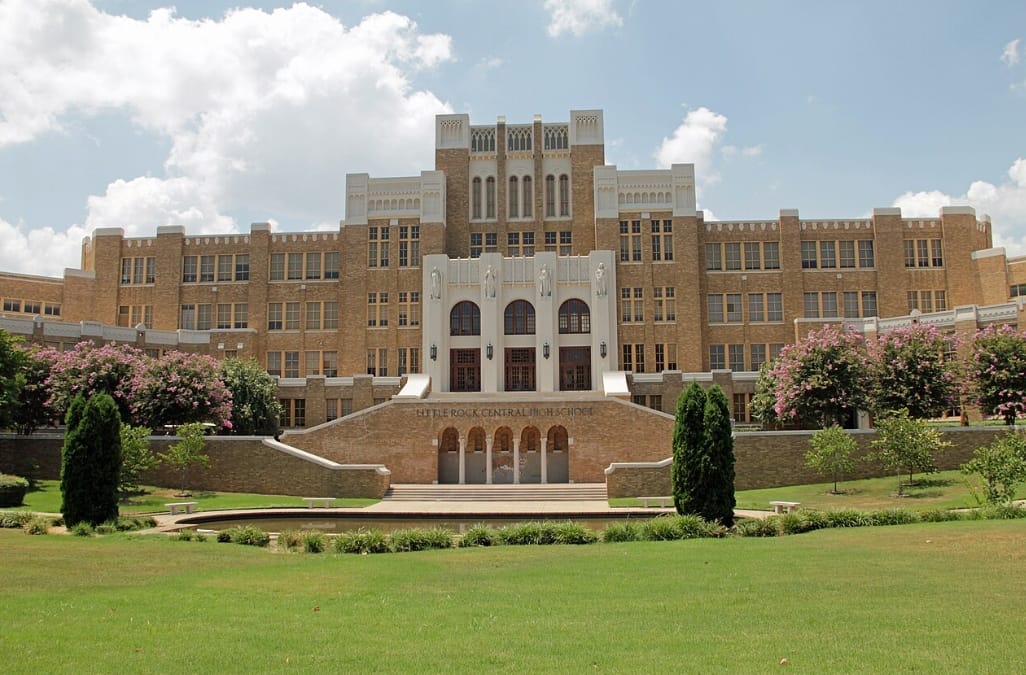
Little Rock Central High School National Historic Site
Site of major conflict over school integration
Site Details
Pin location is approximate.
2120 W Daisy L Gatson Bates Drive
Little Rock, AR 72202
Family Friendly?
Yes
Visitors Per Year
58,571
The National Park Service museum for Little Rock Central High School is across the street from the school building, which still functions as a school. The museum consists of a series of displays in a large room divided into sections. Those displays provide the history of the struggle for equal protection under the law and the effort to integrate public schools. Reading those displays and examining the images may take up to an hour.
The National Park Service also offers a presentation by a park ranger and a guided tour of the exterior of the high school. The presentation, which lasts about an hour, consists of a slide show and discussion organized by the rangers at that site in a small conference room. The guided tour of the exterior of the high school takes another hour during which the ranger recounts the events of the stand-off over integrating the school and describes the personal accounts of the nine black students who sought to attend the previously all-white high school in the fall of 1957.
This history is presented in the displays in a way that is consistent with how it is described in most history textbooks. There were also displays profiling issues related to farm workers, women’s rights, and people with disabilities, suggesting that these were all part of the same struggle for equality, and, by exclusion, other causes were not.
The ranger-led discussion and tour, however, was more simplistic and imbalanced. Opponents of integration were presented as caricatures, described in mocking tones. Racists of the 1950s were human beings whose motivations and complexities should be understood even if their actions should not be emulated. The ranger identified the problem as inherent racism, adding that if one was not an antiracist, actively combating racial injustice, it was the same as being a racist.
The compelling story of the Little Rock Nine is distorted at this site in two notable ways:
- The displays and ranger-led discussion fail to acknowledge the extent to which the Declaration of Independence and Constitution advanced the cause for human dignity and equality even as they fell short of that ideal when first authored. This gives the false impression that these documents and, by extension, the Founding of the U.S. were the causes of racism and inequality as opposed to steps toward their solutions. Following the Civil War, legal protections were expanded with the 13th and 14th Amendments, but the end of Reconstruction, the passage of Jim Crow laws, and the implementation of “Separate but Equal” policies upheld by the Supreme Court in Plessy v. Ferguson limited the extent to which blacks could benefit from their rights. Following the Brown v. Board of Education decision overturning Plessy, efforts to integrate public schools sometimes faced large and organized opposition, as was the case at Central High School.
- Featuring the plight of farm workers, women’s rights, and people with disabilities gives the false impression that these, and only these, causes are part of the same struggle for human dignity and equality. These are simply the causes championed by the Left. The fight for religious liberty, for life, and for parents’ rights could also be presented as part of the struggle for human dignity and equality but are not featured for ideological reasons.
The accounts of what the Little Rock Nine experienced can be upsetting. The ranger-led tour included the repetition of racist slurs used by people trying to block the Little Rock Nine from entering the school. Those slurs are an important part of the history, but can be uncomfortable for children. The museum includes large displays with written text, which would be difficult for young children to read and understand. The fact that the main historical incident revolves around a group of young people trying to enroll in a school can be interesting and inspiring to other young people.
Little Rock’s Central High School was the scene of a high-profile struggle over racial integration in public schools in 1957. Both the backers of integration, including most prominently the NAACP, and the opponents of integration, selected Little Rock’s Central High School as a test case to determine the extent to which the Supreme Court’s decision in Brown would be implemented in practice. Nine black high school students attempted to enroll in Central High school in the fall of 1957 but were initially blocked by crowds of protesters and the National Guard operating under orders of Governor Orval Faubus. Eventually, President Eisenhower sent troops from the 101st Airborne division and then nationalized the National Guard to ensure that the students could enter the school, where they still faced very rough treatment.
That controversy raised, and eventually helped settle, questions over what equal protection under the law required. The controversy also involved disputes over the relative powers of the state and national governments, with federal troops being used to quell domestic disturbances. In addition, the personal stories of the nine black students who sought to enroll at the previously all-white school emphasize the bravery, sacrifice, and suffering they endured in these disputes.
Owned By: The National Park Service
Operated By: The National Park Service
Government Funded: Yes
Did you know?
There were initially 10 black students who attempted to integrate Central High School in 1957, but the intense pressure caused one student to abandon the effort before entering the school.
Recommended Reading
- Little Rock on Trial: Cooper v. Aaron and School Desegregation by Tony A. Freyer
- A Mighty Long Way: My Journey to Justice at Little Rock Central High School by Carlotta Walls LaNier
Reviewed By
Jay P. Greene
Former Senior Research Fellow in the Center for Education Policy at The Heritage Foundation
The opinions expressed above are those of the Reviewer who is providing a good-faith historical assessment to educate the public. Reasonable opinions can vary, and the Reviewer’s opinion is not necessarily the opinion of The Heritage Foundation or its affiliates.