Fort Moultrie National Historical Park
Fort Moultrie is a historic fort originally built in 1776 to defend the port of Charleston. The Fort, with only 31 cannon, defeated a British fleet of nine warships on June 28, 1776, under the command of General William Moultrie, one of the Patriots’ first victories in the Revolutionary War.
Site Details
Pin location is approximate.
1214 Middle St
Sullivan's Island, SC 29482
Family Friendly?
Yes
Visitors Per Year
200,000
- The Visitors’ Center has a small gift shop and two large rooms of exhibits. The displays in the exhibition rooms are very informative and engaging, though some are quite tall and can be difficult to read.
- There is a 22-minute video that explains the story of Fort Moultrie’s role in coastal defense for over 200 years from the Revolutionary War, through the Civil War, and up to the end of World War II. The video features a single actor in period costume who narrates each major period of the fort’s history. The video, dating from 1976, has some strengths and weaknesses. It provides a fairly substantive historical account free of contemporary ideological tint. However, the presentation is a bit corny and occasionally veers into an incoherent dramatization.
- After viewing the displays in the Visitors’ Center, visitors cross the street to enter the actual fort. The remains of the fort are located on the beachfront of Sullivan’s Island. There are volunteers at the entry of the fort to give some direction and a brief history, and they are generally knowledgeable and helpful.
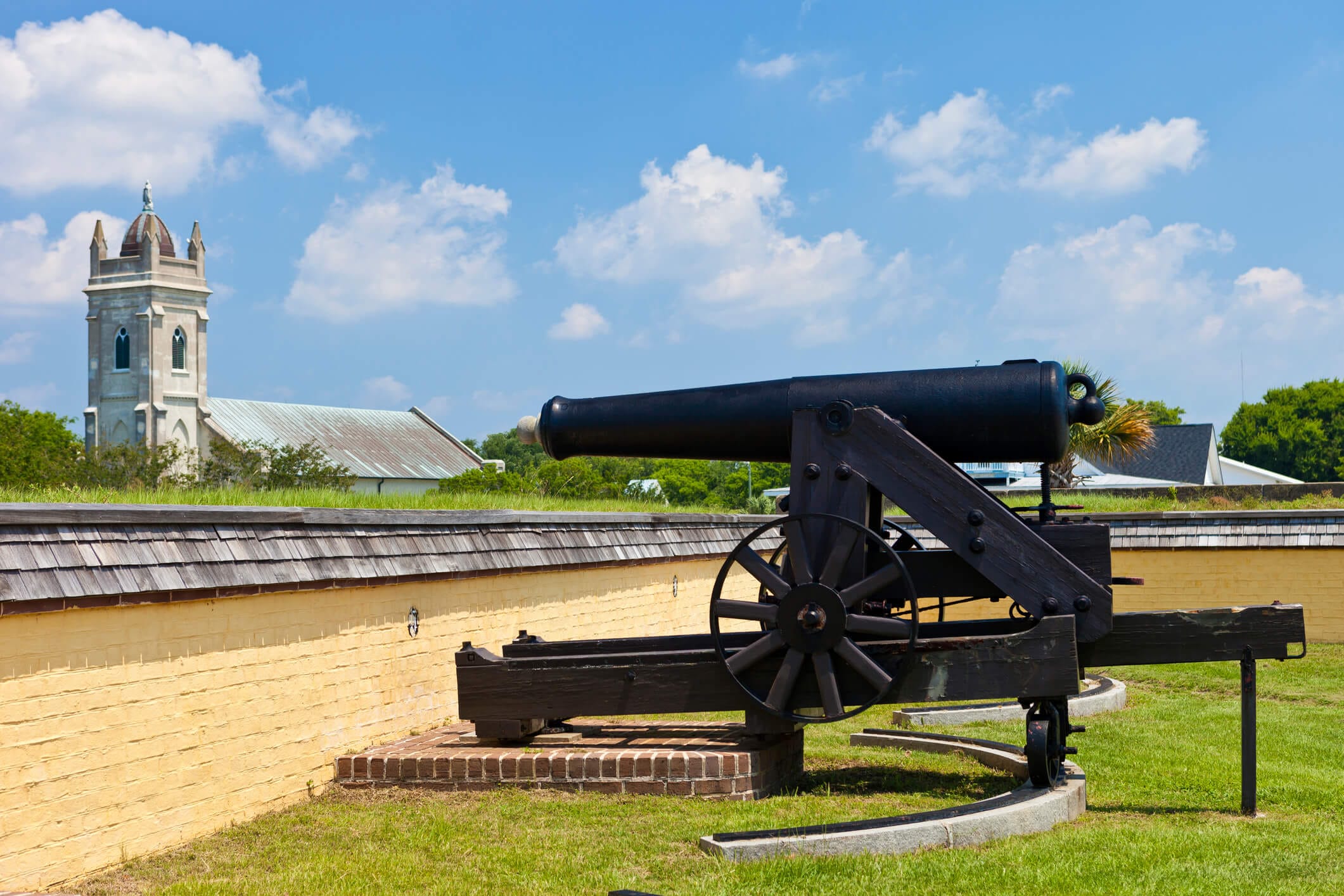
- The fort displays an impressive collection of artillery from the 17th century to the 19th century, including 10-inch Rodman cannon, 10-inch Columbiad cannon, 8-inch Parrot rifles, 7-inch Brooke rifle, and a 12-inch Napoleon Confederate cannon. A 90mm M1A2 Modern Anti-Aircraft Gun is no longer on display at Fort Moultrie and is currently on loan to Fort Mott State Park in New Jersey.
- One of the most intriguing displays at the site is the reproduction of the WWII Army and Navy Harbor entrance control post observation room. During the war, all entry and exit from the port of Charleston was closely monitored. The Radio Room provided a direct communication line between all elements of the harbor defense system. It was constantly manned by two men, one Army and one Navy, who would respond to all sightings of enemy vessels and distress signals coming from ships. Their primary duty was to take immediate action against any suspected enemy activity within the defense sector. Furniture and decor give the visitor a realistic experience of the period with the benefit of an air-conditioned environment.
- Adjacent to the historical exhibits that focus strictly on the history of the fort, there is a small exhibit entitled “The Gullah Geechee Cultural Heritage Corridor,” which includes an account of West African slavery, as Sullivan’s Island was, in fact, an entry point and quarantine station for West Africans who were brought to the Carolina colony during the Middle Passage.
There are no apparent inaccuracies or misrepresentations of events among the exhibits, video, or literature offered by the National Park Services. In fact, the detail provided by the exhibits is very thorough and provides substantive context for each period, yet remains engaging. Finally, the Park Rangers are quite knowledgeable and provide very well-informed answers when asked about details of historic events pertaining to the fort.
There is very little ideological bias in the Fort Moultrie exhibits, and even the majority of its book offerings are relatively fair, though a few seem like a bit of a stretch in the service of political correctness, such as Alexis Bunten’s What Your Ribbon Skirt Means to Me: Deb Haaland’s Inauguration, a children’s book about the first Native American to serve as U.S. Interior Secretary, and Incidents in the Life of a Slave Girl by Harriet A. Jacobs, a firsthand account detailing Jacobs’ life as an enslaved woman in North Carolina.
The exhibit on slavery is appropriate, given slavery’s prominent role in Charleston, South Carolina. Some have criticized the inclusion of the former slave and abolitionist Olaudah Equiano in the exhibit, particularly the following quote from his 1789 autobiography: “The first object which saluted my eyes when I arrived on the coast was the sea, and a slave ship, which was then riding at anchor, and waiting for its cargo. This filled me with astonishment, which was soon converted into terror.” Featuring Olaudah Equiano in the display, given his tangential connection to Charleston, is arguably a bit of a stretch at Fort Moultrie. On the other hand, recent scholarship now contends that he was born in South Carolina, thus giving him some relevance. On the whole, the exhibit is quite fair and does not push a strong ideological agenda.
Fort Moultrie is very family friendly. It is located on Sullivan’s Island, with close access to the beach and lots of space to explore. Exhibits are all very accessible to young children, and the gift shop offers a good collection of books and other items suitable for children. Of course, Charleston can be brutally hot in the summer, and much of the site is outdoors, so families should plan accordingly.
Fort Moultrie served as a critical seacoast fortification throughout much of American history. It played a critical role in the Revolutionary War in 1776, protecting the vital port of Charleston from British invasion. Constructed of sand and palmetto logs, it proved to be surprisingly resilient in its ability to withstand attack, as the palmetto fibers absorbed the shock of cannon balls without splitting the wood. Artillery fire literally “bounced” off the primitive palmetto fortifications. The Americans succeeded in repulsing the British attack under the brave leadership of Captain William Moultrie of South Carolina. Unable to pierce the fort’s defenses, a British fleet under the command of Admiral Peter Parker and General Henry Clinton turned back in defeat. The British avoided the fort for the remainder of the Revolutionary War and eventually took Charleston from the south.
In 1829, the more imposing Fort Sumter was built to complement Ft. Moultrie in providing seacoast protection for the port of Charleston. When South Carolina formally declared its secession from the Union in 1860, the Union Army stationed at Fort Moultrie under the command of Major Anderson abandoned the fort for the superior defenses of Fort Sumter. The Confederacy took control of Fort Moultrie and used it as a base to attack Fort Sumter at the beginning of the Civil War. It remained a critical defensive post for the Confederacy against Union ships between 1863 and 1865.
Following the creation of the Endicott system of seacoast fortifications, Fort Moultrie became part of a modernized system of coastal fortifications that included the construction of concrete fortifications armed with large, breech-loading, rifled guns mounted on disappearing carriages, along with minefields, rapid-fire guns, and searchlights. The system was designed to protect harbors from naval attack by concealing large guns and effectively using minefields and rapid-fire weapons to deter and defeat enemy vessels. Fort Moultrie continued to be a critical part of U.S. seacoast defenses through WWII, when it protected Charleston harbor from German U-boats.
Owned By: National Park Service
Operated By: National Park Service
Government Funded: Yes
Did you know?
South Carolina is known as the Palmetto State in homage to the palmetto logs of Fort Moultrie that proved to be largely impenetrable and prevented the British from successfully launching an assault against the colonial troops in the Battle of Sullivan’s Island in 1776. The state flag today is the flag designed by William Moultrie, who flew a crescent moon on a blue field from atop the fort in the battle with the British Royal Navy.
Recommended Reading
- Fort Moultrie: A Constant Defender by Jim Stokeley
- Unsung: William Moultrie and the Battle of Sullivan’s Island by Norm Rickeman
- Reminiscences of Forts Sumter and Moultrie in 1860–’61 by Abner Doubleday
Reviewed By
David Alvis
Professor of Political Science at Wofford College
The opinions expressed above are those of the Reviewer who is providing a good-faith historical assessment to educate the public. Reasonable opinions can vary, and the Reviewer’s opinion is not necessarily the opinion of The Heritage Foundation or its affiliates.