Tuskegee Airmen National Historic Site
Site preserving the training grounds of America’s first black military aviators, who overcame segregation to become one of the most distinguished fighter groups of World War II
Site Details
Pin location is approximate.
1616 Chappie James Ave.
Tuskegee, AL 36083
Family Friendly?
Yes
Visitors Per Year
25,000-30,000
The self-guided tour lasts about an hour. Visitors begin on a walkway with a sweeping view of the sprawling Moton Field and facilities where much of the initial training was held. The airfield was built by the Tuskegee Institute in 1941 with a contract from the U.S. Government to build a facility to train black pilots.
A bust of Robert Moton (the field’s namesake) greets visitors at the old main gate. Following the death of Booker T. Washington in 1915, Moton became the head of Tuskegee Institute and served in that capacity until retiring in 1935.
Visitors can also read information signs on the establishment of the airfield, the background on the Tuskegee Airmen, and its importance in World War II. Sidewalks connect to an elevated area that overlooks the airfield, hangars, control tower, skyway club, and other facilities. Metal-framed scaffolding shows the locations of where buildings once stood (“Ghost Structures” including the cadet house and the army supply building).
At the aircraft hangars, visitors will want to view a short five-minute orientation video that reveals the Jim Crow laws in Alabama that separated blacks and whites into separate social spheres. On a national scale, the U.S. Army also enforced racial segregation and held a dim view of the intellectual abilities of blacks to operate sophisticated machinery and fly aircraft. But through the pressure of the civil rights organizations and the black press, the Army established a single training center for black combat pilots on farmland in Tuskegee, Alabama—not far from Tuskegee Institute, a historically black college founded by pioneer educator Booker T. Washington. The orientation film includes clips from the 1945 Army film, “Wings for This Man,” narrated by future President Ronald Reagan (although the film does not identify Reagan as the narrator). The film reveals the extensive infrastructure that included not only pilots, navigators, and bombardiers but also parachute riggers, technicians, mechanics, drivers, instructors, and many others—some 15,000 men and women that kept the planes flying—that produced one of the most respected combat units of World War II.
Aviation enthusiasts can view two training airplanes in Hangar #1, including a beautifully restored PT-17 Stearman, which served as the Army’s and Navy’s primary pilot trainer during the 1930s and 1940s. This bi-plane, single-engine propeller aircraft was also the primary trainer at Moton Field. The plane held two crewmen—the trainee and the instructor—and was powered by a 220hp engine that allowed the aircraft to attain a top speed of 124 mph and maximum altitude of approximately 13,000 feet. The plane is nearly 10-feet tall with a wingspan of just over 32 feet. There is also a restored J-3 Piper Cub, a light-weight single-wing aircraft used by trainees who learned to fly through the Civilian Pilot Training Program (CPTP) prior to entering military service. During the spring of 1941, First Lady Eleanor Roosevelt visited the airfield and, against the advice of the Secret Service, asked Chief Flight Instructor Charles A. Anderson to take her on a flight in the Piper Cub. Roosevelt’s flight was widely covered by the national press and helped build support for black aviation.
Also in Hangar #1, visitors can sit inside a World War II era rudimentary flight simulator with basic controls and switches. The space makes effective use of hands-on experiences including telephones that play recorded oral histories with the airmen and a packing table to fold and bag a parachute. Original uniforms and leather bomber jackets are displayed, as are the flight offices and briefing room—giving visitors behind the scenes glimpses of the type of work conducted during World War II.
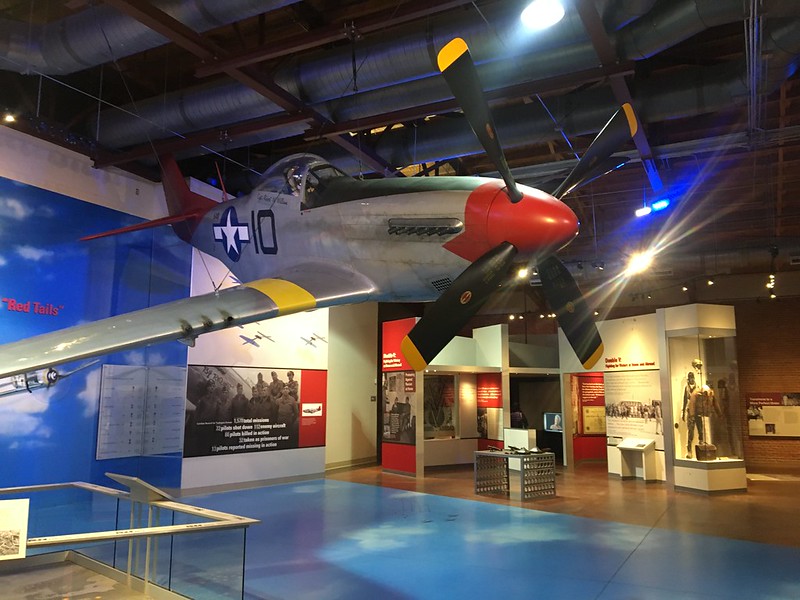
Hangar #2 includes displays emphasizing the “Double V” campaign—a public relations strategy that targeted blacks during the early days of World War II and encouraged them to support the war effort and gain a victory abroad against fascism and a victory at home against racism (Jim Crow). The most prominent feature of Hangar #2 is the P-51 Mustang used extensively by the Tuskegee Airmen assigned to the 99th Pursuit Squadron and the 332nd Fighter Group. They earned the nickname the “Red Tails” for their unique P-51’s with red-painted tails and distinguished themselves on bomber escort missions in the European theater.
One display includes a quote from Major General Edwin J. House who believed that the Tuskegee Airmen should be assigned to state-side coastal patrols and not see overseas action. “The negro type has not the proper reflexes to make a first-class, fighter pilot. . . .” Through their bravery and perseverance, the airmen overcame racism and low expectations to compile an impressive flight record that included 1,578 sorties and shooting down 112 enemy aircraft. Sixty-six of the airmen died in combat, while 32 were held as POWs, and 13 were missing. Although Hangar #2 is a reconstruction, the airfield’s original control tower is connected to the building. Energetic types can climb the three flights of stairs to get a 360-degree view of the airfield and buildings.
The Tuskegee Airmen National Historic Site provides visitors with an accurate and balanced look at the role black pilots played during World War II. This site is focused just on the role of the airmen and does not provide a comprehensive look at World War II.
Unlike many museums and historical sites that deal with racial issues, the Tuskegee Airmen National Historic Site avoids ideological biases, presentism, and social justice activism. Much of it is an unbiased look and celebration of the men who earned their pilots’ wings and courageously fought to preserve the freedoms and opportunities that they were often denied.
The Tuskegee Airmen National Historic Site is family friendly and will be of interest to children who enjoy aircraft, walking, and exploring. The site focuses on the role of the Tuskegee Airmen during World War II and should perhaps be paired with a visit to the nearby Tuskegee Institute and the Alabama state capitol in Montgomery (approximately a 30-minute drive).
The Tuskegee Airmen National Historic Site is historically significant because it was the site where the first black Americans were trained as military pilots—at a time when the military was segregated by race. Denied equality at home yet entrusted with defending democracy abroad, these men used discipline, skill, and courage to reveal that patriotism was not defined by race but by commitment to serving a nation at war. Each successful mission represented an individual triumph over prejudice, while their collective achievements strengthened the American war effort and advanced the nation’s moral cause. In pursuing victory in World War II, the Tuskegee Airmen not only helped defeat fascism overseas but also expanded the meaning of American freedom itself, demonstrating that the promise of the nation was strongest when it moved closer to its ideals. They broke down racial barriers in the segregated military, proved black Americans could excel in aviation, showed courage and gave exceptional service during World War II, and contributed to the integration of the armed forces in the post-war period.
Owned By: The National Park Service
Operated By: The National Park Service
Government Funded: Yes
Did you know?
The historical site is near Booker T. Washington’s Tuskegee Institute.
Recommended Reading
- Freedom Flyers: The Tuskegee Airmen of World War II by Todd Moye
- The Tuskegee Airmen Story by Lynn Homan
Reviewed By
S. Jonathan Bass
Professor of History and University Historian at Samford University
The opinions expressed above are those of the Reviewer who is providing a good-faith historical assessment to educate the public. Reasonable opinions can vary, and the Reviewer’s opinion is not necessarily the opinion of The Heritage Foundation or its affiliates.