Yorktown
Site of the final major battle of the War for American Independence
Site Details
Pin location is approximate.
1000 Colonial Nat'l Historical Pkwy
Yorktown, VA 23690
Family Friendly?
Yes
Visitors Per Year
2,550,000
Yorktown Battlefield:
- The visitors’ center has an excellent 16-minute film that provides a good overview of the battle.
- The visitors’ center has a small museum with interesting artifacts and a reproduction of a British battleship that visitors can walk through.
- Interpretive rangers provide an excellent 45-minute overview of the battle and are responsive to questions.
- There is a 45–60-minute car ride to six major battlefield sites.
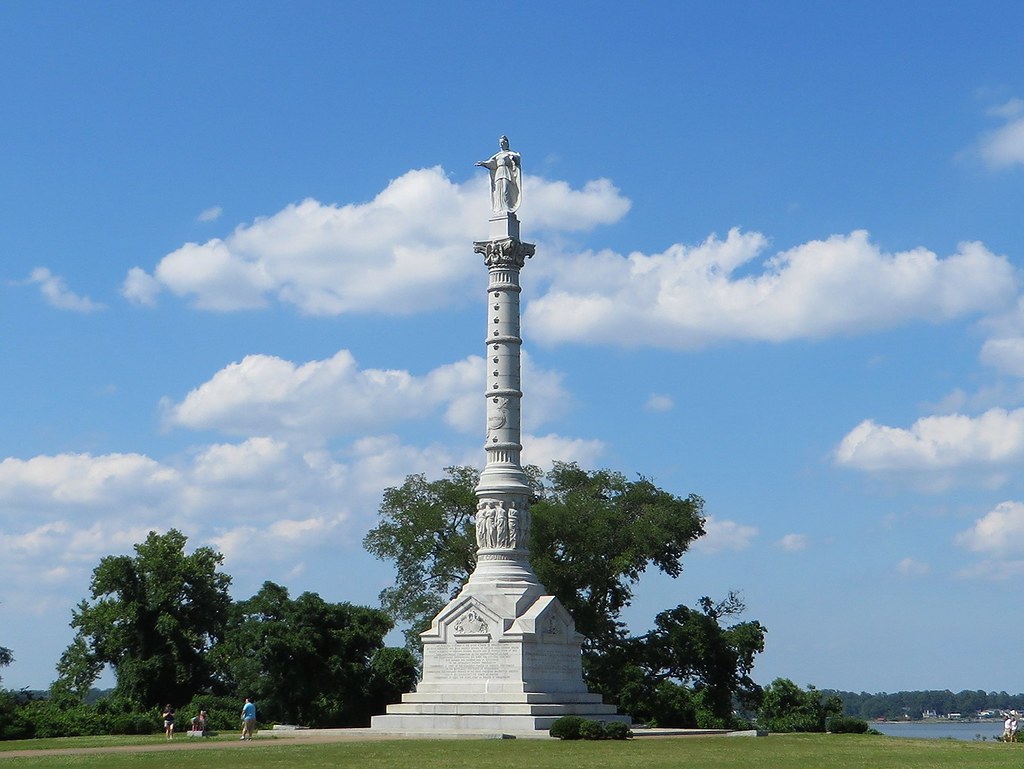
- The Yorktown Victory Monument is a beautiful monument erected in 1884 to commemorate Washington’s important victory.
- There are periodic fife and drum shows.
- On many Saturdays and Sundays, reenactors fire a Revolutionary-era cannon.
American Revolution Museum at Yorktown:
- The museum has a good 30-minute film that provides a solid overview of the War for American Independence.
- The museum contains excellent galleries filled with artifacts and reproductions. Informative signs provide an excellent overview of the Revolutionary War with a focus on the Declaration of Independence. In addition, the museum also provides good coverage of events before and after the war, including the French and Indian War and the creation and ratification of the United States Constitution.
- There are displays covering daily life in the era, e.g., what living conditions were for enslaved Americans, “middling” Americans, and wealthy Americans.
- The museum offers an app that can be downloaded at no cost that offers custom tours for visitors, e.g., the Patriots’ tour, the Loyalists’ Tour, and the Kids’ Tour.
- Outside the museum are replicas of a Revolutionary-era army encampment and a working colonial era farm, both of which frequently feature reenactors who engage visitors and make presentations on various matters, including how to load and shoot a musket, medicine and surgery in the Revolutionary War, and cooking in an army encampment.
Yorktown Battlefield: The introductory movie, signage at the museum, and the presentation by the interpretive ranger are solid, accurate, and provide an excellent overview of the battle and its significance. A military history buff might want a more comprehensive description of the battle, but everyone else (even history buffs) will be satisfied.
American Revolution Museum at Yorktown: The introductory movie, signage at the museum, and the presentation by the reenactors were all accurate. The galleries provide a very comprehensive overview of the founding era with a focus on the Revolutionary War, its causes, the Declaration of Independence, and the creation of America’s constitutional order. If one were to read every sign carefully, he or she could easily spend four hours in the Museum.
Yorktown Battlefield and American Revolution Museum at Yorktown: The movies at both institutions and the park ranger’s presentation make references to what the War for American Independence did not accomplish, i.e., the end of slavery, women’s suffrage, and just treatment of Native Americans. The handling of these subjects was accurate and not overly ideological. Overall, presentations at both sites were balanced and fair.
Yorktown Battlefield: Families with children six years old and older will probably want to watch the movie, visit the small museum, hear the park ranger, and drive around the battlefield, which will take about two hours. They could then walk to Yorktown (which takes about 15 minutes), where there are fine old houses, good dining for lunch, and a beach. On many Saturdays and Sundays, reenactors fire a Revolutionary Era cannon.
American Revolution Museum at Yorktown: Families with children six years old and older will probably want to watch the movie, spend 45 minutes in the museum galleries, and then spend 90 minutes visiting the army encampment, working farm, etc. There are a wide range of presentations by reenactors that will keep children’s attention. For example, the reenactors explained different types of cannon used in the war and took volunteers (children) from the audience to load it. After the children were safely back in their seats, the reenactors fired it (without a cannon ball, of course). This activity was a crowd favorite.
In both places, the minds of children under six will probably start to wander quickly, but at least they are outside and can run around at each site. Interacting with the reenactors may keep the attention of younger children for a bit longer than, say, museum displays.
Combining these sites and perhaps a trip to the beach at Yorktown would make for an excellent day that would not exhaust even families with younger children. Yorktown is also less than 30 minutes from Jamestown, which has two good sites that could also be visited in a single day, as well as Colonial Williamsburg.
Yorktown Battlefield: The Battle of Yorktown (1781) ended major military operations in the War for American Independence. It began with French Admiral de Grasse defeating the British navy in the Battle of the Capes and ended with Lord Cornwallis surrendering his army to General George Washington.
American Revolution Museum at Yorktown: The museum has a wide range of original artifacts and replicas. A visitor who knows nothing about the War for American Independence could spend half a day there and come away with a very solid overview of it.
Owned By:
Yorktown Battlefield: The National Park Service
American Revolution Museum at Yorktown: The Jamestown-Yorktown Foundation
Operated By:
Yorktown Battlefield: The National Park Service
American Revolution Museum at Yorktown: The Jamestown-Yorktown Foundation
Government Funded: Yes
Did you know?
Alexander Hamilton, whose image is on the $10 bill, won military glory at Yorktown when he led the troops that captured the strategic redoubt #10 (part of the British defenses) which he accomplished in 10 minutes.
Recommended Reading
- Victory at Yorktown: The Campaign That Won the Revolution by Richard Ketchum
- In the Hurricane’s Eye: The Genius of George Washington and the Victory at Yorktown by Nathaniel Philbrick
- The Battle of Yorktown by Dennis Fradin
- The World Turned Upside Down: George Washington and the Battle of Yorktown by Richard Ferrie
Reviewed By
Mark David Hall
Professor in Regent University’s Robertson School of Government
The opinions expressed above are those of the Reviewer who is providing a good-faith historical assessment to educate the public. Reasonable opinions can vary, and the Reviewer’s opinion is not necessarily the opinion of The Heritage Foundation or its affiliates.