The Alamo
Former Spanish mission and site of the pivotal 1836 Battle of the Alamo during the Texas Revolution
Site Details
Pin location is approximate.
300 Alamo Plaza
San Antonio, TX 78205
Family Friendly?
Yes
Visitors Per Year
1,600,000
The Alamo is an iconic historical landmark and well worth visiting. The presentations and experiences available provide visitors with a sense of the drama and the historical importance of the Battle of the Alamo for Texan independence.
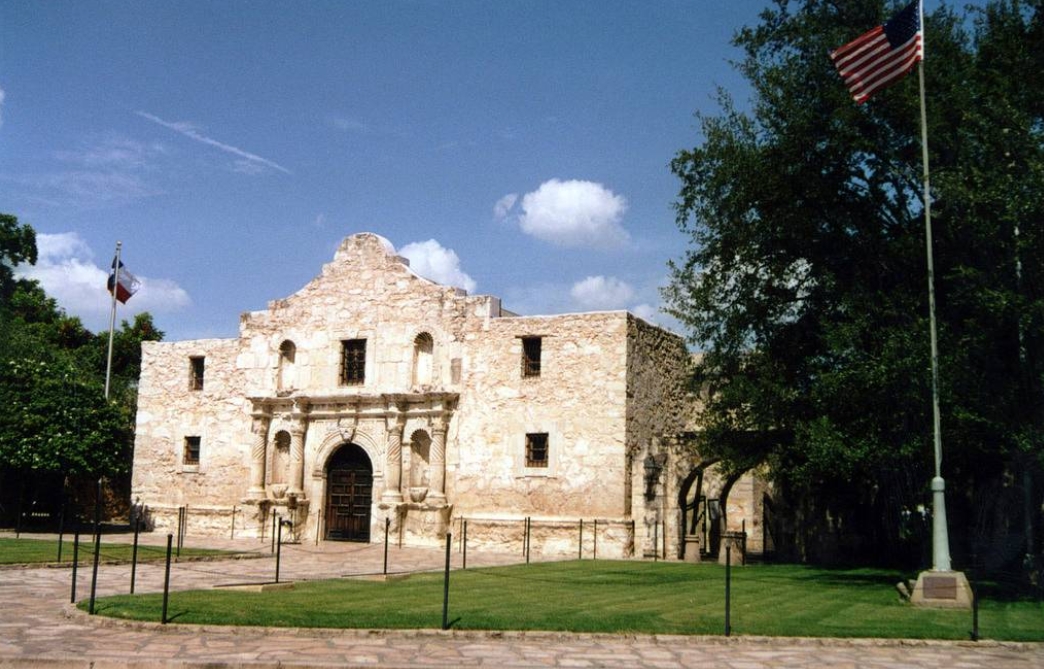
The grounds of the Alamo are beautifully maintained, though visitors are often struck by how little of the original enclosure remains. The property consists solely of the original chapel (with a more recently added roof), the courtyard, and the long barracks, which can only be entered if one purchases tickets for the augmented experience tour. The property will soon be significantly expanded, however, upon the completion of the new Visitors’ Center and Museum, slated for 2027, which will capture the original footprint of the Alamo mission.
Currently, the site offers a few exhibits and experiences free of charge, though guests will find their visit to the Alamo short and fairly cursory if they do no more than these. Entry to the chapel requires (free) tickets to reserve an entrance time. Expect a long line that snakes around the inside of the chapel, making its way towards a three-minute immersive experience in the old sacristy that recreates the sights and sounds experienced by the women and children who took refuge there during the battle. Exhibits and plaques around the chapel provide information about the building itself and the evolution of its role in the Alamo compound since its original construction as a Spanish mission in 1718.
After exiting the chapel, guests are free to stroll through the courtyard and to watch an excellent 18-minute video, projected on the wall of the long barracks, which provides the broad historical overview of the events leading up to the battle of the Alamo, details of the battle itself, and its significance in the struggle for Texan independence from Mexico. Behind the chapel, guests will find a living history encampment with several historical reenactors offering demonstrations of aspects of life for the Texian soldiers during the war with Mexico; live musket firing demonstrations typically occur daily at 11:30 a.m. in the Plaza de Valero.
The site also offers several in-depth ticketed experiences available that provide an opportunity to delve deeper into the fascinating and moving history of the site—and to avoid some of the frequently substantial crowds. These include:
- A guided tour describing the workings of the mission, the heroes, and events of the battle
- A self-guided audio tour leading through the grounds and the Alamo Exhibit
- The Alamo Exhibit with interactive exhibits and a narrated diorama of the battle
- A virtual reality view of the inside of the barracks through a handheld tablet in “Surrounded! The Alamo Augmented Experience”
The Alamo is presented in a historically accurate manner that celebrates the Texan and American spirit of independence. The site’s various displays and exhibits represent the events that transpired at the Alamo in an engaging manner that is designed to instill a proper admiration for the men and women who perished in the Battle of the Alamo. The Texians are portrayed heroically, but General Santa Anna and his Mexican soldiers are neither vilified nor disparaged. The mistakes and general disorganization of the Texians at the Alamo—including the lack of a clear chain-of-command among the soldiers and the lack of military preparedness—are not hidden or sugarcoated.
Perhaps because the Alamo is owned by the State of Texas, the site itself is refreshingly free of ideological bias. Indeed, the Alamo is a model of patriotic historical education. The site’s exhibits are grounded in historical facts that emphasize (without exaggeration or unnecessary glorification) the heroism of those who endured and ultimately perished in the Battle of the Alamo and the significance of the Alamo in Texan and American history.
The site is family-friendly, though perhaps not especially engaging for young children. Families who learn a bit about the Alamo before their visit will better appreciate the significance of this historic site. The grounds are not overwhelmingly impressive in and of themselves. A new Visitors’ Center (scheduled to open in 2027) may make a visit even more meaningful to those without prior knowledge of the Alamo.
The Alamo can get quite crowded and the Texas heat can be oppressive at times. Much of the site is outdoors.
Founded as a Spanish Catholic mission in 1718 to convert Native Americans, the Alamo (located in present-day San Antonio) was the site of the Battle of the Alamo in 1836, a pivotal battle in the Texas Revolution. The battle took place over 13 days in February and March 1836.
In December 1835, a small group of Texian rebels seized the Alamo from the Mexican soldiers who had previously held it as a military fortress. On February 23, 1836, a Mexican force of over a thousand troops led by General Antonio López de Santa Anna began a siege of the fort to recapture it. Around 200 Texians, including Davy Crockett, and commanded by both James Bowie, the frontiersman and legendary knife fighter, and Lt. Col. William B. Travis held out for 13 days before succumbing to Santa Anna’s forces on March 6, 1836. General Santa Anna refused to take any prisoners alive and ordered the execution of the few Texian defenders who were left alive at the end of the siege. Thus, nearly every Texian defender was killed, including Bowie, Travis, and Crockett.
Six weeks after the Battle of the Alamo, the Texians, under the leadership of General Sam Houston, the commander-in-chief of the Texian Army, defeated Santa Anna in the Battle of San Jacinto, the climactic and final battle of the Texas Revolution. “Remember the Alamo!” became the spontaneous rallying cry of the Texian soldiers as they rushed the enemy lines and overpowered the Mexican forces. Santa Anna was captured and brought before General Houston, before whom he begged that he and the other Mexican prisoners be treated with mercy; Houston famously retorted, “What right have you to mercy, when you showed none at the Alamo and Goliad?”
The Battle of the Alamo is an enduring symbol of courage, heroism and the fight for independence.
Owned By: State of Texas
Operated By: Texas General Land Office (GLO) and Alamo Trust, Inc.
Government Funded: Yes
Did you know?
Outrage caused by the wholesale slaughter of the Texian soldiers at the hands of Santa Anna’s army helped to galvanize support for Texan independence among the settlers. “Remember the Alamo!” became the spontaneous rallying cry of the Texian soldiers as they attacked and defeated Santa Anna’s army at the Battle of San Jacinto shortly thereafter.
Recommended Reading
- Remember the Alamo! by Robert Penn Warren
- Sam Houston, the Tallest Texan by William Johnson
- The Blood of Heroes: The 13-Day Struggle for the Alamo–and the Sacrifice that Forged a Nation by James Donovan
- Three Roads to the Alamo: The Lives and Fortunes of David Crockett, James Bowie, and William Barret Travis by William C. Davis
- The Alamo (1960 film)
Reviewed By
Vincent Phillip Muñoz
Tocqueville Professor of Political Science at the University of Notre Dame. Completed this review with the assistance of Jennifer Muñoz, Dominic (13), Mimi (12), and Sophie (8)
The opinions expressed above are those of the Reviewer who is providing a good-faith historical assessment to educate the public. Reasonable opinions can vary, and the Reviewer’s opinion is not necessarily the opinion of The Heritage Foundation or its affiliates.