President James K. Polk Home & Museum
Home of the America’s 11th President, who expanded the nation’s borders to the Pacific
Site Details
Pin location is approximate.
301 W 7th St
Columbia, TN 38401
Family Friendly?
Yes
Visitors Per Year
5,000
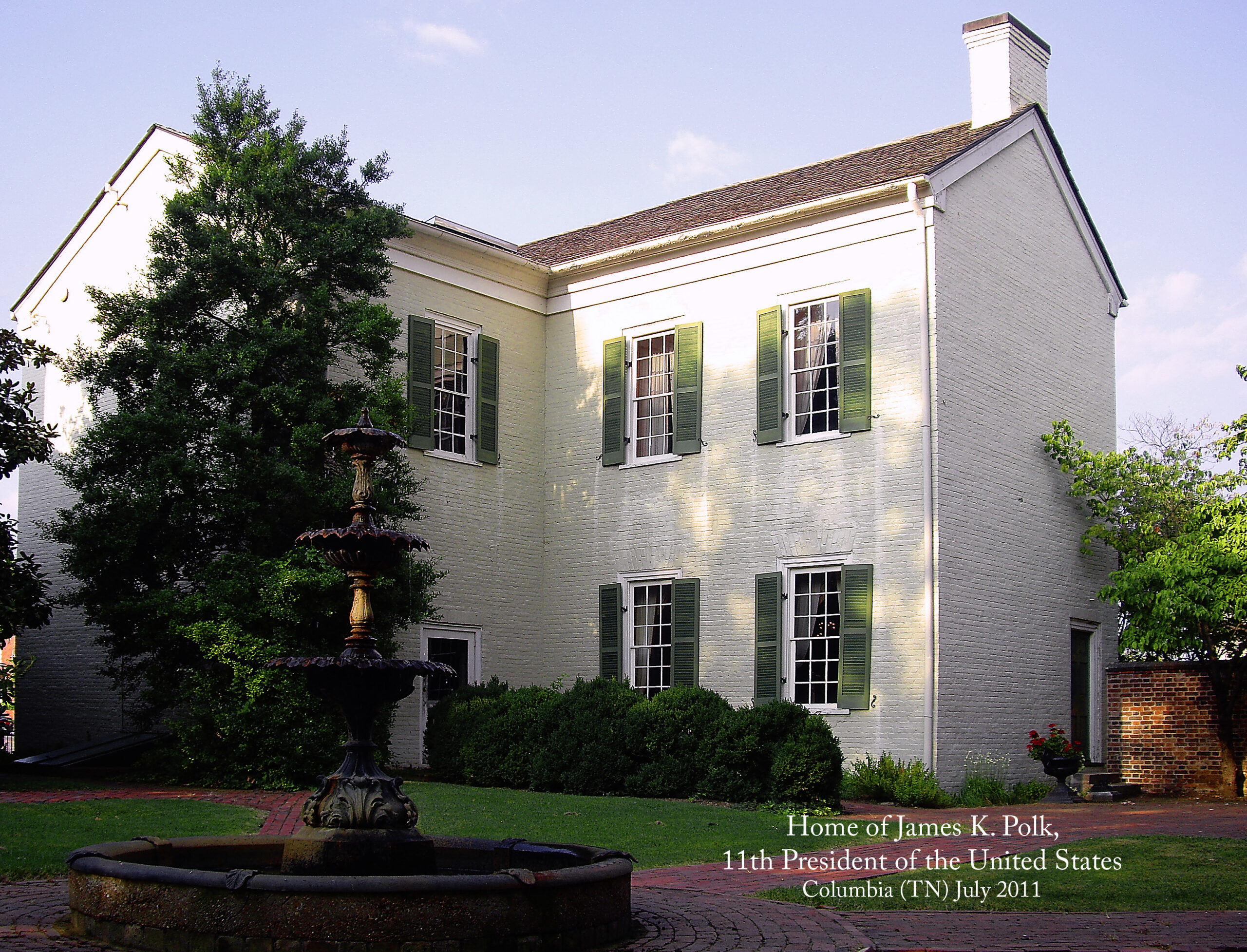
The Polk Home and Museum includes the home itself and the home of Polk’s sisters, called the Sisters’ Home, in which the Visitors’ Center is located. There is also an extensive decorative garden with statuary as well as a vegetable garden, and a refurbished kitchen outbuilding where it is believed slaves slept.
The Polk Home and Museum offers a guided tour, which is preceded by a 12-minute film.
This film moves almost immediately to Polk’s presidency and contains very little about his congressional career. It emphasizes the role played by his wife, Sarah Childress Polk, who outlived her husband by 40 years and was a key partner in his political success.
The film mentions Polk’s connection to slavery (he owned several plantations and bought and sold slaves while President), noting that he knew slavery was wrong but engaged in it anyway. The film covers the Mexican–American War very well, addressing accusations that Polk instigated it and then leaving it to the viewer to decide Polk’s culpability. “Legitimate or not,” says the narrator, “the Mexican War reshaped American geography.”
Likewise, the film closes with the question, “So, how should we take measure of James and Sarah Polk?” The film is clear that people assess Polk’s presidential legacy differently. The viewer is left to decide on his own, without being pushed toward a particular interpretation.
Guests then proceed through each room of the house as guides discuss President Polk’s political life and presidency, his parents and relatives, the contents of the house, the story of the home’s preservation, and particularly Polk’s relationship and partnership with his wife, Sarah Childress Polk. The tour does not delve deeply into legislative or policy specifics; it focuses more broadly on Polk’s presidency and the Mexican–American War. The reconstructed kitchens and large garden provide visitors a window into how the Polks lived and about the lives of their slaves.
Guides emphasize Mrs. Polk’s partnership, help, wealth, education, and political involvement. This is appropriate, in that Sarah Childress Polk foreshadowed the important public role first ladies adopted in the 20th century.
The guides welcome questions and seem particularly good with schoolchildren. Guests are encouraged by guides to judge Polk’s legacy for themselves. They matter-of-factly refer to Polk’s enslaved people and note that he owned several plantations and bought and sold slaves while President. But the tour’s emphasis is decidedly on the lives of James and Sarah Polk and the accomplishments of Polk’s presidency.
The tour could contain more about Polk’s role in launching the Federal Reserve’s predecessor, the Independent Treasury, as well as his success at lowering American tariffs. Overall, however, the James K. Polk Home presents President Polk as a hard-working, significant figure who changed the political geography of North America.
The film incorrectly credits Polk with annexing Texas. It was President John Tyler who signed a resolution of annexation just days before Polk took office. Polk completed the transition to Texas statehood. This is a minor point.
Guides are very keen on accuracy. When asked about a particular interpretation of Polk, one guide stated, “Unless I am 100 percent sure, I won’t tell you it’s a fact.”
In its tours, the President James K. Polk Home and Museum does not present Polk’s story through an ideological or activist lens. The tour is a good example of how history in America is tied not just to place in terms of geography (in this case Columbia, Tennessee), but to places, such as Maury County and even the home itself. The tour is as much about Sarah, Polk’s family members, and the artifacts, as it is about the President himself. But this is done in such a way as to enhance knowledge of President Polk.
Ideology does not creep in as part of the tour. The Polk Home and Museum, however, also has online lesson plans that are aligned with the state of Tennessee’s social studies standards. At least one of these plans, which features the Seneca Falls Convention, appears to have been included solely in the interest of inclusion, because it sheds no light on Polk.
The site of the Polk Home is walkable, compact, and family-friendly. There is ample parking, including five Polk Home visitor-only parking spots next to the site. The Polk Home hosts summer camps for grammar school children and special Homeschool Days for homeschool families. The home is in Columbia, Tennessee, near Nashville. There are other sites of historical interest nearby, such as a plantation home and museum, Civil War battlefields, and Andrew Jackson’s Hermitage.
James K. Polk only lived for six years in this home, from his college graduation in 1818 until his marriage to Sarah Childress in 1824. The Polk Home is the only surviving structure in which President Polk lived, apart from the White House. As such, it is the primary location for educating Americans about Polk’s legacy through the artifacts it has collected.
James K. Polk was the first “dark horse” candidate in American history, emerging from a field of competitors at the 1844 Democratic Party Convention to head the ticket against the Whig Party candidate, Henry Clay of Kentucky. He pledged to serve only one term. Polk, whose nickname was “Young Hickory” because his closeness to his mentor and fellow Tennessean Andrew Jackson (known as “Old Hickory”), won a very close election. The election’s central issue was whether to annex the Republic of Texas, which, by 1844, had been independent of Mexico for eight years. Polk favored annexation. Polk also intended to address the nation’s troubled banking system, high tariffs, and the joint ownership of the large Oregon Territory with Great Britain. By the end of his term, he had lowered tariffs, established the Independent Treasury (which lasted until the creation of the Federal Reserve in 1913), established the current border between the United States and Canada by dividing the Oregon Territory roughly in half, and added to the United States the Mexican Cession, comprising the current states of California, Nevada, Arizona, New Mexico, and parts of Utah, Colorado, and Texas.
Owned By: State of Tennessee
Operated By: The James K. Polk Memorial Association
Government Funded: Yes
Did you know?
James K. Polk’s presidency, from 1845–1849, saw the greatest total land acquisition in American history.
Recommended Reading
- The Presidency of James K. Polk by Paul H. Bergeron
- A Country of Vast Designs: James K. Polk, the Mexican War, and the Conquest of the American Continent by Robert W. Merry
- Manifest Ambition: James K. Polk and Civil-Military Relations during the Mexican War by John C. Pinheiro
Reviewed By
John C. Pinheiro
PhD, author of Missionaries of Republicanism: A Religious History of the Mexican–American War (Oxford, 2014) and Manifest Ambition: James K. Polk and Civil-Military Relations during the Mexican War (Praeger, 2007)
The opinions expressed above are those of the Reviewer who is providing a good-faith historical assessment to educate the public. Reasonable opinions can vary, and the Reviewer’s opinion is not necessarily the opinion of The Heritage Foundation or its affiliates.