Fort Sumter National Historical Park
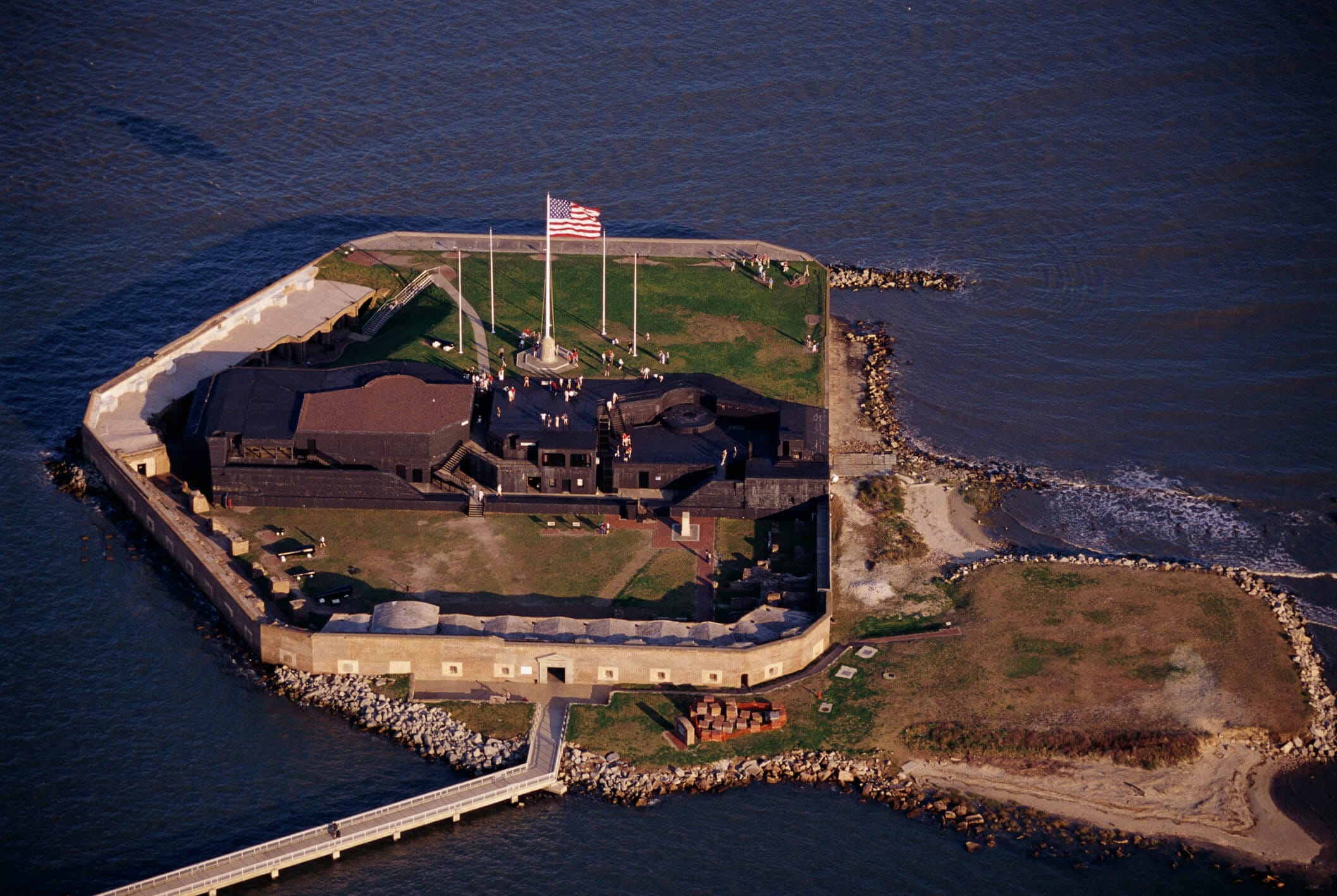
Historic U.S. Army fort, built after the War of 1812 to defend Charleston Harbor and where the first shots of the Civil War were fired on April 12, 1861
Site Details
Pin location is approximate.
340 Concord Street
Charleston, SC 29401
Family Friendly?
Yes
Visitors Per Year
300,000
Fort Sumter Tours provides the only National Park Service authorized access to Fort Sumter. The boat ride is about 30 minutes each way, and visitors have one hour to explore the fort. The boat ride is pleasant as there are beautiful views of both Charleston Harbor as well as Sullivan Island’s Fort Moultrie. The accompanying National Park Ranger delivers a very informative and accessible presentation of Fort Sumter and its historical significance.
There are two departure locations: Fort Sumter Visitors’ Center at Liberty Square (the official National Park Service Visitors’ Center) and Patriots Point Naval and Maritime Museum. The Fort Sumter Visitors’ Center is located in Charleston next to the Charleston Aquarium. There is street parking (metered), a paid parking lot, and a parking garage. The website promotes the parking garage though it is the most expensive option. The Visitors’ Center at Liberty Square has a large hall of exhibits with a gift shop. Normally visitors arrive near the ferry departure time for their tour of the fort.
Fort Sumter provides a very comprehensive and accurate account of the fort’s history, particularly during the Civil War, in two sets of exhibits (the Visitors’ Center on Liberty Square and the museum located at Fort Sumter). Both sites offer a chronological set of displays detailing the fort’s construction, the events surrounding the Civil War, and the subsequent history of the fort through the mid-twentieth century. These include:
- Numerous displays detailing the shelling of Fort Sumter on April 12, 1861, marking the beginning of the Civil War;
- Substantive and quite informative accounts of the leadership of the Confederate forces by General Pierre Gustave Toutant-Beauregard (better known as PGT Beauregard) against the Union-held Fort Sumter under Major Robert Anderson; and
- A good account at Fort Sumter of the HL Hunley, the first submarine used in war, which inexplicably sank after destroying the Union sloop-of-war, the Housatonic. (The Hunley remained lost until it was discovered in 1995.)
The museum has many informative displays including a chronology of the events of the Civil War and numerous artifacts from the site. It also includes a useful account of Major Anderson’s return to Fort Sumter on April 14, 1865, when the Union finally reclaimed Fort Sumter and raised the American flag following the defeat of the Confederacy.
The two sets of exhibits at Fort Sumter are quite in-depth and convey the history and significance of the Fort accurately.
Fort Sumter provides one of the most balanced treatments of history among National Parks. On the controversial topic of slavery, the park offers a fair and substantive account of that pivotal issue in the southern secession movement. Beginning with the adoption of the Constitution, the exhibits in the Visitors’ Center at Liberty Square note the ambiguous status of slavery in the Constitution and an entire poster records numerous quotes from the Founding generation, including Thomas Jefferson, condemning the institution. The displays accurately describe the divergence in American public opinion over the issue and its culmination in the conflict of the Civil War. Overall, it is a thoughtful and balanced presentation of controversial issues that deserves to be commended for accuracy and judgment.
Fort Sumter is family friendly. The boat ride is certainly an exciting part of the visit, and the fort itself is mostly stroller friendly. It is best to board the boat early to guarantee a seat. Consider bringing water, as concessions on the boat are expensive. The first boat of the day, which leaves at 9:30 a.m. from the Visitors’ Center, is best in the summer, given how hot it is in the later part of the day. There are no bathrooms at Fort Sumter, but there are some on the boat and at the Visitors’ Center.
Visitors only have one hour at the fort, which is not enough time to explore the fort and its museum. Given the limited duration of the visit, it is recommended that visitors spend less time visiting the artillery in the embrasures and more time in the museum.
The first shots of the Civil War were fired at Fort Sumter on April 12, 1861. Fort Sumter was built after the War of 1812 as part of a project to protect the American coastline. The fort was built with New England granite on a shallow part of Charleston Bay to protect Charleston alongside Fort Moultrie and Castle Pinkney. Fort Sumter is most remembered as the beginning point of the Civil War. When South Carolina seceded, there were four federal forts in South Carolina: Fort Moultrie, Castle Pinkney, Fort Johnson, and Fort Sumter. Fort Moultrie had two companies of men under the command of Robert Anderson. Just six days after secession, on December 6, 1860, Major Robert Anderson, believing Fort Moultrie’s location on Sullivan’s island to be indefensible, secretly moved his command to Fort Sumter, which was about 90 percent complete. South Carolina regarded Anderson’s move as an act of aggression and breach of faith. South Carolina governor Francis Pickens demanded that the U.S. government evacuate Charleston harbor. President James Buchanan refused and sent a relief ship, Star of the West, to bring necessary provisions, but South Carolina did not allow the ship to enter the harbor.
In early March of 1861, President Abraham Lincoln assumed office and General Beauregard took command of the Confederate troops at Charleston. By this point, Fort Sumter had become the focal point of tension between the North and South.
On April 11, 1861, Beauregard demanded that Anderson surrender Sumter. Anderson refused. The following day, April 12, 1861, Fort Johnson began its artillery attack on Fort Sumter, signaling all Confederate batteries around Charleston to shell the fort. With this attack on a Union-held post, the Civil War began. After 34 hours, Anderson surrendered and lowered the U.S. flag. The same flag would not be raised again until April 1865 by the same Major Anderson following the surrender of Confederate forces.
After the war, the army attempted to restore Fort Sumter. A new sally port was cut through the left flank, storage magazines were constructed, and gun emplacements were located. Eleven of the original first-tier gunrooms were also reclaimed and armed with 100-pounder Parrott guns.
From 1876 to 1897, Fort Sumter served mainly as a lighthouse station. With the outbreak of the Spanish–American War, Battery Hugar was completed, and two long-range rifles were installed in 1899. These guns, however, were never fired. Although there was a small garrison at Battery Hugar during WWI, in the following years, it was no longer used as a military establishment and was given to the National Park Service in 1948.
Owned By: The National Park Service
Operated By: The National Park Service and Fort Sumter Tours
Government Funded: Yes
Did you know?
Seventy thousand tons of New England granite were shipped from as far away as Maine to build the 109,900-ton rock foundation on which Fort Sumter was built. The fort was constructed (beginning in 1829) on what was essentially a sandbar near the Charleston Harbor entrance.
Recommended Reading
- Allegiance: Fort Sumter, Charleston, and the Beginning of the Civil War by David Detzer
- Days of Defiance: Sumter, Secession, and the Coming of the Civil War by Maury Klein
- Thunder in the Harbor: Fort Sumter and the Civil War by Richard Hatcher
- The Cannons Roar: Fort Sumter and the Start of the Civil War—An Oral History by Bruce Chadwick
- The Firing on Ft. Sumter: A Splintered Nation Goes to War by Nancy A. Colbert
Reviewed By
David Alvis
Professor of Political Science at Wofford College
The opinions expressed above are those of the Reviewer who is providing a good-faith historical assessment to educate the public. Reasonable opinions can vary, and the Reviewer’s opinion is not necessarily the opinion of The Heritage Foundation or its affiliates.