Fort Adams
Largest coastal fortification in the United States, built in the 19th century and garrisoned until the 1950s
Site Details
Pin location is approximate.
80 Fort Adams Dr
Newport, RI 02840
Family Friendly?
Yes
Visitors Per Year
1,300,000
Tours generally follow the same format, with each guide providing a personal touch. There is no rote script.
- The guided tour lasts just over an hour and costs $20, with discounts for seniors, veterans, students, and children. The park allows for self-directed tours at a lower price. Both tours stop at various spots within the fort where informational displays provide an education on the construction of the fort, the materials used, the various weaponry employed, and much else.
- Highlights include large, old cannon, the unrestored interior architecture of the commanding officer’s quarters, and a trek into one of the installation’s deep and dark listening tunnels, which were once used to detect a subterranean invasion.
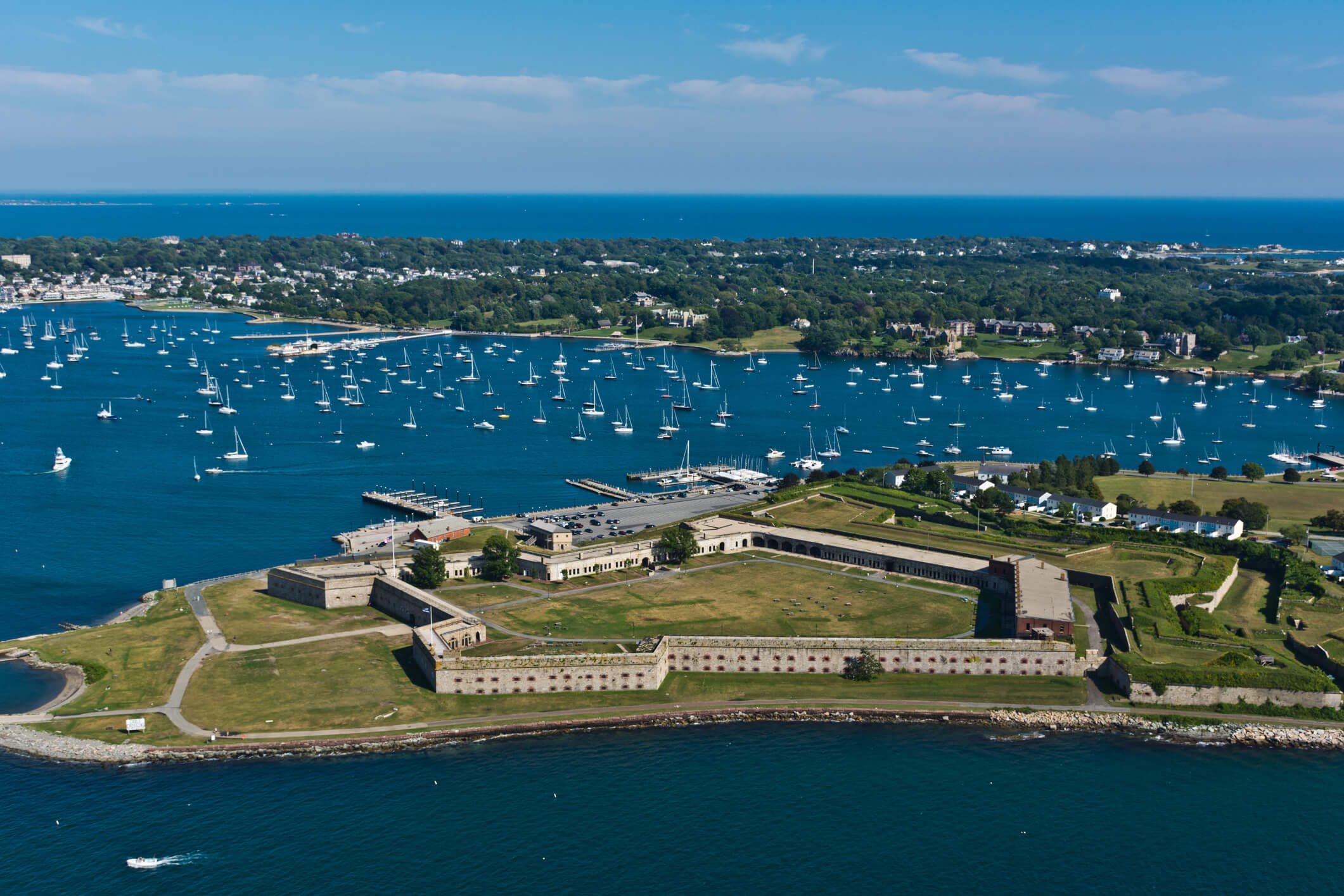
- Fort Adams, situated on a peninsula, offers spectacular views of Rhode Island’s natural and manmade beauty. This includes, as part of a paid tour, the view of Narragansett Bay from atop the fort. A free stroll of the exterior of the fortification allows for sights of aquatic and avian wildlife, sailboats on the water, several lighthouses, and the architecture of the fort and houses on the surrounding land. Selfie opportunities abound.
- Given its proximity to the U.S. Naval War College, Fort Adams also contains displays on military history unconnected to the site.
Historic Fort Adams meets scholarly standards of accuracy and provides a comprehensive overview of the site’s history. The tours and displays provide information without an agenda beyond a remembrance of the past and appreciation for how Americans of earlier generations, with more primitive technology, erected a defense against the threat of nautical invasion. Given that the site was never on the receiving end of an incoming shot, nor did it ever fire on an enemy, Fort Adams may seem unremarkable in comparison to, say, Monticello, Manassas, or the Manhattan Project National Historic Park. That nothing happened here, however, is precisely the history that its designers hoped would result from such a mammoth, intimidating fortification. They did not install five-foot granite walls or spend more than three decades perfecting this bulwark to invite foreign navies to invade Narragansett Bay.
The tours, both guided and unguided, and the displays are completely free of the non-sequitur, politicized content that often turns historical sites into an excuse to make a point about present-day controversies. Instead, expect to find maps, 19th-century cannons, explanations of the technology that made Fort Adams so effective, an ancient outdoor bust of John Adams, and exhibit signs about who built the structure, how, and with what materials.
The outdoor, wide-open nature of the park allows energetic children to have plenty of opportunities to run around in the fresh air. The massive cannon has a coolness factor, as does the excursion by flashlight into one of the lengthy listening tunnels (although not recommended for anyone with claustrophobia or fear of the dark).
Given the site’s location, both in the northeast and on the water, visitors may wish to plan trips for the more temperate months. Rain occasionally seeps into the tunnels, making for an unpleasant walking experience. (Make sure and consult the weather forecast.) Fort Adams occasionally plays host to outside events, such as the Newport Jazz Festival and the Newport Folk Festival, so best to check the state park’s website calendar of events before planning a trip.
Youngsters are likely to encounter some unfamiliar terminology, such as “redoubt,” “tenaille,” “bastion,” “casemate,” and, at least in its original, basic definition, “loophole,” providing a good vocabulary lesson.
Since the tour includes a lot of walking, including up steep, slanted steps and down a dark, wet tunnel on uneven ground, visitors with limited mobility may wish to skip some parts of Fort Adams or skip Fort Adams entirely.
Dogs are welcome.
Fort Adams, named for the second President, attracts attention for what did not happen there. Its massive, imposing presence deterred foreigners from invading Narragansett Bay, an important commercial harbor in early America. The federal government began construction of the first iteration of the fort during the 1790s, and in 1824 began construction on the structure as it stands today. Construction finished in 1857, and military personnel were garrisoned there until the early 1950s.
Since no battles were fought here, Fort Adams was denied a place in history akin to Fort Mims or Fort Eben-Emael, but the installation found ways to make its mark in myriad unexpected ways. President Franklin Pierce, Civil War General Ambrose Burnside, Pulitzer Prize–winning writer Thornton Wilder, and William Griffith Wilson (Bill W., cofounder of Alcoholics Anonymous) were all stationed here at various times. At least nine Presidents visited, including Dwight Eisenhower, who used its big yellow Victorian house with a wraparound porch as a summer White House. Since 1985, the site has been the host of the historic Newport Folk Festival, which in this incarnation has featured such acts as Willie Nelson, Judy Collins, Nanci Griffith, Roger Waters, Ben Harper, Paul Simon, the Pixies, Mumford & Sons, Dolly Parton, and Bob Dylan (who famously went electric at the festival but not, alas, at this site).
Fundamentally, Fort Adams stands as the ultimate expression of America’s Third System of coastal fortifications, which included Fort Pulaski in Savannah, Fort Point in San Francisco, and Fort Carroll in Baltimore.
Owned By: Rhode Island
Operated By: Fort Adams Trust
Government Funded: Yes
Did you know?
Fort McHenry, Fort Sumter, and Fort Ticonderoga could fit comfortably inside Fort Adams’s geographic footprint.
Recommended Reading
- Fort Adams: A History by John T. Duchesneau and Kathleen Troost-Kramer
- A Legacy in Brick and Stone: American Coast Defense Forts of the Third System, 1816–1867 by John Weaver
Reviewed By
Daniel Flynn
Visiting Fellow at the Hoover Institution, senior editor for The American Spectator, and author of The Man Who Invented Conservatism: The Unlikely Life of Frank S. Meyer (Encounter Books, 2025)
The opinions expressed above are those of the Reviewer who is providing a good-faith historical assessment to educate the public. Reasonable opinions can vary, and the Reviewer’s opinion is not necessarily the opinion of The Heritage Foundation or its affiliates.