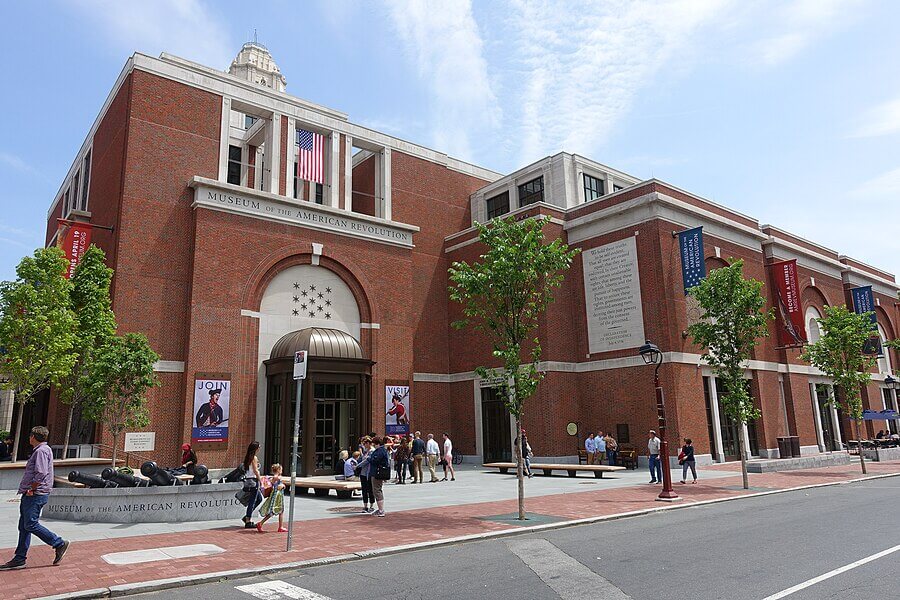
Museum of the American Revolution
Only museum devoted to telling the story of America’s Revolutionary era, featuring George Washington’s war tent and other artifacts
Site Details
Pin location is approximate.
101 S 3rd St
Philadelphia, PA 19106
Family Friendly?
Yes
Visitors Per Year
170,000
- The main exhibit is on the second floor of the building. Before going up, visitors can watch a short introductory film that plays throughout the day in the theatre. This film introduces viewers to the Revolution and the struggles inherent to it, as well as the themes of the museum, including the attention it devotes to women, African Americans, American Indians, and the framing narrative of the Revolution as an unfinished project that continues into the present through issues like gay liberation. The first floor also includes a gallery for special exhibits, the Revolution Place exhibit for children ages 5-12, and the museum shop and café.
- The main exhibit of the Museum of the American Revolution is organized into four categories: “Becoming Revolutionaries,” “The Darkest Hour,” “A Revolutionary War,” and “A New Nation.” The galleries are impressive, combining artifacts with short films, digital displays, and interactive exhibits. Many galleries include life-size tableaux illustrating fascinating moments or figures from the history of the Revolution.
- Notably, the last section of the main exhibit, “A New Nation,” is dated “1783–Present” and concludes with a short film on the “Ongoing Revolution.” This reminds visitors of the overarching narrative of the museum, established in the orientation film at the beginning, that the American Revolution is an unfinished idea. The “Ongoing Revolution” includes, for example, quick shots of a gay liberation protest and an Occupy Wall Street protest, suggesting that these movements are extensions of the Revolution. While the idea that the American Revolution was incomplete, especially because of slavery, has long been part of the American tradition, the decision to include, albeit briefly, these more contemporary movements unnecessarily politicizes the museum. As one leaves the museum, there is a wall of mirrors surrounding a message to “Meet the Future of the American Revolution.”
- In addition to covering the major political developments and military events one would expect, the main exhibit tells the stories of women, African Americans (both enslaved and free), and American Indians, especially the Oneida Indian Nation (which donated $10 million to the museum), during the revolutionary era. It also illuminates conflicts and tensions within the revolutionary generation, presenting, for example, the Revolutionary War as essentially a civil war in the south.
- A theatre on the second floor features “Washington’s War Tent,” a short film that plays every hour on the hour. As the film plays, the real tent that George Washington used as an office and sleeping quarters during the war is slowly revealed behind the screen. This is an impressive feature, and the tent is the centerpiece of the Museum’s collection. It should definitely be seen, even if one has to interrupt one’s viewing of the main exhibit to come back for a showing of the film. The film tells the story of the tent as a symbol of the Revolution and America itself. It also awkwardly reminds viewers that Washington had an enslaved valet, William Lee.
- The museum offers several tours, including an audio tour narrated by its CEO that explains not only the content of the galleries, but how and why the museum was designed the way it was. It is a valuable supplement to the many films and interactive displays throughout the museum. Various other tours are also offered for additional cost, including a 1.5 hour outdoor walking tour of significant locations in the vicinity of the museum, and a 60-minute guided tour of the highlights of the museum itself (one could easily spend several hours at the museum going through it on one’s own).
The museum accurately presents the history it covers and details important conflicts and tensions within the founding generation. The main artery of the museum focuses on the political and military course of the revolutionary era.
However, the museum is somewhat disproportionate in terms of its coverage of stories less often told—those of women, American Indians, slaves, and freemen of African descent. Most visitors will learn interesting things they probably did not know. At the same time, the significant time and space devoted to these stories could have been spent on more detailed presentations of key political and military figures and events. For example, the museum once featured a special exhibit on Alexander Hamilton, but he receives very little attention in the current main exhibit.
Overall, the impressive galleries are historically accurate and informative, but the museum allows contemporary preoccupations to frame its telling of the American Revolution, focusing considerable attention on the stories of identity groups less often featured in historical accounts and suggesting in the orientation and concluding films that certain contemporary political causes are part of the unfinished project of the American Revolution.
In June, the museum celebrated Pride Month and offered a 60-minute walking tour “exploring the revolutionary story of the self-proclaimed Public Universal Friend, a nonbinary leader of a new religion in the 1770s.”
Many elements of the main exhibit are engaging for children, and there is an interactive exhibit for children ages 5–12. A couple of the films briefly depict more recent political causes, including gay liberation. Parents of young children should know that brief images of contemporary political causes, including gay liberation and Occupy Wall Street, appear in the museum’s framing films. The museum also generally offers a complex account of the Revolution that does not seek to undermine it, but does not mythologize it either. In June, the museum celebrated Pride Month, including a small installation outside the exit of the main exhibit.
The museum often features costumed living-history interpreters and discovery carts that will be of interest to all visitors, including children. The immersive approach to the exhibits, many of which include short videos pointing to artifacts in the collection, as well as interactive displays, touchable objects, and even some that are meant to be smelled, will be engaging for children. Children will also be interested in an 18-foot liberty tree, a tableau of a brawl among revolutionary soldiers, and especially the recreated deck of an American privateer ship, which visitors can board in the “War at Sea” exhibit. Finally, the museum features a special discovery center for children ages 5–12 that includes a military camp, a tavern, and a home. These are interactive exhibits with digital screens, reproductions of period-specific objects, and other experiential features children will enjoy.
The museum is easily accessible, has modern facilities, and is easy to navigate.
Before the Museum of the American Revolution opened, there was no major museum focused specifically on telling the story of the American Revolution. It is appropriate that such a museum would open in Philadelphia just a few blocks from Independence Hall and many other sites essential to the birth of our nation, including, for example, the place where Thomas Jefferson penned the Declaration of Independence.
Owned By: Museum of the American Revolution
Operated By: Museum of the American Revolution
Government Funded: Yes
Did you know?
The museum owns and exhibits the real tent George Washington used as an office and sleeping quarters during the Revolutionary War.
Recommended Reading
- The Radicalism of the American Revolution or The American Revolution: A History by Gordon S. Wood
- 1776 by David McCullough
- The Declaration of Independence and the U.S. Constitution
Reviewed By
Steven McGuire
PhD in Politics from The Catholic University of America
The opinions expressed above are those of the Reviewer who is providing a good-faith historical assessment to educate the public. Reasonable opinions can vary, and the Reviewer’s opinion is not necessarily the opinion of The Heritage Foundation or its affiliates.