Perry’s Victory and International Peace Memorial
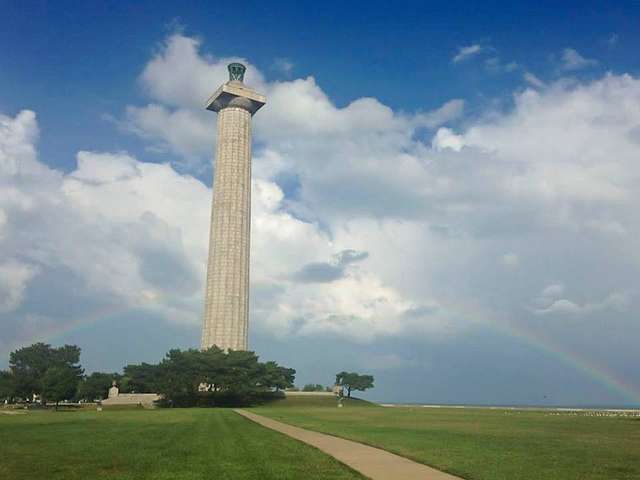
Memorial commemorating a significant American victory in the War of 1812
Site Details
Pin location is approximate.
93 Delaware Ave
Put-In-Bay, OH 43456
Family Friendly?
Yes
Visitors Per Year
200,000
The site offers a Visitors’ Center, beautiful views of Lake Erie where an important naval battle was fought during the War of 1812, and a memorial in the form of a tall Doric column, with a viewing platform atop the column accessible via stairs and an elevator.
In the rotunda on the ground floor of the memorial column, visitors can see the tomb of six naval officers and sailors from both sides of the war—three Americans, and three English. A park ranger is available to answer questions.
To access the viewing platform, visitors ride an elevator with a park ranger, who covers safety procedures and answers questions. The platform itself is higher than the top of the Statue of Liberty and offers stunning 360-degree views of Lake Erie.
In the Visitors’ Center, an entertaining 15-minute video introduces guests to the history of the War of 1812 and the Battle of Lake Erie. A small exhibition area contains photos, artifacts, and historical context for the war, the combatants, and the memorial itself. There is also a large model of the naval battle.
The Battle of Lake Erie is accurately represented at the Visitors’ Center, with detailed explanations of the battle’s participants, tactics, and outcomes. While the placards explaining the causes for the War of 1812 could give more attention to British aggression, such as the impressment of American sailors, they are generally evenhanded.
The memorial itself was partly designed to inspire visitors to pursue international peace; however, the Visitors’ Center and the information at the memorial do not take an activist approach. The exhibits recognize the heroism of several of the battle’s participants, especially Oliver Hazard Perry, as well as the irony of the peace memorial being constructed during the First World War, and they detail the ways in which America, England, and Canada (which became a self-governing nation in 1867) have resolved their conflicts since the War of 1812.
The memorial is on an island in Lake Erie, making access a bit more challenging than other such sites. Visitors must take a ferry to reach the island, which can be inundated with vacationers during the summer months. Visitors should familiarize themselves with the ferry services required to reach the island, as well as the restrictions for getting to and from the island depending on the season (for example, there is no ferry service during the winter months). Once at the site, however, visitors will enjoy beautiful views of the Lake, as well as a recently constructed Visitors’ Center and an impressive trip up the 352-foot-high memorial itself.
The exhibits are not particularly geared toward young children, although placards throughout the grounds raise thought-provoking questions that older children will enjoy. For example, at the desk of Oliver Hazard Perry, visitors are invited to imagine themselves in Perry’s shoes, writing letters the day before battle, and to document their ideas on a nearby whiteboard.
The video in the Visitors’ Center, called “The Battle of Lake Erie,” is informative and accessible for older children, although it does contain vivid descriptions of the injuries sailors sustained during battle, which may be disturbing for younger children.
Throughout the War of 1812, the British Royal Navy blockaded all major U.S. ports and, when the war broke out, immediately seized control of Lake Erie. Although the U.S. Navy was still relatively young and inexperienced, the dramatic naval battle that played out on Lake Erie on September 10, 1813, between American and British forces would provide the United States with a much-needed morale boost and make Master Commandant Oliver Hazard Perry a household name.
Perry, captaining the U.S. Brig Lawrence, commanded the entire Lake Erie fleet. After two hours of intense fighting that left most of his ship’s crew dead or wounded, Perry was forced to abandon his beleaguered flagship and transfer to the Niagara to continue the fight (but not before making sure to take the battle flag emblazoned with the words “DONT GIVE UP THE SHIP”). As the result of a crucial mistake by British naval forces that saw two ships collide and become entangled, Perry was able to seize the opportunity and force the surrender of the entire British squadron. On both sides, one in four men became casualties during the Battle of Lake Erie.
After the battle, Perry scrawled a few words on the back of an envelope and sent it to Major General William Henry Harrison, commander of army operations in the Northwest Territory: “We have met the enemy,” Perry wrote, “and they are ours.” Perry was only 28 years old at the time of the battle, but he already had 14 years of naval experience. The rest of his career following the Battle of Lake Erie was undistinguished. Perry died on his 34th birthday, August 23, 1819, of yellow fever during a diplomatic mission to South America.
Owned By: The National Park Service
Operated By: The National Park Service
Government Funded: Yes
Did you know?
The memorial is 47 feet taller than the Statue of Liberty, and the observation deck is 12 feet higher than Lady Liberty’s torch.
Recommended Reading
- The Naval War of 1812: A Complete History by Theodore Roosevelt
- A Signal Victory: The Lake Erie Campaign 1812–1813 by David Curtis Skaggs and Gerard T. Altoff
- 1812: The War that Forged a Nation by Walter R. Borneman
Reviewed By
Jason W. Stevens
Editor of Causes of the Civil War: Core Documents (Ashbrook Press, 2019)
Cara Stevens
Associate Professor of History at Ashland University. Author of Thomas Jefferson and the Fight against Slavery (University Press of Kansas, 2024)
The opinions expressed above are those of the Reviewer who is providing a good-faith historical assessment to educate the public. Reasonable opinions can vary, and the Reviewer’s opinion is not necessarily the opinion of The Heritage Foundation or its affiliates.