Women’s Rights National Historical Park
Site that tells the story of the First Women’s Rights Convention, held in Seneca Falls, New York, on July 19–20, 1848
Site Details
Pin location is approximate.
136 Fall St
Seneca Falls, NY 13148
Family Friendly?
Yes
Visitors Per Year
35,000
The Women’s Rights National Historical Park comprises the Wesleyan Chapel, Declaration Park (a grassy area between Wesleyan Chapel and the Visitors’ Center with a 100-foot bluestone wall onto which the Declaration of Sentiments has been etched in full), the Visitors’ Center, the Elizabeth Cady Stanton House, and the M’Clintock House.
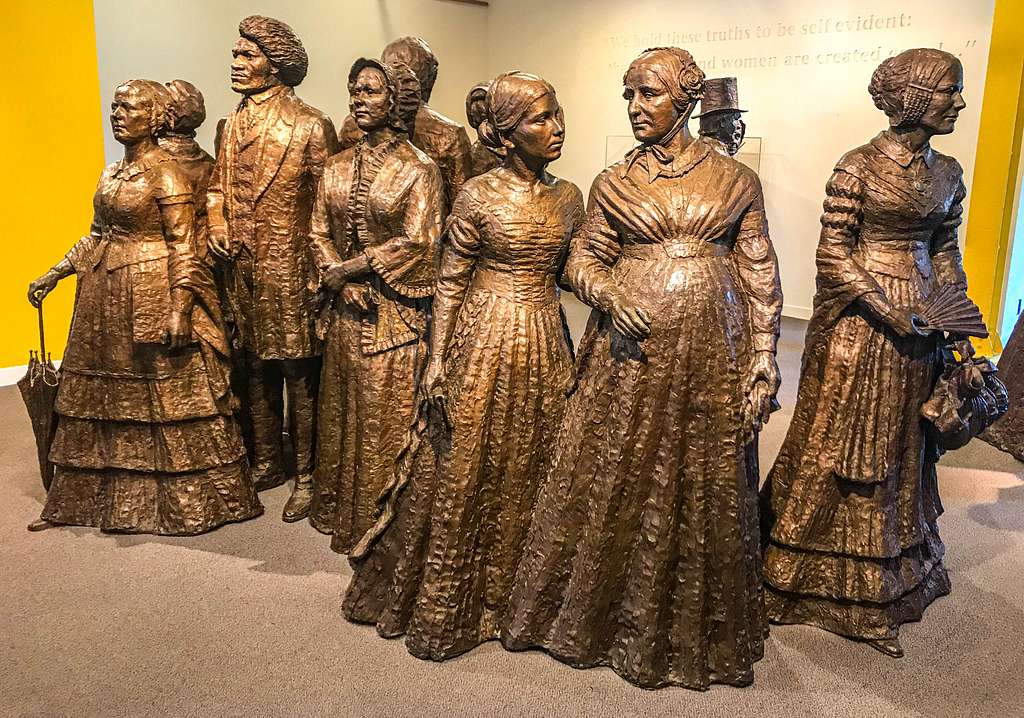
The Wesleyan Chapel, the actual location of the first Women’s Rights Convention, retains little of its original structure, but a stage and pews have been recreated, and murals depict attendees of the 1848 convention.
- Park rangers offer several 15–20 minute tours of Wesleyan Chapel throughout the day that are tightly scripted and accurate. Significant attention is given to Elizabeth Cady Stanton, the organizer of the convention and author of the Declaration of Sentiments (modeled after the Declaration of Independence).
- Plaques throughout the chapel that focus on the history of the convention are accurate and interesting. They offer short biographies of male and female attendees and the general goals of the convention: to affirm that men and women are created equal by nature and ought to enjoy equality under the law.
The Visitors’ Center is two stories, with a welcome center, a gift shop, an activity center, museum exhibits, and a small theater which periodically runs a 25-minute film entitled “Dreams of Equality.”
- The documentary style film “Dreams of Equality” follows the life of a fictionalized heroine who attends the first Women’s Rights Convention in Seneca Falls in 1848.
- A display on “true womanhood” recounts the ideal 19th century woman as an obedient wife and devoted mother and homemaker. The display points out that this ideal left out many poor, single, enslaved, and wage-earning women.
- An excellent display compares the first national convention in Rochester with the local convention at Seneca Falls two weeks before, revealing the swift growth, expansion of concerns, and internal debate within the movement.
- A few displays concern race. One dedicated to the debates surrounding the 15th Amendment is well done. Another highlights the advocacy of various women of color but offers a one-sided interpretation of recent voting rights cases. Two others describe interesting connections between the Underground Railroad, Anti-Slavery Society, and the Women’s Rights Convention.
- Several other displays concern religion, some in unsatisfactory ways. One rightly refers to Sojourner Truth as “profoundly Christian.” Another features Stanton’s controversial Woman’s Bible (written nearly a half century after the Women’s Rights Convention), which contained a re-interpretation of Genesis that is sympathetic to Eve’s rebellion, without contextualizing the debate surrounding the Bible. The display correctly mentions that Stanton’s Bible was condemned not only by clergy at the time, but also by her own allies in the women’s movement, including other leaders of the National American Woman Suffrage Society. The display does not explain that the reason these women opposed Stanton’s Bible is because they based their arguments for equality in a natural law understanding that was biblically based. Without this clarification, Stanton’s reinterpretation becomes contextualized in the exhibit as an example of freedom of conscience—a thread woven through to a display about modern debates over abortion.
- The second floor invites readers to consider several relevant and important questions including, “What are rights?”
The Elizabeth Cady Stanton House was the home of the women’s rights leader from 1847 to 1862 and is open for tours on select days. The structure remains largely as it was during Stanton’s life there, though none of the Stantons’ belongings remain. The tour guides follow a memorized script, which is mostly accurate, that focuses on Elizabeth Cady Stanton’s family life with reference to relevant historical milestones. It begins with her relationship with her parents and the construction of the Erie Canal, which provided greater economic opportunity and led to the development of canal towns like Seneca Falls. The tour concludes with the Stanton family’s move to New York City in 1862 and the legacy of the Stanton children. A brochure and outdoor plaques summarize the significance of the site.
The M’Clintock House is located in Waterloo, New York, and was the home of the 1848 Women’s Rights Convention organizer Mary Ann M’Clintock, but it is currently closed.
While the Declaration of Sentiments (and the signatories) are displayed in full in Declaration Park, it is unfortunate that the Declaration’s Resolutions are not fully displayed, as they very clearly articulate the religious and natural law grounds for the early movement’s equality claims.
Some plaques in the chapel unfortunately come to hasty and controversial conclusions, such as associating Seneca Falls with the Equal Rights Amendment and modern-day abortion rights activism. For example, one plaque reminds visitors that the “struggle continues for basic rights” including “reproductive rights” with a photograph of a pro-abortion protest. In the Visitors’ Center, the final montage of the film “Dreams of Equality” shows a protester with the sign: “women must control their wombs.”
Colorful exhibits at the Visitors’ Center include a great deal of accurate historical content related to the Women’s Rights Convention, but some omissions can cause the displays to be misleading.
- Exhibits give the overall impression that the early movement did not value marriage and motherhood. In truth, advocates’ opposition to coverture marriage was not opposition to marriage per se but to the way in which, under coverture laws, married women lost certain rights they had enjoyed as single women.
- One display erroneously claims that marriage gave husbands the right to beat their wives through the “rule of thumb.” This claim has been widely debunked, even as domestic abuse, together with abuse of alcohol, were major concerns for the movement. It is true, however, that married women had no authority to decline conjugal intercourse, a central focus of the early movement that went unmentioned or was erroneously conflated with modern abortion Rights rhetoric.
- In an otherwise accurate display about the Grimké sisters, the Bible is not mentioned at all, even though Sarah Grimké’s writing expressly grounds sexual equality in Genesis. A large display depicts the spirituality of Native Americans as a model for the women’s movement, while Christianity—which Grimké, Lucretia Mott, and others relied upon for their claims—is presented as clearly biased against women.
One notable inaccuracy of the Elizabeth Cady Stanton house tour is that guides sometimes fail to give Daniel Cady credit for his role in teaching his daughter about the law; instead, sole credit for Elizabeth’s exposure to the law is given to the Cady family’s slave, Peter Teabout.
No one visiting the National Historic Park would have any idea that the women of the early movement spoke out against induced abortion in the strongest terms. Visitors would come away, instead, with the clear impression that the early movement held the same views as modern feminists.
- Subtle visual cues reveal bias in a photo of two women with opposing views on abortion: A young and cheerful pro-choice woman holds a sign: “keep your laws off my body.” An unattributed quote captions the photograph which frames abortion as an issue of conscience.
Another piece dedicated to women’s fashion celebrates accomplished Rochester-area women who are well-known supporters of abortion and gay rights.
All areas in the park are accessible to strollers. Tours in the chapel are easy to exit, and visitors are free to return at will. Declaration Park is child friendly; it is enclosed and set back from the street. The Visitors’ Center has an elevator and areas to nurse a baby in privacy. The Stanton House is not handicap accessible. There are stairs at the entrance, and the second floor is also only accessible by stairs. Due to the confined nature of the tour, it may be difficult to bring children under 5, though the tour is quite brief, about a half an hour.
Parents should be aware of ideological undertones that evoke the values of the Sexual Revolution. A few items in the gift shop have LGBTQ+ flags on them.
The Wesleyan Chapel in Seneca Falls, New York, was the site of the first Women’s Rights Convention in 1848, which launched a national women’s rights movement. Elizabeth Cady Stanton, who lived in Seneca Falls, organized the convention with Lucretia Mott and several other women. Stanton and Mott’s friendship began in London, England, in 1840, when both women were not permitted to participate in the World Anti-Slavery Convention because of their sex. The chapel was chosen as a location because it was known as a venue for free speech. It was also one of the first churches in the U.S. to support abolition. More than 300 people attended the convention, including famed abolitionist and orator Frederick Douglass, who served as secretary.
The convention sought to affirm that men and women are created equal, and that women should have rights to own property, to speak publicly, to receive an education and hold a job, to maintain custody of children, and to vote; suffrage was the most controversial of the convention’s demands. The convention produced the Declaration of Sentiments (modeled after the Declaration of Independence) and 12 Resolutions that grounded the pursuit of equality in natural law. Roughly one-third of the attendees signed the Declaration of Sentiments. The 1848 convention spawned many subsequent women’s rights conventions and was pivotal to the organization of women’s rights as a national movement.
Owned By: National Park Service
Operated By: National Park Service
Government Funded: Yes
Did you know?
Seneca Falls, New York, was an inspiration for the small town of Bedford Falls in Frank Capra’s iconic film “It’s a Wonderful Life.”
Recommended Reading
- Pity for Evil: Suffrage, Abortion, and Women’s Empowerment in Reconstruction America by Madeleine McDowell and Monica Klem
- The Rights of Women: Reclaiming a Lost Vision by Erika Bachiochi
Reviewed By
Erika Bachiochi
Fellow at the Ethics and Public Policy Center, Director of the Mercy Otis Warren Initiative for Women in Civic Life and Thought at Arizona State University’s School of Civic and Economic Thought and Leadership and the author of The Rights of Women: Reclaiming a Lost Vision
Cecelia Lester
President of Feminists Choosing Life of New York
The opinions expressed above are those of the Reviewer who is providing a good-faith historical assessment to educate the public. Reasonable opinions can vary, and the Reviewer’s opinion is not necessarily the opinion of The Heritage Foundation or its affiliates.