General Grant National Memorial
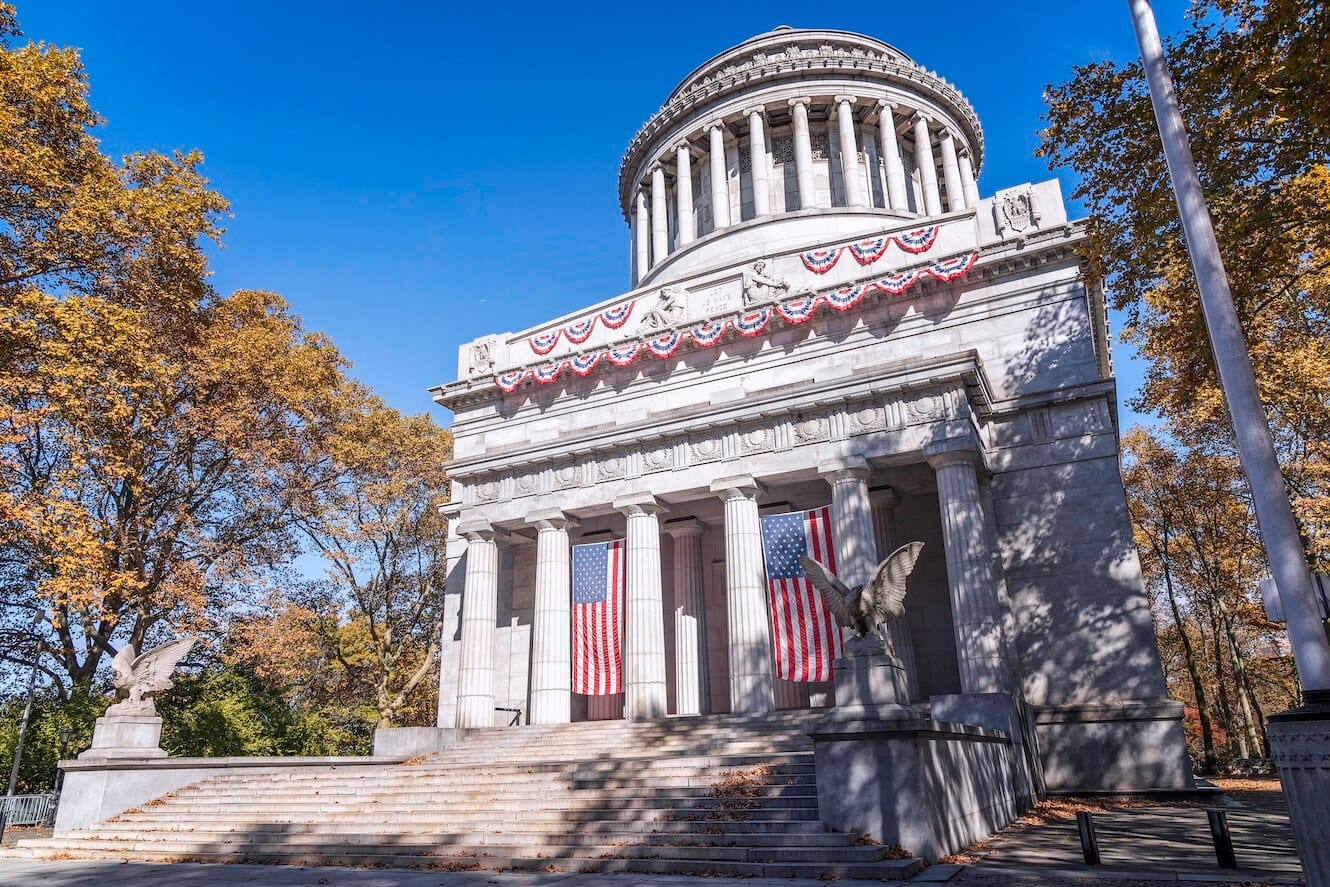
Tomb of General Ulysses S. Grant and his wife, Julia, and a site dedicated to his legacy
Site Details
Pin location is approximate.
W 122nd St & Riverside Dr
New York, NY 10027
Family Friendly?
Yes
Visitors Per Year
100,000
When visitors arrive, they are shown a QR code to access the National Park Service app for a self-guided audio tour.
- The Memorial’s ceiling and piers have mosaics and sculptures depicting stages of Grant’s life and its most iconic scenes, including the battles of Chattanooga and Vicksburg and Lee’s surrender at Appomattox.
- Two trophy rooms display replicas of regimental flags donated by Civil War regiments to the memorial, surrounded by murals of the northern and southern theaters of the War.
- To the left of the entrance is an original regimental flag from the 11th Indiana Regiment of Volunteers, the regiment that fought under Grant from 1862 to 1863.
- Below the main level is the crypt with the sarcophagi of Ulysses and Julia Grant, encircled by busts of the five best generals who served with him: William Tecumseh Sherman, Philip Sheridan, George Thomas, James McPherson, and Edward Ord.
Across the street and to the left of the tomb (when facing the tomb), there is a small Visitors’ Center. The stairs leading down to the Visitors’ Center can be found to the left of the Overlook Pavilion, while a wheelchair accessible path can be found to the right of the Overlook Pavilion. The Visitors’ Center contains bathrooms, a gift shop and bookstore, and a small room for lectures with posters recounting the history of Grant’s life and presidency, as well as the construction of the memorial. These offer the most extensive exposition of Grant’s life and accomplishments available on the site.
The National Park Service’s brochure, signage, and audio tours accurately give an overview of General Grant’s life and describe the love and respect that his countrymen and fellow officers held for him throughout his life and at his death. Most information communicated is simple and pictorial, as is fitting for a mausoleum. The Visitors’ Center’s presentation is laudatory but not uncritical. It clearly presents what made Grant great, while touching on his failures or the unintended consequences of some of his policies.
The site’s overall attitude is one of gratitude and respectful remembrance of one of our country’s great leaders. It betrays no ideological biases in its basic introduction to Grant’s life and accomplishments. Instead, it celebrates the love that Americans had for him at his death, black and white, northern and southern. It honors him as the man who won the Civil War, helped end slavery, and reunited the nation. A sign outside notes that Richard T. Greener, the first black graduate of Harvard, supervised the fund-raising campaign to build the memorial. It also notes: “The Harlem community has been actively involved with the memorial from its beginning.”
While the site is family friendly, it offers a basic introduction to Grant’s life, and parents will want to read more with their children before or after for a richer experience. The memorial is accessible by the 1 train, using the 116th Street or 125th Street stops. Parking in Morningside Heights is limited, and drivers will want to consult the street signs to be aware of when there is no parking due to street cleaning. There are several playgrounds in the area surrounding the memorial, and Riverside Park, which is nearby, offers numerous trails to explore. Bathrooms are available in the Visitors’ Center to the memorial’s left. While the Visitors’ Center is wheelchair accessible and stroller friendly, families with small children and visitors with limited mobility will want to plan accordingly when visiting the tomb, as it is not wheelchair accessible, and there is a long flight of stairs leading up to the memorial, and another flight of stairs in the interior to reach the crypt below.
Grant first earned fame as a general during the Civil War. As a brigadier general, he won the first major Union victory at Fort Donelson in Tennessee in 1862. Later victories at Vicksburg and Chattanooga followed. In 1864, Grant was appointed lieutenant general and given command of the entire Union army. In his campaign of that year, he concentrated his forces on General Robert E. Lee’s army near the Confederate capital of Richmond, while General William Tecumseh Sherman led his western Union army through Georgia. The campaign was a success, and on April 9, 1865, Lee surrendered at Appomattox Court House, effectively ending the Civil War. Despite his victory, Grant remained popular in the South, perhaps because of the sympathy he had for its residents. In his Personal Memoirs, he wrote that he felt “sad and depressed . . . at the downfall of a foe who had fought so long and valiantly, and had suffered so much for a cause, though that cause was, I believe, one of the worst for which a people ever fought.”
Grant went on to win the presidential elections of 1868 and 1872. He was the only President between Abraham Lincoln and Lyndon B. Johnson to actively work to ensure full rights of citizenship for former slaves. He pushed the ratification of the Fifteenth Amendment, which guaranteed that the right to vote could not be denied on the grounds of “race, color, or previous condition of servitude.” He also supported the Force Acts of 1870 and 1871, which empowered the President to use military force to protect the newly recognized rights of African Americans. In addition, Grant established Yellowstone as the first national park. After he completed his term in office, Grant became the first American President to tour the world in 1877 and was widely acclaimed as the man who had saved the American Union. In his later years, he worked with his friend Mark Twain to publish his memoirs before his death in 1885. His 1885 funeral remains the largest such event in American history.
Owned By: The National Park Service
Operated By: The National Park Service
Government Funded: Yes
Did you know?
General Grant’s tomb is the largest mausoleum in North America.
Recommended Reading
- The Personal Memoirs of Ulysses S. Grant by Ulysses S. Grant
- Grant by Ron Chernow
Reviewed By
Nathaniel Peters
Director of The Morningside Institute
The opinions expressed above are those of the Reviewer who is providing a good-faith historical assessment to educate the public. Reasonable opinions can vary, and the Reviewer’s opinion is not necessarily the opinion of The Heritage Foundation or its affiliates.