Federal Hall National Memorial New York
Site of important early American events, culminating in the first meetings of the federal government under the Constitution and the inauguration of George Washington as the first President
Site Details
Pin location is approximate.
26 Wall St
New York, NY 10005
Family Friendly?
Yes
Visitors Per Year
125,000
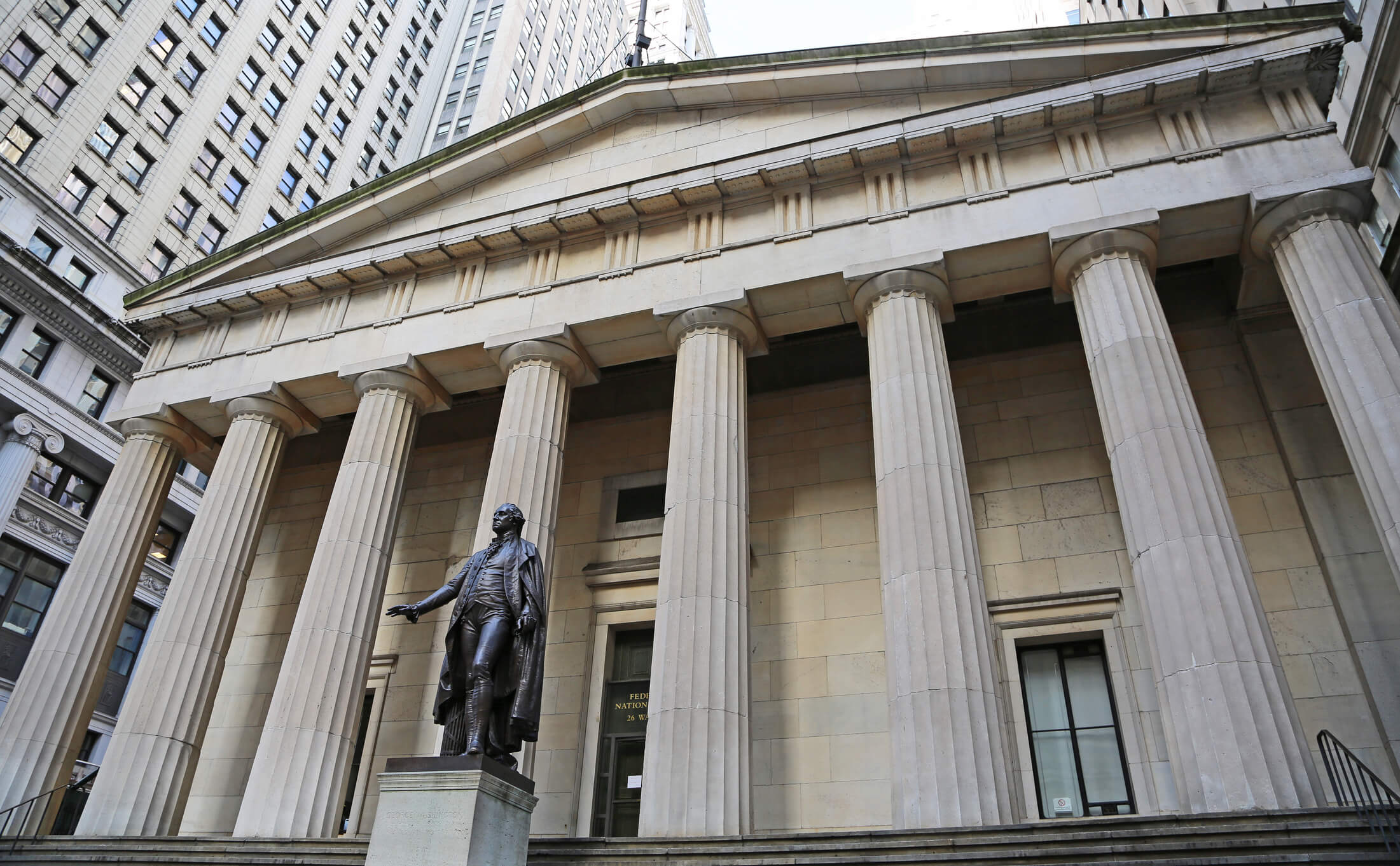
Federal Hall is an early 19th century building between Wall and Pine Streets in lower Manhattan, the heart of New York City’s financial district. Its most impressive feature is the larger-than-life bronze statue of George Washington on the steps on the Wall Street side. The statue stands on the spot where the first President took his oath of office on April 30, 1789, its right hand raised as if it had just been lifted from the Bible.
The visitors’ entrance is at the back of the building on Pine Street. An entry hallway leads to a two-story domed rotunda lined with marble columns. Exhibition rooms off the hallway and the rotunda feature descriptions of key events that took place in earlier iterations of the building: the trial of Peter Zenger for sedition in 1735, a victory for colonial freedom of the press; the Stamp Act Congress of 1765, the first joint meeting of colonies protesting imperial taxation; the passing of the Northwest Ordinance in 1787, which defined the government of future states in the Midwest; George Washington’s first inauguration as President in 1789; and Congress’s passing of the amendments that would become the Bill of Rights, also in 1789.
- Two of these key events are visualized. The Zenger trial is represented by a replica of an 18th-century printing press and a quote on the wall from Zenger’s lawyer, Andrew Hamilton, that the case was about upholding the right “of exposing and opposing arbitrary power.”
- Washington’s inauguration is depicted through several prints and paintings of the scene as well as portraits of the President. The Bible on which Washington took the oath of office, which is owned by the Masonic Lodge, is sometimes on display. And the stone slab on which Washington stood rests against the wall of the rotunda.
- The other key events are described in wall panels or through labels in glass exhibit cases.
Additional wall panels cover the history, economy, ecology, and defense of the New York area. There is a 15-minute film in which Park Rangers discuss these topics, as well as America’s Founding. Rangers on duty in the building give tours lasting half an hour that focus on key events that took place in Federal Hall, and the history of the building itself.
The Zenger trial is well described. Washington’s inauguration as President is represented through the paintings and prints in the room off the rotunda, the stone he stood on, and the impressive bronze statue of him taking the oath of office that stands on the exterior steps. The other key events that happened here—the Stamp Act Congress, the passing of the Northwest Ordinance and the Bill of Rights—are mentioned only briefly. The information visitors get is accurate, but slight.
One label calls the peaceful transition from the Articles of Confederation to the Constitution “a revolution… almost without precedent or parallel in history.” But the dramatic events that played out in government in 1789 to 1790 are lost. For example,
- Visitors learn that when Congress sat in Federal Hall, it voted to move the nation’s capital from New York City to the Potomac, but not that this was the result of a deal Treasury Secretary Alexander Hamilton made with Rep. James Madison to get his financial program passed.
- Visitors are told that Congress passed the amendments that became the Bill of Rights, but not how delicately James Madison had to shepherd them through the House of Representatives: He had to persuade colleagues who did not want to add any amendments at all, while resisting amendments that would have tampered with the structure of government.
- There is no mention of Washington going to the Senate to get its advice and consent on the first treaty he needed to negotiate, with the Creek Indians. The experience was so frustrating—he wanted quick answers, senators wanted to talk—that no President has gone to the Senate in person to discuss a treaty since.
The wall texts that discuss greater New York are sometimes interesting: A panel on immigration makes the unfamiliar point that many immigrants from Europe around 1900 went back, as they were coming to the United States to work, not to settle. Overall, however, there is a blizzard of information about topics unrelated to the site.
One story that ought to be covered, since it involves a New York Founder, is John Jay’s role in ending slavery in the state. In 1785, John Jay was elected first President of the New-York Manumission Society, which educated black children and lobbied for emancipation. In 1799, as governor, he signed the law which set a date for all slaves in New York to be freed. When the day came, July 4, 1827, William Hamilton, pastor of the AME Zion Church, proclaimed: “Blessed God! How good it is, he [John Jay] has lived to see, as a reward, the finishing of a work he helped to begin.”
The texts and labels that greet the visitor are generally accurate, and often celebratory. The launch of the federal government under the Constitution, and the key events which preceded it, are presented as historic and beneficial. Local and national problems—centuries of pollution in the New York harbor, only recently ended; slavery, introduced by the Dutch, perpetuated by the British, and persisting after independence—are given their due, without being inappropriately dwelt on.
Most of the rooms at Federal Hall are small and can get crowded on busy days. There are only a few visually interesting items, supplemented with lots of text, much of it not about the specific site.
There is a gift shop that offers brochures and some charming souvenirs—Hamilton mugs, Washington bobble heads.
There are interesting sites close by. The New York Stock Exchange is across Wall Street and offers its own tours. Two blocks west on Wall Street, across Broadway, is Trinity Church, the cemetery of which holds the grave of Alexander Hamilton.
New York, large and centrally located, was an important city and meeting site during the colonial period, and the home of the new federal government under the Constitution from 1789 to 1790. A number of key events took place in buildings that stood on that spot—City Hall, 1703–1788, and the first Federal Hall, 1788–1812.
In 1735, Peter Zenger was tried in City Hall for libeling royal Governor William Cosby in his newspaper the New York Weekly Journal. The jury’s decision to acquit Zenger made the law of seditious libel under which he was prosecuted a dead letter. As a result, America’s colonial press would be remarkably freewheeling.
In 1765, Parliament passed the Stamp Act, imposing a tax on all paper documents used in the colonies. Delegates from 12 colonies met in City Hall to protest, presenting a united front against imperial overreach.
During and after the Revolutionary War, the capital of the new nation moved from Philadelphia through several other cities, landing finally in New York. In 1787, the Continental Congress, meeting in City Hall, passed the Northwest Ordinance, forbidding slavery in the future Midwest.
French engineer Pierre L’Enfant remodeled City Hall to make it a suitable home for the new Congress under the Constitution. George Washington took the presidential oath of office on a balcony overlooking Wall Street. Congress passed groundbreaking legislation: establishing three executive departments (State, Treasury, War); organizing the federal judiciary; assuming the debts of the states and honoring all U.S. government IOUs at the same rate; negotiating the United States’ first treaties under the Constitution; moving the nation’s capital to Philadelphia for 10 years beginning in December 1790, then to a site on the Potomac River; and sending 12 amendments to the states, 10 of which, ratified by 1791, would become the Bill of Rights.
Federal Hall was torn down in 1812. The building on the spot today was built in 1842 and served as a custom house and a depository for the Treasury. In World War I, a giant rally for buying bonds was held on the front steps. On September 16, 1920, an anarchist bomb exploded down Wall Street at lunch hour, killing 38 people—the worst terrorist attack in the city until 9/11. On the first anniversary of 9/11 in 2002, Congress met in the rotunda of Federal Hall as a show of patriotic remembrance.
Owned By: National Trust for Historic Preservation
Operated By: National Park Service
Government Funded: No
Did you know?
George Washington, the first President, took his first oath of office at the Federal Hall National Memorial.
Recommended Reading
- Gotham: A History of New York City by Edwin G. Burrows and Mike Wallace
- The Age of Federalism by Stanley Elkins and Eric McKitrick
Reviewed By
Richard Brookhiser
Historian, Author of Founding Father: Rediscovering George Washington; Alexander Hamilton, American; and James Madison, and Senior Editor of National Review
The opinions expressed above are those of the Reviewer who is providing a good-faith historical assessment to educate the public. Reasonable opinions can vary, and the Reviewer’s opinion is not necessarily the opinion of The Heritage Foundation or its affiliates.