New Mexico History Museum
Museum that chronicles the history of New Mexico and the broader Southwest region that later became part of the United States
Site Details
Pin location is approximate.
113 Lincoln Ave
Santa Fe, NM 87501
Family Friendly?
Yes
Visitors Per Year
70,000
The New Mexico History Museum and the Palace of the Governors are two distinct buildings on a single campus. The main entrance is to the museum, which is the best place to start, followed by a walk through the interior courtyard to the Palace. A third building houses the museum’s working photo archives and library, which are accessible by appointment only.
The cornerstone exhibit in the museum is called “Telling New Mexico: Stories from Then and Now,” which is well done. The “then” long predates colonial settlements on the east coast, as Spanish explorers began seeking the Seven Cities of Gold all the way back in the 1500s. In 1598, the first Spanish settlement in present-day New Mexico was founded by some 500 settlers and 10 Franciscan priests, and the role of Catholicism in the region became part and parcel of its story.
In the subsequent decades, Spanish and Native American forces waged territorial battles; there was a great deal of conflict not only over territory, but culture and religion as well. These were two very different worlds coming together, and, while they experienced periods of peace and good relations, there were many revolts and counter-revolts and shifting alliances between the Spanish and nearly two dozen Native American tribes, pueblos, and nations.
The exhibit traces much of this history in fascinating detail, then moves through historical milestones like the founding of Mexico, the establishment of the Santa Fe Trail, and the impact of the late 19th century doctrine of “Manifest Destiny,” which resulted in the largest territorial expansion in U.S. history. It covers America’s “forgotten war” with Mexico, the Mexican–American War, which schoolchildren seem rarely to be taught. It goes on to cover the Civil War (which included a lesser-known but significant battle in New Mexico), the United States’ unfolding “Indian Policy,” and the outlaw period featuring one particularly notable name, Billy the Kid. It also covers the advent of the railroad, New Mexico statehood, and the complex web of competing land claims between the original Native Americans and Spanish settlers who were given land grants by “New Spain,” and American settlers, some of which continue to be contested today.
Upstairs from the main exhibit hall the museum has smaller exhibit spaces featuring items of local interest, such as the burning of Zozobra (“Old man gloom”), an annual Santa Fe tradition, and “Home on the Range,” tracing the historical intersection of southern New Mexico ranches with the White Sands Missile Range. The museum’s lower level features a fun mid-20th century hospitality exhibit called “The Fred Harvey Company and its Legacy,” a photographic exhibit entitled “Working on the Railroad” that highlights the workers who built America’s transcontinental railroads, and smaller exhibits on World Wars I and II and The New Deal in New Mexico. Other exhibits were closed due to construction, but there is plenty to see.
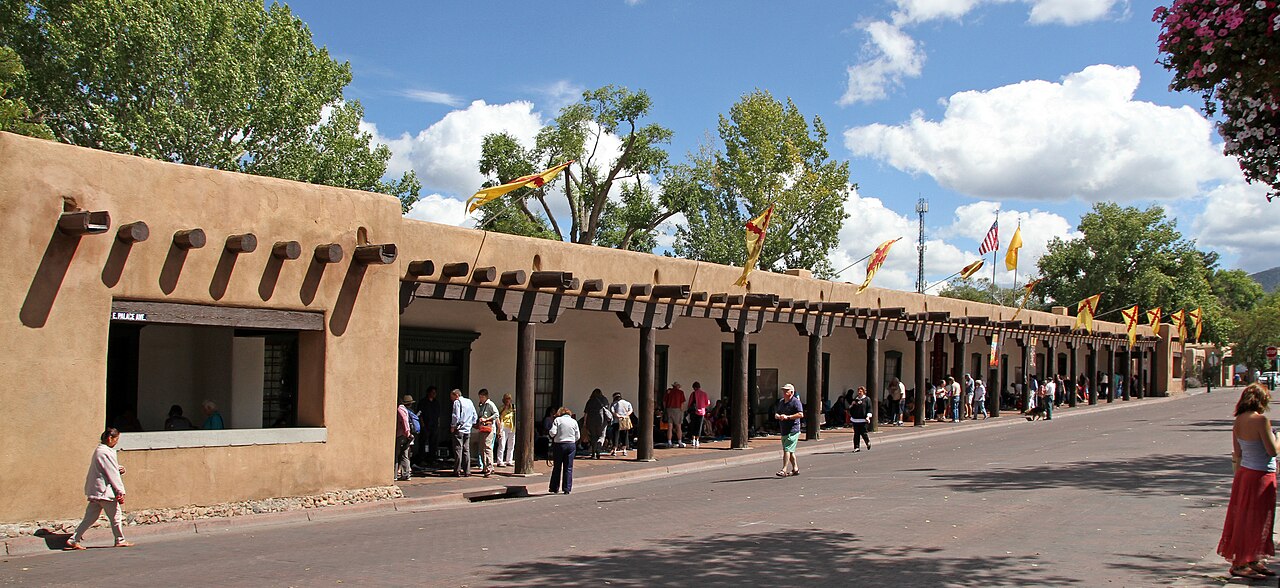
The adjoining Palace of the Governors is the oldest public building continually in use in the United States. The rambling Spanish-Pueblo Revival-style building played a key role in the history of New Mexico, alternately under the control of Spanish and Native American interests. It has been designated a National Historic Landmark and a National Treasure by the National Trust for Historic Preservation.
Currently undergoing renovations, the Palace is mostly empty of furnishings but can be ambled through. Exhibits on the walls include images of the Palace through time, historical and archeological highlights, and special topics like Santa Fe’s railroad history and the Santuario de Chimayo, a Catholic sanctuary to which tens of thousands of pilgrims walk up to 70 miles during Holy Week. It also features a fun exhibit on New Mexico dining called “Forks in the Road” and a 32-foot model train. Outside, its block-long portal features Native American artisans selling handmade jewelry and crafts.
Most of the historical references to incursions, retreats, battles, revolts, and power changes present the actual dates, times, and events, but not knowing what is not included makes it difficult to conclude how accurate and comprehensive the museum is. In fairness, there is a great deal of ground to cover, given both the museum’s more than 500-year scope as well as the various ethnic backgrounds of visitors to the museum, who may come with their own perspectives and biases.
One tour guide gave an example of someone who cut off the guide’s statement, “The Spanish arrived…” by saying, “The Spanish invaded.” There were many different players in this complex period of history, and depending on one’s perspective, either statement could ring truer. The guide said the museum has a strict policy of not taking sides, and the overall visitor impression is that the museum presents a fair and balanced overview of the area’s history (though that could vary by tour guide).
- The exhibit on the Mexican–American War includes a big, backlit replica of a famous George Crofutt painting called “American Progress,” sometimes also called “Westward Ho!” which the Library of Congress describes as showing “an allegorical female figure of America leading pioneers westward, as they travel on foot, in a stagecoach, Conestoga wagon, and by railroads, where they encounter Native Americans and herds of bison.” In describing the painting, one tour guide suggested that it was somewhat ethnocentric.
- At the entrance to the Palace of the Governors is a land acknowledgment statement that says the museum “recognizes that the Palace campus carries out public functions as part of a centuries-old tradition and may be viewed differently from one community to another based upon historic associations.” This statement seems to demonstrate less of an ideological bias than a genuine recognition of how many times the Palace and its grounds have changed hands.
- One exhibit in the Palace was a project of local high school students called “Gas Baths and the Bracero Program in New Mexico and Beyond.” It touches on a virtually unknown and controversial early 20th century government project, comparing it to the gas chambers in Nazi Germany, which seemed a bit hyperbolic.
- The Palace also uses BCE rather than B.C.
More generally, the vision of the museum is to offer “a welcoming place for exploration of multifaceted views on history, dialog that bridges social and cultural divides, and reflection on the conditions needed for a more resilient, just, and sustainable future.” It is guided by five “assumptions”:
- The study of history ranges from stories of individuals and accounts of community life to tracing patterns of social change and seeking to understand the past through multiple causes and conditions.
- The telling of history must be honest, accurate, and responsible, acknowledging a commitment to truth, support for the basic tenets of human rights, and awareness of the nature and use of power.
- New Mexico history is not a single, universally accepted story or an interwoven tale of three cultures, but a tapestry of narratives drawn from the lived experiences of many people at various points in time throughout the entire state.
- Objects, images, and documents can serve as evidence of past times and an emotional connection between viewers and the past; they are also reflections of the interests, resources, and views of those who collected them.
- An understanding of the past provides insights into the many ways of being human, the dynamics of change, and the nature of society—all of which can contribute to informed citizenship, a more ethical society, and broader achievement of a greater quality of life.
Most of the content and presentation are oriented towards adults, although the museum tries to engage younger visitors through its “Investigations” worksheets that engage kids on a sort of scavenger hunt. The text of each exhibit should be carefully evaluated based on its subject matter and what it does and does not say, which is best done by a mature adult mind.
New Mexico is the first region of America to which European settlers came, predating even the Pilgrims. The Palace of the Governors was built in 1610, just three years after the founding of Jamestown and 10 years prior to the Mayflower Compact and the establishment of the Plymouth Colony in what would become Massachusetts.
The museum presents a tour through the largely unknown history not only of the state of New Mexico, but of what once was the New Mexico Territory, which in 1794 made up almost 75 percent of the current land mass of the United States, stretching east to Louisiana, north to Canada, and west to the Pacific Coast.
Often overlooked as simply part of the “Sunbelt,” this part of the country also dominated late 19th century American policy and politics. New Mexico and its environs played a key, if overlooked, part in the “manifest destiny” of America.
The museum sits at the heart of the world-famous Santa Fe Plaza, with lots to do and see in the immediate vicinity.
Owned By: State of New Mexico, governed by the Museum of New Mexico Board of Regents
Operated By: New Mexico Department of Cultural Affairs
Government Funded: Yes
Did you know?
New Mexico was called New Mexico in 1563, more than 200 years before the nation to its south adopted “Mexico” as its name. Both take their names from the Aztec valley in present–day Mexico.
Recommended Reading
- New Mexico’s Palace of the Governors: History of an American Treasure by Emily Abbink
- New Mexico: Past and Future by Thomas E. Chavez
Reviewed By
Steve McKee
Visiting Fellow at The Heritage Foundation
The opinions expressed above are those of the Reviewer who is providing a good-faith historical assessment to educate the public. Reasonable opinions can vary, and the Reviewer’s opinion is not necessarily the opinion of The Heritage Foundation or its affiliates.