Princeton Battlefield State Park
Site of the Battle of Princeton, the final victory in Washington’s “Ten Crucial Days” campaign, and where the Clarke House served as a field hospital for the wounded of both armies
Site Details
Pin location is approximate.
Clarke House 500 Mercer Rd
Princeton, NJ 08540
Family Friendly?
Yes
Visitors Per Year
5,000
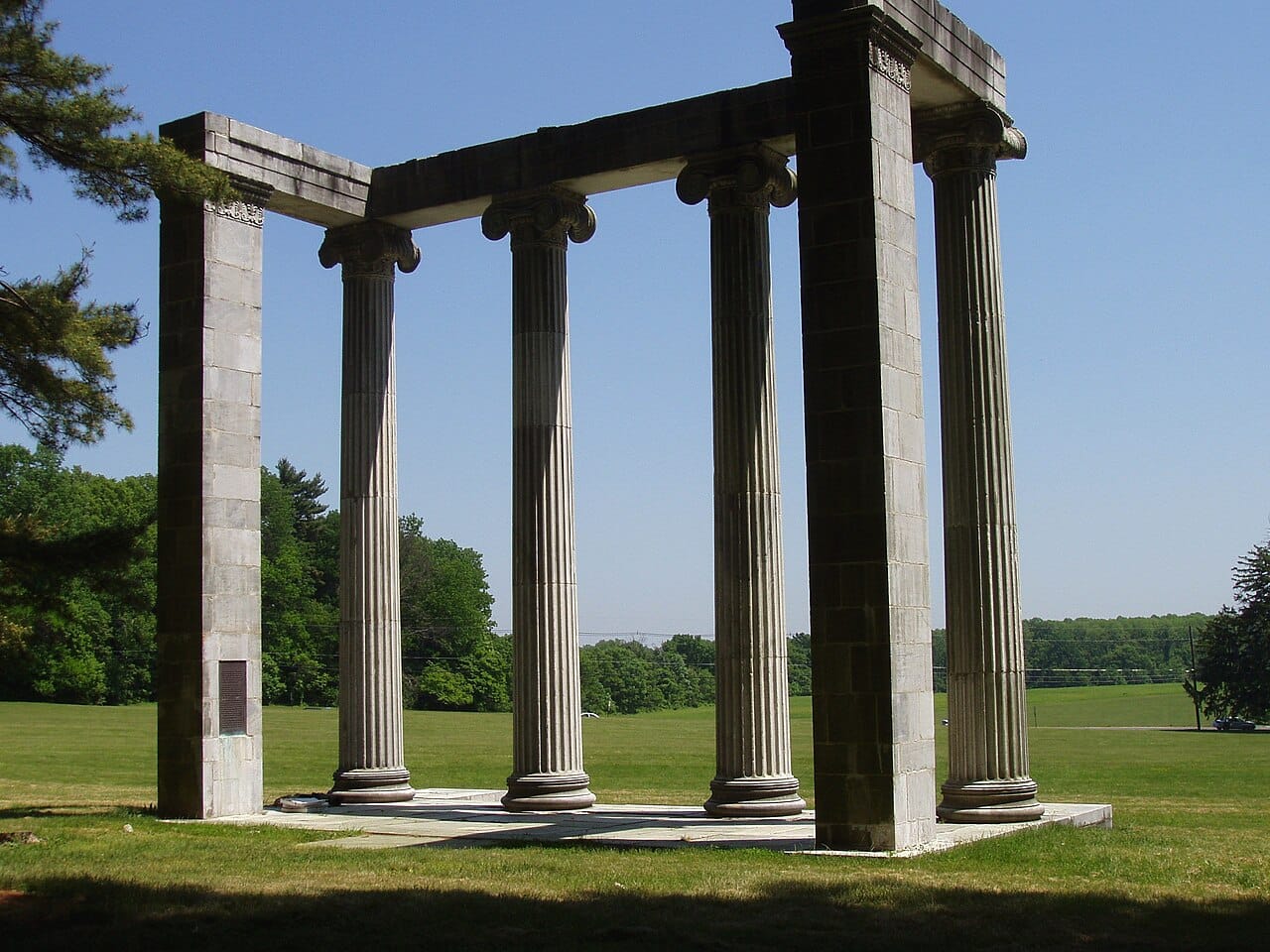
The Princeton Battlefield State Park, a spacious park divided by a road, features 13 signs that detail key moments of the battle and surrounding context. It also includes the Clarke House, a Quaker residence that played a role in the conflict, the remnants of an oak tree commemorating General Hugh Mercer, and a commemorative colonnade. Visitors to the battlefield and Clarke House learn about the Battle of Princeton and the overarching significance of the “Ten Crucial Days,” during which the Patriots won several significant victories in the War for Independence. Visitors will also learn about 18th-century Quakers and agrarian life through the extensive exhibits at the Clarke House.
The Clarke House Museum partners with local sites for events, offers tours of the battlefield and house, and includes a supervised please-touch history museum where families can interact with replicas of historic items. It also offers interactive workshops where kids can learn about foodways (era-specific production and consumption of food), candle making, historic dyes, Lenape beading, and making historic items like a garlic basket.
The tour guides are not given a direct script to follow but are expected to offer detailed information about the house and battle.
The tour guides at the Clarke House focus more on the Clarke family and home than the battlefield, so visitors should rely on the plaques for information about the battle. The exhibits in the Clarke House and the plaques surrounding the site provide accurate, detailed information about the battle and place the battle within the larger context of the War of Independence and the daily life of 18th-century Quakers.
Likely due to the influence of the Princeton Battlefield Trust, the plaques and exhibits in the Clarke House are thoughtful and informative without evincing ideological bias or inserting modern political issues into their representation of the past. However, many tour guides choose to emphasize aspects of history with an ideological bent. For example, some guides end tours with a land acknowledgement to the Lenape people, inserting an issue with no relevance or relation to the era of history discussed at the site.
The guides do thoughtfully overview the problem of slavery for 18th-century Quakers, using the example of Susannah and the Clarke family. Susannah was an enslaved woman serving the family during the battle, though slavery was then condemned by the Quaker community who had begun a 10-year manumission plan. Tour guides condemn the enslavement of Susannah in ideological terms, but they also relay how Susannah was given family heirlooms in the family patriarch’s will and was written about favorably in family records. This story reflects the conundrum of the practice of slavery by the Clarke family, who were Quakers and believed slavery went against Quaker doctrine. The guides use this example to illustrate many of the ideals at play during that time as well as the varied aspects of human nature.
The battlefield and Clarke House are family friendly and provide a great opportunity for children to visualize both 18th-century life and the scope of a Revolutionary War battle. The site would pair perfectly with a morning or afternoon spent at nearby Washington’s Crossing. The videos and plaques surrounding the battlefield are informative and family friendly.
The semiquincentennial of the Battle of Princeton will take place in 2027, and the site is experiencing an uptick of visitors in anticipation of America 250.
The Battle at Princeton is best known as the conclusion of the “Ten Crucial Days” during which American troops under the command of George Washington achieved three vital victories, beginning with Washington’s famous crossing of the Delaware. These victories inspired the bedraggled American troops of the Revolutionary War to keep fighting. Washington’s crossing, and the American victories at the Battle of Trenton and the Battle of Princeton in January 1777, reinvigorated American war efforts and led to the Battle of Saratoga later in the fall of that year, which is considered the turning point of the American Revolution.
The Clarke House was built by a Quaker named Thomas Clarke as part of a 200-acre farm. The house became a field hospital after the battle. The Clarke House is not known to have been visited by General Washington during the battle. However, Dr. Benjamin Rush, the father of American medicine and a Founding Father, treated General Hugh Mercer, general of the Continental Army, in the home. Mercer died from his battle wounds in the house. Not far from the house is the site of the historic Mercer Oak, named in the general’s honor. The original tree, which, legend has it, is where a fatally wounded Mercer leaned while encouraging his men to stand their ground, was felled by a storm in 2000. An offspring grown from an acorn of the original tree was planted in its place.
Not far from the Princeton Battlefield State Park, on the campus of Princeton University, is Nassau Hall, where the battle ended. Less than a mile from Nassau Hall is the Walter Lowrie House, the official residence of Princeton’s president.
Owned By: New Jersey State Park Service
Operated By: New Jersey State Park Service, Princeton Battlefield Society
Government Funded: Yes
Did you know?
The Battle at Princeton ended at Nassau Hall, the main building on the campus of the College of New Jersey (today known as Princeton). In 1783, the building served as the nation’s capital when the Continental Congress met.
Recommended Reading
Washington’s Crossing by David Hackett Fischer
Rush by Stephen Fried
When Washington Crossed the Delaware: A Wintertime Story for Young Patriots by Lynne Cheney
Reviewed By
Claire Aguda
Visiting Research Fellow at the Russell Kirk Center for Cultural Renewal
The opinions expressed above are those of the Reviewer who is providing a good-faith historical assessment to educate the public. Reasonable opinions can vary, and the Reviewer’s opinion is not necessarily the opinion of The Heritage Foundation or its affiliates.