Strawbery Banke Museum
Museum that preserves a historic Portsmouth neighborhood, showcasing its evolution from the 1760s to the 1950s
Site Details
Pin location is approximate.
14 Hancock St
Portsmouth, NH 03801
Family Friendly?
Yes
Visitors Per Year
80,000
Strawbery Banke brings more than 350 years of history alive, from Indigenous history to the present day, in a historic waterfront neighborhood in Portsmouth, New Hampshire. The museum interprets a changing neighborhood and tells the stories of everyday life throughout the ages. Visitors are invited to tour historic houses on original sites, meet engaging costumed role players, watch traditional crafts demonstrations, and explore heirloom gardens and historical landscapes.
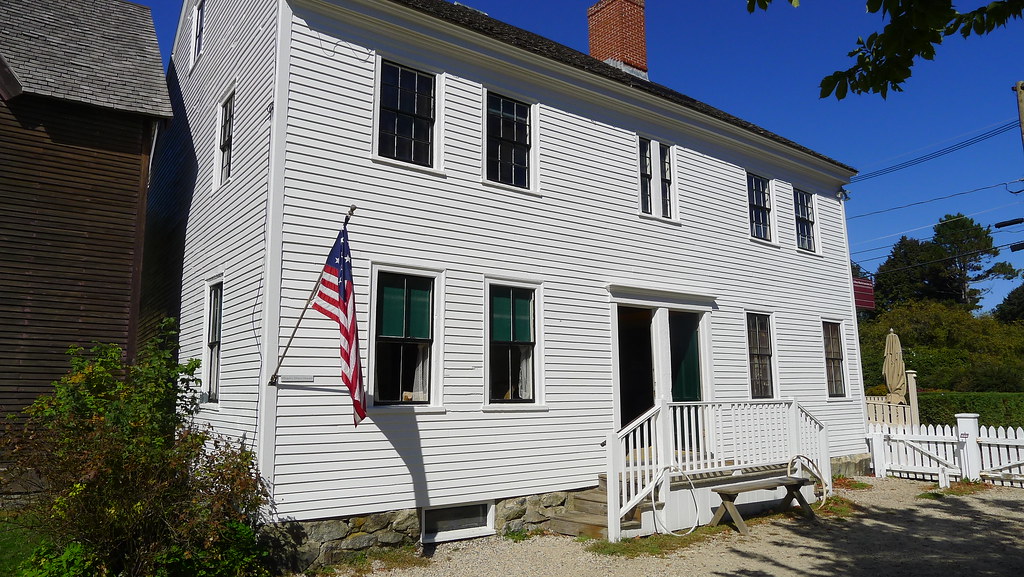
Strawbery Banke consists of 26 houses and eight gardens. To provide a few examples:
- Lowd House: Built circa 1810, the Lowd House features woodworking tools of the 19th century. Peter Lowd was a cooper (barrel maker), who purchased this house in 1824. The house is in the Federal style, which includes elegant woodwork around the front door with a fanlight and pilasters. The southern portion of the house was added to an early Georgian structure. Lowd’s work as an artisan allows the museum to exhibit the trades of boatbuilding, brewery work, cabinet making, and coopering. All of these trades point to the importance of wood in the advent of the Industrial Revolution in Portsmouth.
- Yeaton House: Built circa 1795, the Yeaton House’s theme is war, trade, and travel in the port of Portsmouth. Yeaton House illustrates the transition architecturally from the Georgian to the Federal style. The Port of Portsmouth exhibition shows the evolution of the city’s maritime history. A largely working-class neighborhood, this part of the city supplied the workforce to shipbuilding, fishing, and crews on trade and war vessels. The exhibit includes first-person accounts from aboard the USS Kearsarge during the Civil War, when the Portsmouth Naval Shipyard and the Continental Navy were launched. The exhibit features numerous models of ships built in Portsmouth, a recreated shipping office, and decorative aspects of the maritime industry.
- Aldrich House and Garden: Built circa 1797, the Aldrich House interior dates from 1909. Portsmouth merchant Thomas Bailey purchased this house in the first quarter of the 19th century. His grandson Thomas Bailey Aldrich visited this home as a child and set his novel A Story of a Bad Boy here. Although born in Portsmouth, Aldrich spent much of his youth in the South and New York City, where his literary circle included William Dean Howells, Mark Twain, and Henry Wadsworth Longfellow. He succeeded Howells as editor of The Atlantic Monthly. Upon his death, his widow Lilian purchased the Aldrich House and created a memorial to her husband. Each room uses imagery from A Story of a Bad Boy. Thomas Bailey Aldrich House Museum opened in 1908, and Strawbery Banke re-opened the house in the 1990s.
- Pridham House: Built circa 1795, Pridham House is interpreted from the angle of the 1950s. The Shapley-Drisco-Pridham House shows the domestic settings of two very different generations of occupancy. The right half shows how the Shapley family lived in the 1790s and the left half interprets how the last families lived here in the 1950s, before Urban Renewal and the subsequent founding of Strawbery Banke. The Pridham family lived on the left side of the building after it was changed into a duplex. Blanche Pridham worked at the Liberty Street Laundry, and Joe Pridham worked at the Portsmouth Naval Shipyard after returning from WWII. The house celebrates the 1950s neighborhood of working-class residents who socialized at picnics, played baseball, and participated in community parades.
Strawbery Banke is informative about Portsmouth history and the people who lived over time in this part of the port city. The exhibits are largely accurate about the sort of work tradesmen did and the décor and furniture of period homes. But, because the museum lacks an overarching narrative and orientation to both Portsmouth and the neighborhood, its historical accuracy is difficult to judge. The periods of history covered can be disorienting.
One of the houses closest to the entrance—the Jones House—features a video and exhibits about the English settlers’ mistreatment of local native tribes, which can give visitors the first impression that the original settlement and the history of Portsmouth arose from great injustice. Visitors do not have to start with the Jones House, but if they do, their museum experience may start with feelings of shame and anger directed at the original English settlers.
A recent addition to Strawbery Banke is a Seacoast African American Cultural Center, a small museum on site that celebrates black Americans but seems unrelated to the museum’s main focus on the neighborhood’s history. The inclusion of Native American and black American narratives not only seems forced, but it casts a cloud of suspicion over the entire neighborhood even as Strawbery Banke functions in many respects as a vehicle to promote tourism in Portsmouth and keep alive local history—the history of white settlers and their descendants. Social justice activists might well complain that Strawbery Banke acknowledges oppression while at the same time profiting from it.
Aside from the assault on settler colonialism in the Jones House, and the overt celebration of African-American culture unconnected to local history in the Seacoast African American Cultural Center, ideological bias is mainly an undercurrent.
At certain points, visitors to the museum will notice signs of the initiatives that Strawbery Banke describes on its website, such as:
- Abenaki Heritage Initiative: “Over the years, Strawbery Banke has hosted panel discussions and lecture series about Indigenous heritage; featured Indigenous artisans, storytellers, and experts; and added exhibits and events focused on the heritage of Abenaki peoples. The Abenaki Heritage Initiative provides an umbrella under which to organize the continued relationship building with Abenaki descendant communities and planned daily programming and special events featuring Indigenous stories.”
- Diversity, Equity, Inclusion, Accessibility, and Belonging (DEIAB) Task Force: “Strawbery Banke Museum tells the stories of the diverse neighborhood called Puddle Dock and indigenous peoples of the Seacoast area. We endeavor to: Foster a culture that is equitable, inclusive, and accessible for a diverse workforce; Offer inclusive, decolonized*, and accessible historical interpretation, providing the necessary tools to allow everyone to enjoy the museum’s daily program; and Accurately and holistically reflect this rich history through a team that is composed of a diverse and inclusive group of community members.”
- Personal Pronouns: Museum visitors may notice staff wearing pins alongside their name tags, indicating whether they use she/her, he/him, or they/them pronouns. The effort toward ensuring that a person’s chosen name and desired pronouns are being used is a basic courtesy and aligns with the mission of the Museum’s DIEAB Task Force. We invite you to learn along with us about the importance of personal pronouns and to help us create an environment where everyone’s identities are valued.
Portsmouth is a very attractive and seemingly thriving New England seaside town. It is filled with shops, eateries, and small hotels. The city also has a well-preserved set of houses from the early 19th century and some from the 1750s. For families and visitors wanting to explore a small New England town, Portsmouth is very inviting. Strawbery Banke is only one part of the city’s draw to tourists.
The Strawbery Banke website boasts “costumed role players,” some of whom “demonstrate traditional crafts.” Depending on the season, there are sometimes few role players on-site, but the guides (not in every building) are helpful. Staff members usually offer a short introduction about the house and are then available to answer questions. In specific houses, the exhibits include minimal hands-on displays for woodworking either for housing construction or shipbuilding.
Parents will want to keep an eye on the large collection of children’s books, and designated reading area, devoted to Native American history. A glance through these resources showed children’s stories that plausibly comment on the challenge of colonial settlements in a way that portrays natives uniformly as victims of European domination. Noticeably lacking is a comparable dedicated section featuring children’s reading material about tradesmen, 1950s urban life, or even the experience of becoming a writer and editor.
There are no hands-on activities for children. However, Strawbery Banke seems to be a destination for homeschoolers, especially on those days when the museum sponsors kid-friendly events, which they do quite often. For example, Springfest allows children to see and interact with baby farm animals. In the “Living on Turtle Island” program, adults and children learn to make wigwams, cook Native American food, and play indigenous games. In June, to round out a sample of events, the museum has weeklong summer camps on historical fiction writing for children (one group) and teenagers (another).
Strawbery Banke is potentially significant for observing a sweep of American history, from the colonial period to the middle of the 20th century in a location that is off the beaten path of famous colonial destinations. New Hampshire itself is rich in colonial intrigue. Settled in 1623, New Hampshire received its own political administration in 1629 while still within Massachusetts, and became its own colony in 1677, with a royal charter in 1679 to make independence official.
Portsmouth was an important port for the colony (and later the state), though it never achieved the industrial output that Manchester, New Hampshire, did as the largest cotton textile plant in the world at one point. Portsmouth’s economy was always geared to shipping and shipbuilding, which is a theme that Strawbery Banke captures well in several of its houses.
Portsmouth was also important to the American Founding. The city was protected by Fort William and Mary, which Patriots raided in 1774 at the behest of Paul Revere, who warned that the British navy was en route to lay siege to the city. During debates over the Constitution, New Hampshire’s delegation was the ninth (and decisive) vote to ratify the United States’ new federal government. Even later in U.S. history, Portsmouth was home to negotiating and signing the Treaty of Portsmouth (1905) which ended the Russo-Japanese War.
Visitors to Strawbery Banke with some knowledge of New Hampshire history may well connect the dots between the museum’s exhibits and the development of the city and state within the United States’ history. But because the museum stresses local residents and their occupations, these larger connections are lacking.
Owned By: Strawbery Banke, Inc.
Operated By: Strawbery Banke, Inc.
Government Funded: Yes
Did you know?
Thomas Bailey Aldrich (1836–1907), novelist, poet, and editor of the Atlantic Monthly magazine between 1881 and 1890, spent several years of his childhood with his grandparents in Portsmouth. Their home is part of the museum, though Aldrich spent his adulthood in Boston and Saranac, New York.
Recommended Reading
- An Old Town by the Sea by Thomas Bailey Aldrich
- Strawbery Banke: A Seaport Museum 400 Years in the Making by Dennis Robinson
Reviewed By
D. G. Hart
Professor of History at Hillsdale College
The opinions expressed above are those of the Reviewer who is providing a good-faith historical assessment to educate the public. Reasonable opinions can vary, and the Reviewer’s opinion is not necessarily the opinion of The Heritage Foundation or its affiliates.