Nebraska History Museum
The flagship site and the headquarters of the Nebraska State Historical Society
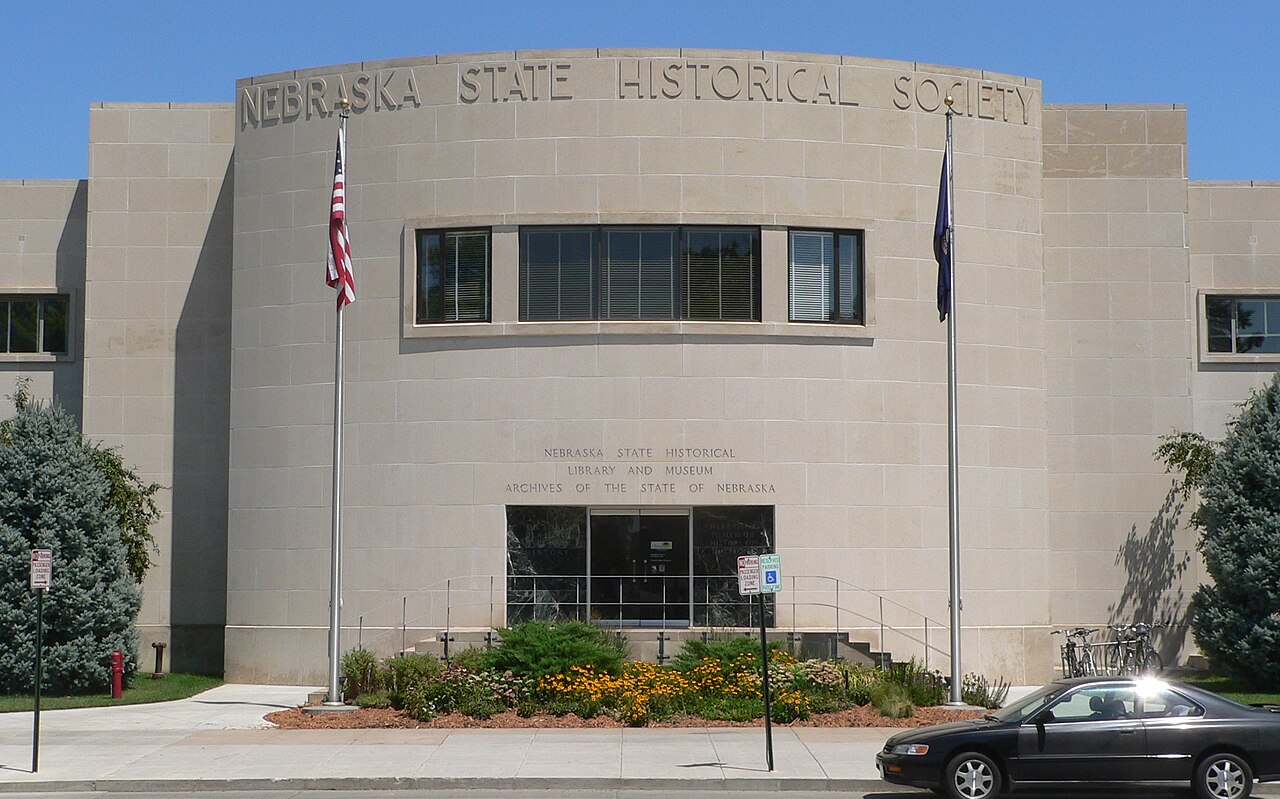
Site Details
Pin location is approximate.
131 Centennial Mall N
Lincoln, NE 68508
Family Friendly?
Somewhat
Visitors Per Year
70,000
The museum is primarily a walk-through experience divided among three floors, each with a different thematic emphasis.
- The main exhibits on the first floor focus heavily on Native American life in Nebraska. Artifacts such as tools, clothing, pottery, and other items illustrate how Indigenous communities lived and adapted to Nebraska’s harsh environment. While the displays are informative, they occupy a substantial portion of the museum’s space, allowing for comparatively less attention to other foundational chapters of state history, such as the pioneer settlement era or Nebraska’s political development.
- The second level shifts toward cultural artifacts and lighter material about Nebraska life. Objects on display highlight immigration, community traditions, and local culture, supplemented by smaller exhibits that share scattered historical “snapshots” or fun facts. A section of the floor is reserved for traveling exhibits, which rotate throughout the year. The current traveling display focuses on the creators of Curious George. Although the exhibit was developed in Nebraska, the story of how the creators of Curious George escaped the Nazi siege of Paris has no connection to Nebraska history and takes up valuable space that could have been used to paint a more complete picture of the state.
- The third (top) floor is devoted primarily to children. It functions as a play and discovery space, filled with interactive activities and hands-on stations designed to introduce younger visitors to historical themes.
While the museum succeeds in providing an accessible and interactive experience, its structure and content prioritize cultural anecdotes and present-day sensibilities over a rigorous and proportional account of Nebraska’s historical contributions.
The Nebraska History Museum fails to fully meet scholarly standards of accuracy and comprehensiveness.
- The exhibits at the Nebraska History Museum give the impression that Native American history is the dominant force in the state’s past. The first floor divides Nebraska history into seven eras, six of which focus on Native peoples, while only one covers the past 300 years of settlement through modern times. The Native-focused eras highlight cultural achievements and daily life, but omit mention of tribal conflicts, leaving the impression of harmonious societies contrasted against negative portrayals of European settlers.
- Several panels on the second floor highlight political history, but the focus is selective. Multiple references celebrate the New Deal and its role in reducing unemployment in Nebraska, yet Republican contributions are almost entirely absent. The one Republican highlighted, George W. Norris, is described primarily as progressive and liberal. While accurate, this is one of the only mentions of Republicans in the museum, creating an incomplete picture of Nebraska’s long political history in a state that is majority Republican.
- The protest exhibit further illustrates the imbalance. One sign displayed reads, “Protect your sisters not just your cis-ters,” a slogan from the 2018 Women’s March in reference to men who identify as women. By presenting transgenderism as representative of women’s rights activism, the exhibit displays a clear ideological agenda and overlooks the many historically significant causes Nebraskan women fought for. The only other sign displayed states, “We are the 99 percent,” a reference to the Occupy Wall Street movement. Together, these examples showcase only modern progressive causes, without reference to the broader history of protest movements that were crucial to the political development of Nebraska, including suffrage, farmers’ rights, and civil rights.
There is clearly an ideological lens in the way the museum emphasizes certain topics while downplaying or omitting others. For example, homesteading, a central element of Nebraska’s development, receives very little attention, while the story of a single formerly enslaved homesteader is highlighted. This selective focus can create a skewed understanding of the state’s history and contributes to inaccuracies in how Nebraska’s past is presented to visitors.
The museum offers interactive exhibits that are likely to engage younger children. The children’s play area on the top floor combines fun with education, offering insights into how children have entertained themselves throughout history. Exhibits like the one on Curious George also cater to younger audiences and make the museum accessible for families.
However, for families seeking a museum that provides an accurate and comprehensive education on Nebraska’s history, this site may be disappointing. Many exhibits focus on topics only loosely related to the state, and those that do address Nebraska history often present it with a noticeable political bias that could influence young visitors’ perspectives.
Nebraska has a rich history that includes the experiences of Native American tribes, as well as noteworthy events like the Lewis and Clark expedition, the Kansas–Nebraska Act, the proliferation of homesteading, and the expansion of railroads in the 19th century. William Jennings Bryan spearheaded the populist agrarian movement in Nebraska, leading to growth in the state’s agriculture in the 20th century. In the more modern era, Omaha has become a national center for the insurance industry and for popular entertainment like the Nebraska Cornhusker football team.
For a visiting family, the location is an ideal spot in downtown Lincoln, Nebraska. There tends to be ample parking within easy walking distance in the summer. A variety of other museums, such as Morrill Hall on the campus at the University of Nebraska and the Nebraska Children’s Museum, are reasonably priced and within walking distance.
Owned By: Nebraska State Historical Society (NSHS)
Operated By: Nebraska State Historical Society (NSHS)
Government Funded: Yes
Did you know?
The museum houses over 125,000 artifacts spanning 13,000 years.
Recommended Reading
- Nebraska History Moments by David L. Bristow
- Marking Time: Nebraska’s Historic Places by Bobbi and Steve Olson
Reviewed By
Steve Bullock
CEO of PerfectRx, former Professor and Vice President for Academic Affairs of Midland University and Professor and Associate Vice Chancellor for Academic and Student Affairs of University of Nebraska at Omaha
The opinions expressed above are those of the Reviewer who is providing a good-faith historical assessment to educate the public. Reasonable opinions can vary, and the Reviewer’s opinion is not necessarily the opinion of The Heritage Foundation or its affiliates.