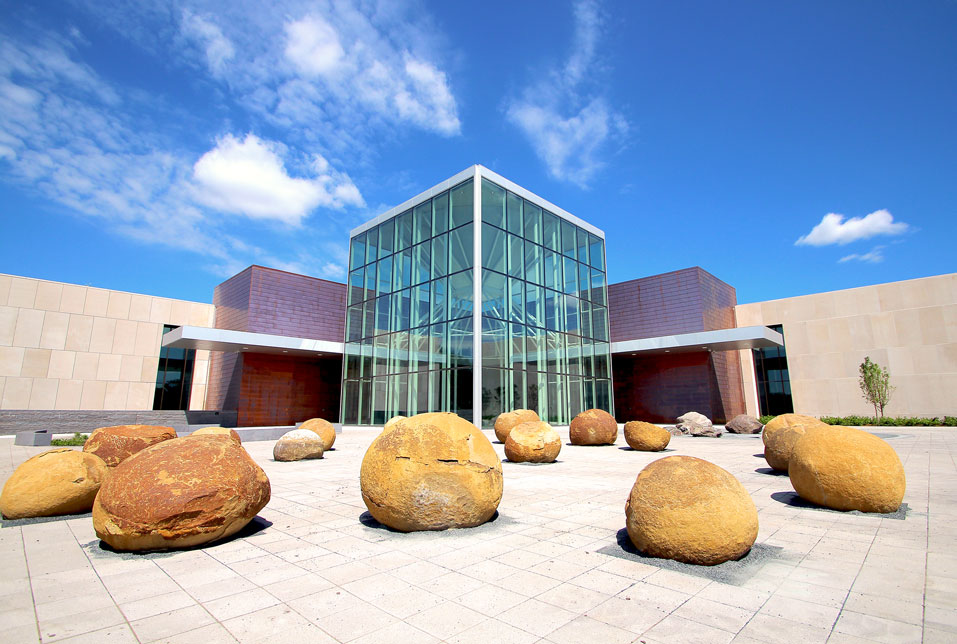
North Dakota Heritage Center & State Museum
North Dakota’s largest museum, tracing the state’s history from its geologic origins 600 million years ago to the present
Site Details
Pin location is approximate.
612 E Boulevard Ave
Bismarck, ND 58505
Family Friendly?
Yes
Visitors Per Year
250,000
The North Dakota Heritage Center and State Museum is near the state government complex in Bismarck and is easily accessible with ample parking. Bismarck is a thriving city and has benefitted greatly from the oil boom in western North Dakota.
Soon after entry, a visitor will encounter the “Guns of North Dakota” display, which provides an analysis of the evolution of weaponry that will interest many tradition-oriented visitors.
- A large frontier army cannon sits within the entrance to the museum, evoking for the visitor the frontier garrisons and frontier army experiences.
- Also in the entryway is a large Mastodon skeleton. This area of North Dakota, especially along the Missouri River breaks, is an active area for dinosaur skeleton excavation, and that exhibit will particularly generate interest among younger visitors.
A Liberty Bell replica, cast in France in 1950, is on display in the main hallway of the center. The placement of the Liberty Bell replica invites visitors to pause and consider the events depicted in the museum within the context of the other major (and more familiar) events in American history.
Another exhibit focuses on Medora Manca, a New York heiress and namesake of the town of Medora. Married to the Marquis de Morès, a French nobleman, the Marquis de Morès, she painted landscapes and scenes around their summer home in western North Dakota. Her watercolors are displayed prominently in the center. Teddy Roosevelt also stayed in Medora as a young man to earn his frontier credentials.
The North Dakota Heritage Center and State Museum is breaking ground on a major expansion—set to open in 2027—to focus on veterans and wars in North Dakota history. As a prelude, there is a display about the dreadnought USS North Dakota on the lower level that will interest many visitors.
Another display called “The Art of Making Do” focuses on the frugality and work ethic of the Germans-from-Russia who migrated to the Dakotas in the 1880s, and who fought to make a living on the prairie. The exhibit focuses on the crafts and woodworking these immigrants did (and would be a great precursor to woodworking projects for kids).
The “Innovation Gallery” focuses on early Native Americans in North Dakota, especially the Mandan. The displays are not excessively moralistic or politically correct, instead focusing on war and hunting and the role of guns and horses in Native American life.
The largest exhibit, called the “Adaption Gallery,” focuses on North Dakota’s production of wheat and sunflowers and forms of energy new to North Dakota, such as oil.
Laced throughout the museum is a fair amount of photography and other imagery related to sports in North Dakota, including old Indian basketball teams and newer images related to the national championships won by teams from North Dakota State University.
The center bookstore has a solid collection of volumes and is not overly stocked with politically correct books. Many of the books are focused on homesteading and the Lewis and Clark expedition.
The North Dakota Heritage Center and State Museum is exemplary, well-financed, and solidly led.
There are no apparent issues of ideological bias.
Kids will likely particularly enjoy the Mastodon skeleton, the Liberty Bell replica, the exhibit on painter Medora Manca, and “The Art of Making Do” exhibit.
Families visiting Yellowstone, Mount Rushmore, or points West should consider visiting the North Dakota Heritage Center and State Museum. It would make an outstanding stopover to break up a trip, and, if time allows, boat rides are available on the Missouri River.
After going through the exhibits at the North Dakota Heritage Center and State Museum, visitors will come to understand an unknown area of the country much better. North Dakota was home to the Mandan, a major cultural entity that nearly vanished; was shaped by the Great Dakota Boom, a process that helped define the settlement of the territory and that determined the nature and direction of the middle of the country; was a site of large-scale migrations of unique settlers such as the Germans-from-Russia; became a center of Populism, a major third–party movement and one of the few which succeeded in American history; and later became a place of essential natural resource development.
Owned By: State of North Dakota
Operated By: State of North Dakota
Government Funded: Yes
Did you know?
The North Dakota Heritage Center and State Museum is next to the State Capitol, an unusual Art Deco building constructed in 1934.
Recommended Reading
- The Horizontal World by Debra Marquart
- Pacing Dakota by Tom Isern
Reviewed By
Jon K. Lauck
Editor-in-Chief of the Middle West Review
The opinions expressed above are those of the Reviewer who is providing a good-faith historical assessment to educate the public. Reasonable opinions can vary, and the Reviewer’s opinion is not necessarily the opinion of The Heritage Foundation or its affiliates.