Grant-Kohrs Ranch National Historic Site
A working ranch, originally established in 1862, that preserves the history and culture of the open range era in the American West
Site Details
Pin location is approximate.
266 Warren Ln
Deer Lodge, MT 59722
Family Friendly?
Yes
Visitors Per Year
27,479
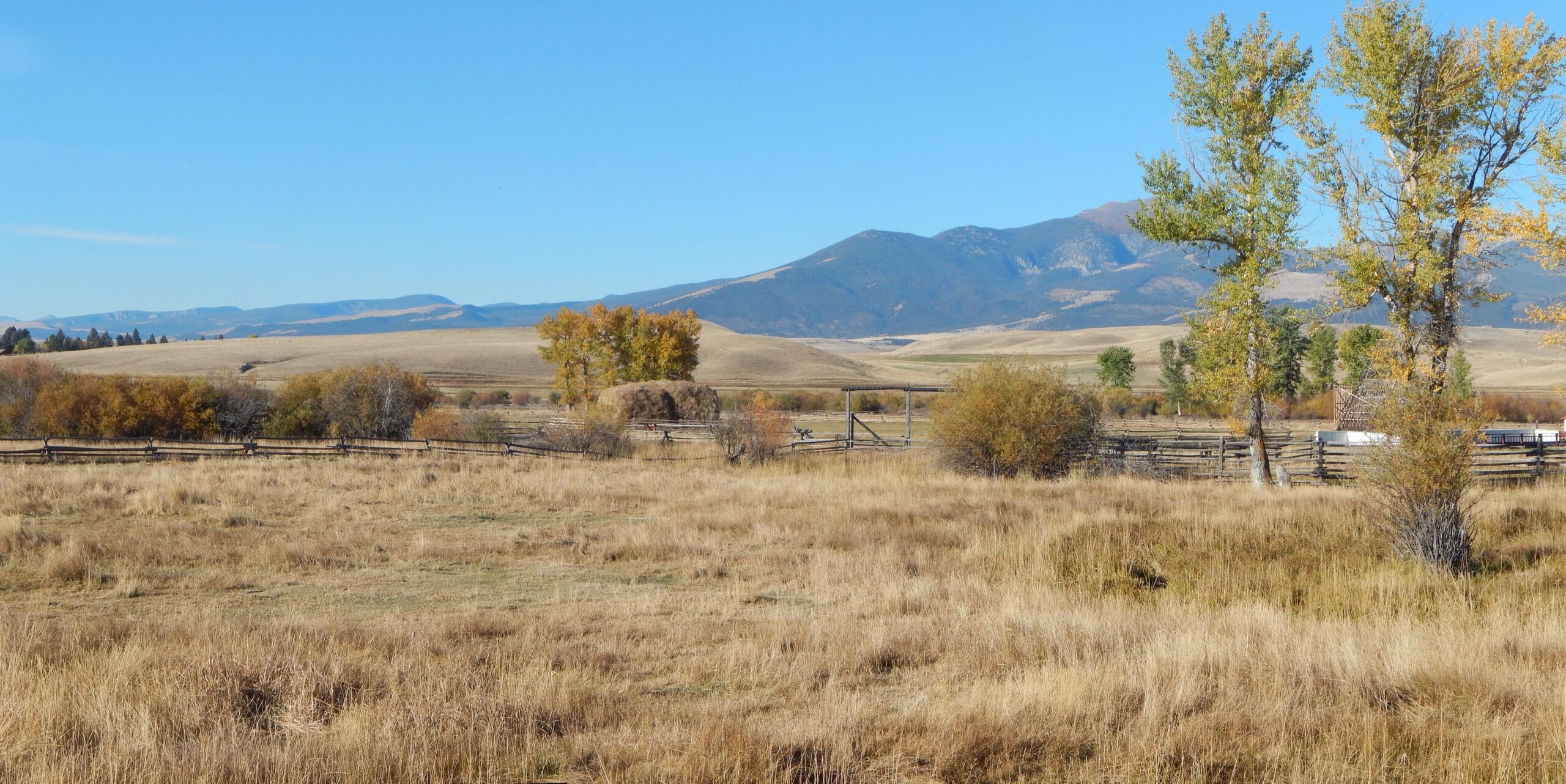
Grant-Kohrs Ranch consists of 88 historic buildings, including the restored ranch house, bunkhouse, barns, granaries, sheds, corrals, hayfields, and several explanatory exhibits that visitors encounter on self-guided tours. At just over 1,600 acres, visitors arrive at the site, park, and then take a walking path to the main house and other buildings. Along the way, there are explanatory exhibits that provide historical details about life on the ranch in the 19th and early 20th centuries. Grant-Kohrs is a working ranch, which makes the site unique. Taking the guided tour of the house and exploring the ranch on a self-guided tour takes about three to four hours.
The Visitors’ Center is very small, and its purpose is for rangers to provide maps of the Ranch and to schedule guided tours of the main Ranch House. Once visitors get their maps, they can proceed along a paved trail to the Ranch House, which is about a quarter mile. There are no guided tours of the property available, but the Ranch House tour is led by a ranger.
The primary attractions at Grant-Kohrs are the main Ranch House, Bunkhouse Row, and the Thoroughbred Barn. The Ranch House was built in 1862 as a trading post, with a small residence upstairs. By 1890, the Kohrs family had expanded the house to include a large parlor, dining room, and several bedrooms. The house was the first in Montana to have a bathroom with running water. All the furnishings and artifacts in the house are original, so visitors get a true perspective on the house, especially at the turn of the 20th century.
Bunkhouse Row is adjacent to the main Ranch House, and it was where the ranch hands and cowboys slept and ate. Visitors can see sections of Bunkhouse Row that include sleeping quarters, washroom, kitchen, and dining room.
Thoroughbred Barn was originally a stable. Today, it houses historic horse-drawn vehicles and ranch equipment. The collection is impressive. Not only does the ranch have the original Daugherty Wagon from 1862, there is also an ox-cart, fifth wheel wagon, cutter, bobsled, World War I era ration cart, surrey, single-seat mountain buggy, California cart, a swan-bodied cutter, thoroughbrace wagon, a road grader, a pung, a troy wagon, a sulky, a phaeton buggy, and a McCormick-Deering grain binder. Each of these vehicles is authentic and was used on the ranch at various times.
The Ranch House, Bunkhouse Row, and the Thoroughbred Barn are fascinating, but there are several other buildings to explore in addition to these. There is the ice house, the garage and repair shop, the feed lot, granary, buggy shed, draft horse barn, the dairy, the barn for the oxen, the Bielenberg Barn (in which winter calving took place), and the Warren Barn, which stored hay.
Grant-Kohrs is a working ranch, offering numerous activities, especially in summer. Visitors can see branding, haying, and other chores. The ranch offers sample lesson plans for teachers on subjects like blacksmithing, cattle drives, and survival. Teachers can also sign up for workshops and spend the summer at the ranch learning skills to teach their students. During the summer, there are several programs for kids, both long and short term.
The guided tour of the main Ranch House, often led by park rangers, is an indispensable part of any visit to Grant-Kohrs. The house is impressive, and it represents a comprehensive collection of late 19th and early 20th century artifacts.
The exhibits and displays at Grant-Kohrs are, for the most part, non-ideological and accurate. A few of the exhibits oversimplify the ethnic diversity of the ranch in the era of the open-range cattle industry. This emphasis is typical of how Western history has been taught for the past generation. One display, entitled “Equal in the Saddle,” depicts a group of cowboys from a range of ethnicities in a scene of laughter and harmony. While it is true that the frontier was multicultural, to depict cowboy culture as idyllic or intentionally striving for equality amid diversity is inaccurate to the period and fanciful.
Another display apparently sets out on a myth-busting agenda. Entitled “Reality Check,” it states that cowboys were young rather than old, unarmed instead of pistol-toting, and destitute. Both “Equal in the Saddle” and “Reality Check” are meant to correct misconceptions provided by movies and dime-store novels, but such depictions flatten out Western history at least as much as the narratives they seek to correct.
There is a mild ideological bias that stresses diversity and multiculturalism, but such bias is infrequent and not forced upon visitors. As an National Park Service historic site, it is consistent with what one would expect, but not in a way that detracts from the quality of the park.
Grant-Kohrs is a friendly site for children. There is plenty of open space to explore, including a nature trail. The ranch has several offerings for children, especially during the summer. Check the website for upcoming events and attractions for families.
Visitors should check the weather forecast for the day they visit. The weather in Deer Lodge, Montana can be unpredictable, particularly in spring and fall. Much time is spent outdoors, so be sure to dress comfortably.
Grant-Kohrs is well off the beaten path. The ranch is in Deer Lodge, Montana, a drive of almost two hours from Bozeman, the site of the nearest major airport.
Between 1860 and 1900, the cattle industry on the Western frontier experienced a boom. The scarcity of beef caused by the Civil War between 1861 and 1865, along with the depletion of the vast buffalo herds during the Indian Wars up to 1890, meant that demand for beef in the United States was high, and plenty of land was available for cattle production. From Texas in the south to Montana in the north, cattle production flourished, and with it, cowboy culture.
Cattlemen and cowboys drove many thousands of head of cattle along the Chisholm Trail, the Goodnight-Loving Trail, the Kohrs Trail, and the Bozeman Trail. Cattle drives were meant to take cattle to market, while allowing them to feed along the way on the range east of the Rocky Mountains. For months at a time, cattle drives moved cattle to major railroad depots at places like Denver, Colorado, Dodge City, Kansas, and St. Louis, Missouri. From those depots, cattle would be taken by train to cities such as Omaha, Nebraska or Chicago, Illinois for slaughter, processing, and preparation for shipment to Eastern markets.
By 1900, the open range was closed off by barbed-wire fences, which had been patented in 1874. The winter of 1886-87 was cruel, with cattle herds being devastated by the cold and some ranchers losing virtually everything. Railroads were more ubiquitous and population was increasing, so that by 1900, it was no longer profitable, or even possible, to drive cattle for long distances. Still, as an industry, ranchers adapted to new technologies, cultural patterns, and economic realities. The Grant-Kohrs Ranch is an example of how ranching evolved over time, and how those who owned and worked ranches during the period of change were able to adapt and preserve their way of life.
The ranch continued under private ownership until the 1960s. In 1972, Congress created the Grant-Kohrs National Historic Site to “provide an understanding of the frontier cattle era of the Nation’s history, to preserve the Grant–Kohrs Ranch, and to interpret the nationally significant values thereof for the benefit and inspiration of future generations.”
Owned By: The National Park Service
Operated By: The National Park Service
Government Funded: Yes
Did you know?
Johnny Grant had a Daugherty wagon he brought when he established the ranch in 1862. The wagon passed into the ownership of Conrad Kohrs when he bought the ranch in 1866, and the wagon served as an ambulance after the Battle of Big Hole, the third battle of the Nez Perce War, fought in 1877. It also served the Kohrs family when they took a seven-week trip to Yellowstone in 1883. The original wagon is on display in the Thoroughbred Barn.
Recommended Reading
- Montana: A History of Two Centuries, by Michael P. Malone, Richard B. Roeder, and William L. Lang
- Theodore Roosevelt: An American Mind, edited by Mario R. DiNunzio, especially his essays, “The Lordly Buffalo,” “Still Hunting Elk on the Mountains,” “Hunting the Grizzly,” “In Cowboy Land,” and “Ranching in the Badlands”
- The Last Best Place: A Montana Anthology, edited by William Kittredge and Annick Smith
Reviewed By
John D. Wilsey
Professor of Church History and Philosophy at The Southern Baptist Theological Seminary
The opinions expressed above are those of the Reviewer who is providing a good-faith historical assessment to educate the public. Reasonable opinions can vary, and the Reviewer’s opinion is not necessarily the opinion of The Heritage Foundation or its affiliates.