Minnesota State Capitol
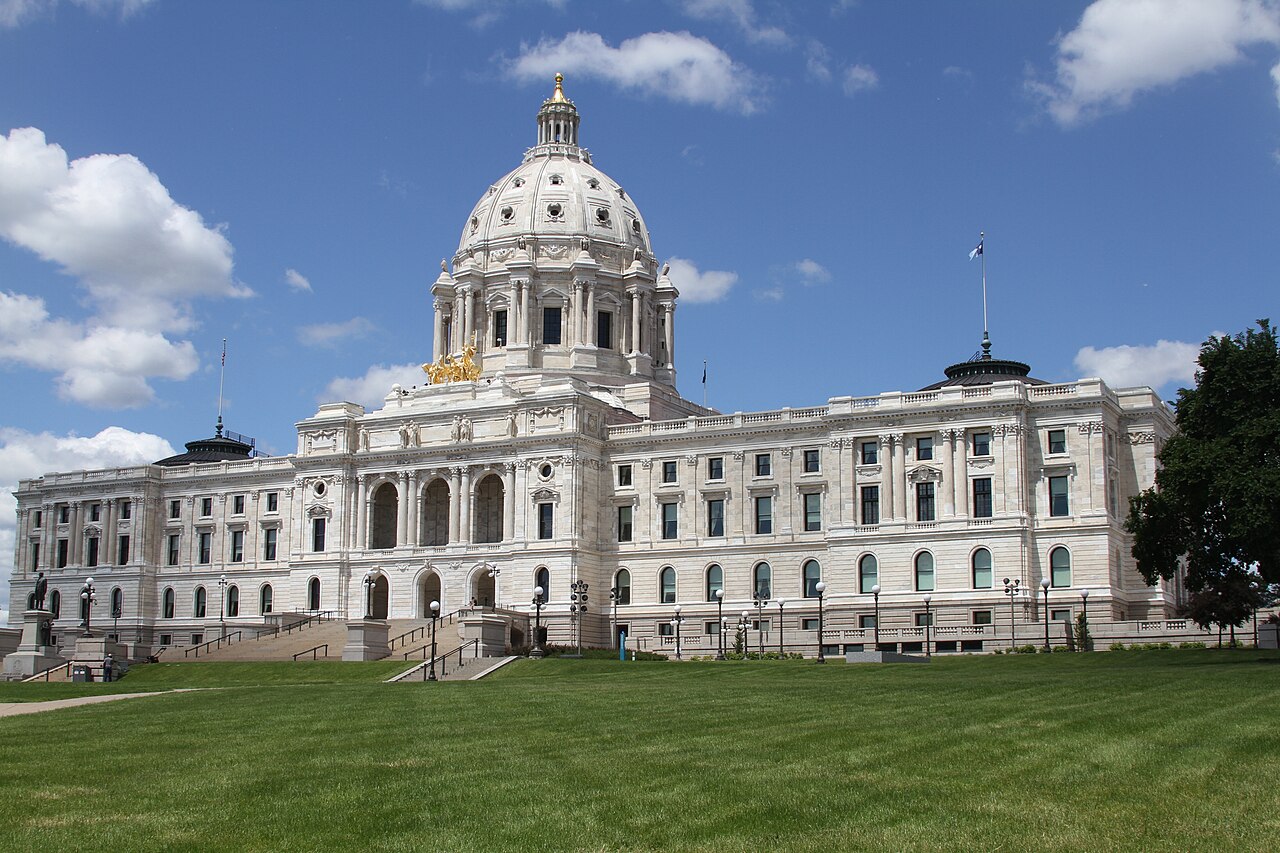
Architectural landmark designed by Cass Gilbert and completed in 1905, featuring one of the largest unsupported marble domes in the world
Site Details
Pin location is approximate.
75 Rev Dr Martin Luther King Jr Boulevard.
St. Paul, MN 55155
Family Friendly?
Yes
Visitors Per Year
50,000-100,000
The Minnesota State Capitol is one of the most architecturally significant state capitols in the United States and is widely regarded as the first major architectural masterpiece by Cass Gilbert, one of the most influential American architects of the era. The primary historical precedent of the Capitol’s dome is the dome of St. Peter’s Basilica in Rome, designed by Michelangelo. This type of dome is relatively rare and is generally recognized as one of the most technically and aesthetically accomplished forms of dome construction. As a result, the Minnesota Capitol’s dome is considered one of the finest in the United States—arguably second only to the dome of the U.S. Capitol in Washington, D.C.
The Capitol contains roughly 60 major artworks, making it both an artistic and an architectural landmark. Its numerous large‑format murals painted by leading artists such as Edwin Howland Blashfield, Kenyon Cox, John La Farge, Howard Pyle, Francis Davis Millet, and Douglas Volk are exceptional and historically significant in their own right. In addition to its murals, the exterior façade is crowned by a gilded quadriga sculpture symbolizing the “progress of the state,” which was created by Daniel Chester French and Edward C. Potter.
The building’s architecture and artwork underwent a comprehensive restoration from 2013 to 2017, and everything is now in pristine condition allowing visitors to experience the Capitol as it would have appeared when it first opened its doors in 1905.
Public tours lasting approximately 45 minutes begin on the ground floor and include a visit to either the Senate or House of Representatives chamber. In each chamber, visitors will learn about its allegorical artwork that balances depictions of civic duties with a sense of civic pride in the state of Minnesota. At the Minnesota Supreme Court, John La Farge’s four murals all touch on the importance of the rule of law, including a superb mural of Moral and Divine Law, which hangs above the Court’s bench. In the Senate chamber, there’s a nod to both agriculture and to exploration with Edwin Blashfield’s paintings Minnesota: Granary of the World and Discoverers and Civilizers Led to the Source of the Mississippi. Tours conclude on the roof, where visitors experience an up-close view of the building’s exceptional gilded bronze quadriga and enjoy sweeping views across the city of St. Paul.
The tours are conducted by the Minnesota Historical Society. The docents are exceptionally well-versed, striking a thoughtful balance between historical accuracy and engaging storytelling.
There are no apparent issues with ideological bias. The Capitol’s extensive use of paintings throughout the building provides a vivid visual history of the United States from the Civil War to its westward expansion in an informative and straightforward manner.
The site is very family friendly. The docents’ presentation strikes an excellent balance, introducing key historical references and the symbolism embedded in the Capitol’s paintings in a way that is highly engaging and accessible to a wide range of audiences, from schoolchildren to adults with deep historical interests.
The Minnesota State Capitol was the breakout architectural project by Cass Gilbert. The design is neoclassical and is emblematic of the Beaux-Arts style. Its design and urban planning were influenced by the 1893 Chicago World’s Fair and the City Beautiful movement, which emphasized classical civic architecture, prominent boulevards, and dedicated public spaces.
Gilbert’s exceptional design and execution of the Capitol launched his national career, leading to many prominent commissions across the United States. He would later design the Woolworth Building in New York City—then the tallest skyscraper in the world—the U.S. Custom House in New York, and the United States Supreme Court in Washington, D.C. Like the Minnesota State Capitol, these buildings are widely regarded as masterpieces of American architecture and among the finest works constructed in the early 20th century.
The Capitol’s decorative largescale murals provide an expansive visual history of the United States, depicting themes ranging from the Civil War to westward expansion. Many of the artists were among the most significant painters of their era, several of whom were recruited following their celebrated contributions to the 1893 Chicago World’s Fair.
The building’s exterior and interior architecture, along with its use of firstrate local materials, reflect both Cass Gilbert’s vision and the state’s early commitment to creating a premier statehouse. Many of the materials—especially the marbles and granites—were sourced from within Minnesota, underscoring the Capitol’s role as a showcase of the state’s natural resources and craftsmanship.
The dome serves as a visual beacon throughout St. Paul and Minneapolis. The Capitol occupies a commanding position as the architectural focal point of the surrounding governmental district, anchoring St. Paul’s civic center and terminating several major urban axes. Its placement and design embody the civic planning ideals that emerged from the Chicago World’s Fair and the broader City Beautiful movement.
Owned By: State of Minnesota
Operated By: Minnesota Historical Society
Government Funded: Yes
Did you know?
The Capitol’s marble dome is one of the largest self-supporting marble domes in the world.
Recommended Reading
- Our Minnesota State Capitol: From Groundbreaking through Restoration by Denis P. Gardner
- Minnesota’s State Capitol: The Art and Politics of a Public Building by Neil B. Thompson
- Minnesota State Capitol by Jane Moorman
- Cass Gilbert: The Early Years by Geoffrey Blodgett
- Cass Gilbert, Architect: Modern Traditionalist by Sharon Irish
Reviewed By
Matthew Enquist
Founder of Matthew Enquist Architect, Fellow of the Institute of Classical Architecture & Art (ICAA), and Chair of the ICAA Books Committee
The opinions expressed above are those of the Reviewer who is providing a good-faith historical assessment to educate the public. Reasonable opinions can vary, and the Reviewer’s opinion is not necessarily the opinion of The Heritage Foundation or its affiliates.