Historic Fort Snelling
Historic frontier fort established in 1819, significant in westward expansion, the Dakota War, and U.S. military training during the Civil War and both World Wars
Site Details
Pin location is approximate.
200 Tower Avenue
St. Paul, MN 55111
Family Friendly?
Somewhat
Visitors Per Year
47,500
The fort’s buildings and grounds are populated by volunteers in period costume, demonstrating various aspects of life in the fort. Musicians play on the fife and drum for flag raising. After that, there are scheduled tours, lasting 15 minutes. The guides point out the main areas of the fort and give the overall history. Then visitors can go visit the carpenter’s workshop to see wooden tools being carved, or the schoolhouse for a lesson in elocution, and the like.
Other highlights of the fort include:
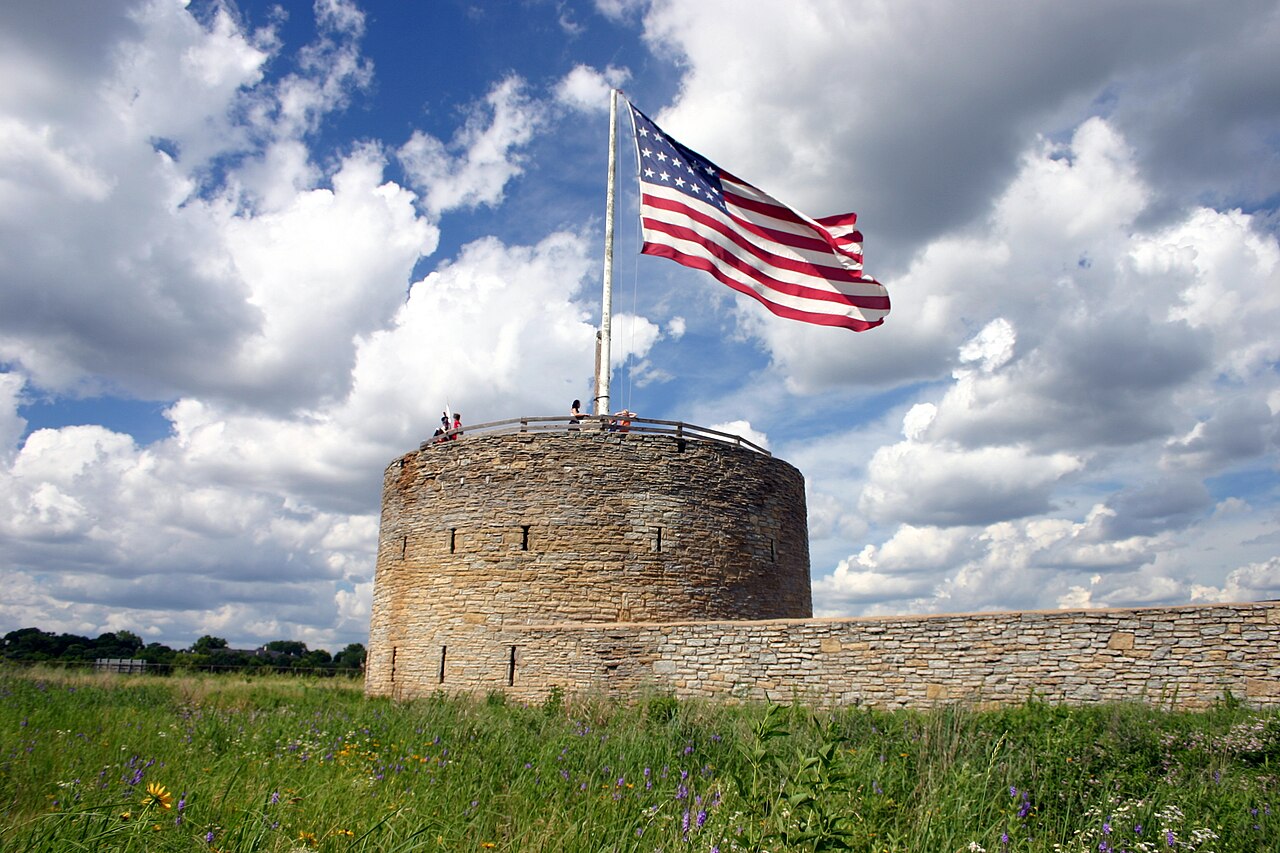
- The Round Tower, dating from 1820
- The powder magazine, built to explode upward
- The married quarters and barracks for single soldiers
- The commanding officer’s house
- The hospital
There are 11 stations manned by volunteers, although not all are active all the time. The volunteers are given basic information relating to their station, as well as bibliographies so they can grow in their knowledge over time.
There is also a two-story Visitors’ Center and museum, much of which focusses on slavery and the sufferings of the Dakota Sioux, including a 15-minute video along those lines. There are also exhibits about its World War I–era hospital, and information about some of the units it mustered for various wars, with many quotes from individual soldiers.
There are issues with cherry-picking, and there is an unbalanced presentation of the facts in the Visitors’ Center and museum. For example, visitors are presented many times with the tragic fact that up to 300 Dakota died during the winter of 1862–1863 in a “concentration camp” at the base of the bluff, yet there is no mention of the sharply increased mortality figures for the European Americans in the area as well, who were suffering from the same disease outbreaks.
The Visitors’ Center repeatedly highlights the sufferings of the Dakota and ignores or downplays their atrocities against settlers: The women of the Krause family “spent six weeks in a Dakota village,” and Mary Schwandt “was orphaned during the war.” The display focuses on the Dakota woman who hid Schwandt from attempts to murder her but avoids mentioning that the Dakota murdered her family and raped her repeatedly. The video also fails to present both sides fairly. In addition, the Visitors’ Center does not mention that nearly 30,000 settlers were displaced by the Dakota attacks, although a sign out on the grounds mentions that fact.
A photo in the Visitors’ Center shows protestors holding a sign that reads “Take down the fort—an icon of American imperialism.” The sign notes that “protests in 2010 drew attention to inadequate historical interpretation of Dakota history at Fort Snelling,” and that they continue to add stories.
Slavery played a minor role in the history of Fort Snelling but receives a disproportionate emphasis throughout the Visitors’ Center. For example, one placard answers the question, “Who built Fort Snelling?” by noting that hundreds of soldiers did, but three–quarters of the placard is about slavery at the fort. It is noteworthy that Dred Scott met and married his wife at Fort Snelling, but it is unfortunate that the Visitors’ Center treats this as a major legacy of Fort Snelling, a fort that sent thousands of volunteers to Gettysburg and other battles to eradicate slavery. The video remarks that the end of slavery simply marked the beginning of a long battle for civil rights.
While the Visitors’ Center and museum show bias and cherry-picking, the outside areas are great for families to explore. Children may be particularly interested in seeing the forge operate and the demonstrations of battlefield tactics in the days of muskets, in which families can participate. The demonstrations and activities are engaging, the buildings are interesting, and the volunteers exhibit no bias or ideology.
When it was built, Fort Snelling was a remote outpost, 700 miles upriver from St. Louis. It provided security for settlers and managed relations with Indians. As the need for this declined, the fort became unnecessary but received a new lease on life with the eruption of the Civil War. Fort Snelling became an important recruitment and training location and fielded the first volunteer unit for the North in the Civil War. It sent units to the wars with the Plains Indians, the Spanish–American War, and both world wars.
Owned By: Minnesota Historical Society
Operated By: Minnesota Historical Society
Government Funded: Yes
Did you know?
Fort Snelling was home to the 99th Infantry battalion, an all-Norwegian unit formed to help free Norway from the Nazis.
Recommended Reading
- Thirty-Three Years Among the Indians by Colonel Richard Irving Dodge
- Painting the Dakota: Seth Eastman at Fort Snelling by Marybeth Lorbiecki
Reviewed By
Alex Rolfe
Library Director at George Fox University
The opinions expressed above are those of the Reviewer who is providing a good-faith historical assessment to educate the public. Reasonable opinions can vary, and the Reviewer’s opinion is not necessarily the opinion of The Heritage Foundation or its affiliates.