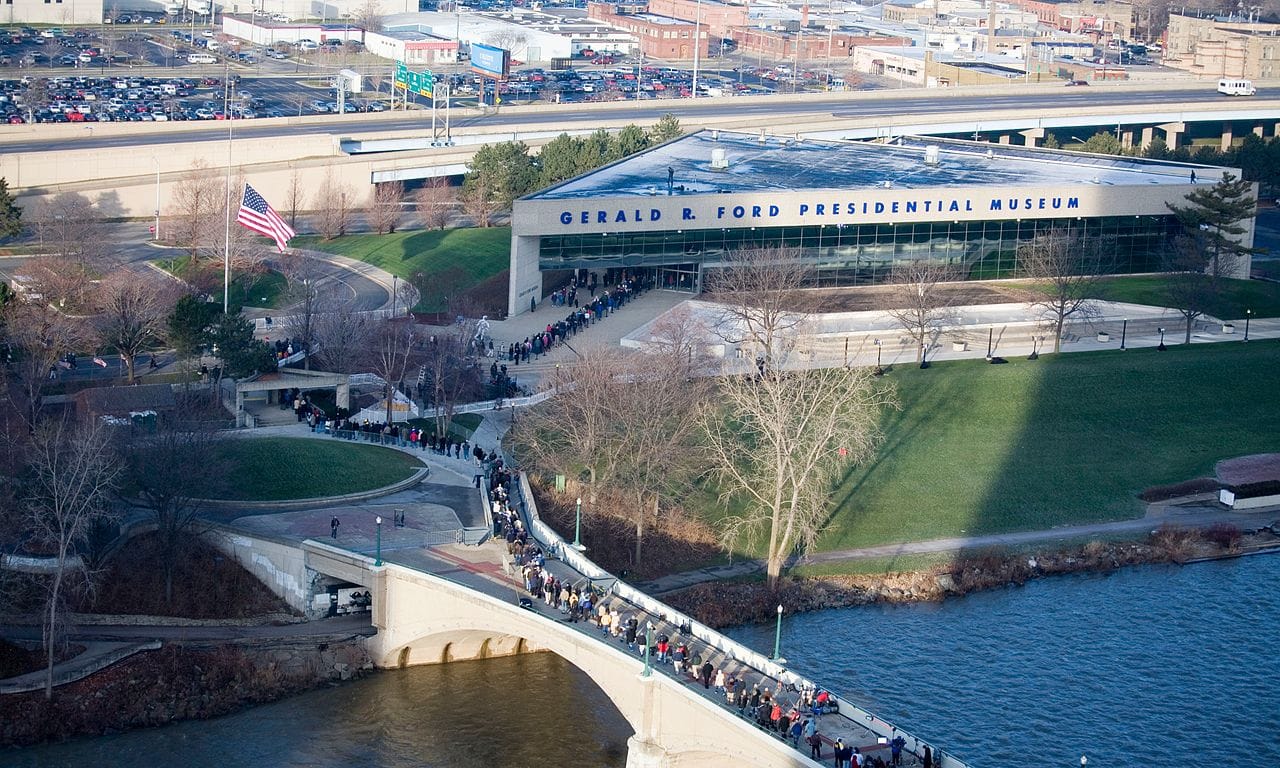
Gerald R. Ford Presidential Library & Museum
Presidential museum and burial site of America’s 38th President
Site Details
Pin location is approximate.
303 Pearl St NW
Grand Rapids, MI 49504
Family Friendly?
Yes
Visitors Per Year
26,000
There is no guided tour of the Ford Museum. A self-guided tour takes about two hours, especially if visitors watch the many short films and use the touch-screen displays.
The tour starts with a 20-minute film, “A Time to Heal: Gerald Ford’s America.” The film explains how Ford was appointed Vice President under the 25th Amendment when Vice President Spiro Agnew resigned amid scandal. The Watergate scandal then engulfed the Richard Nixon Administration. When President Richard M. Nixon resigned on August 9, 1974, Ford became President.
The museum emphasizes the Ford presidency and is well-organized, following the chronology of his life and emphasizing those moments that reveal Ford’s well-known temperate character and politics. All exhibits include one or more short films (usually 1-3 minutes in duration), along with interactive touch-screen displays containing documents, home movies, video footage, and audio. There are many artifacts, as well as drawers containing additional information.
To demonstrate the development of Ford’s character, the museum spends time on key moments in Ford’s pre-presidential life. When the University of Michigan decided to keep Ford’s football teammate Willis Ward, who was black, out of a game against Georgia Tech due to the latter university’s insistence, Ford threatened not to play.
There also is an exhibit on Ford’s World War II service in the U.S. Navy. Ford served on the USS Monterey, an aircraft carrier that caught fire during the war, an incident from which Ford learned the value of coolness under pressure.
Following a brief post-war law career, Ford entered the U.S. Congress in 1948 as a Republican. He served in Congress until 1973, when he was appointed Vice President. The museum calls Ford a “fiscal conservative” who sought to eliminate wasteful spending. At the same time, Ford was a staunch anti-communist during the Cold War who supported American military defense.
Outside of the Cold War context, the museum highlights him as a “moderate conservative” and even uses the term “progressive” at one point to identify him with the Nelson Rockefeller wing of the Republican Party.
The Watergate exhibit and film highlight the American people’s anxiety and Ford’s attempt at restoring a sense of integrity to the White House. As with Ford himself, the museum’s coverage of Watergate is more concerned with the fate of the American people than with Nixon’s.
The foreign policy of the Ford Administration is covered extensively, including Ford’s signing of the Helsinki Accords, U.S.-Soviet relations, the end of American involvement in Vietnam and pullout from Saigon in 1975. Other topics addressed in detail are Ford’s controversial pardon of Nixon, the two assassination attempts on Ford, the 1976 Bicentennial Celebration, and Ford’s failed 1976 reelection campaign.
The relatively small exhibit on Betty Ford emphasizes her support of the Equal Rights Amendment (ERA). An interactive exhibit on a touchscreen includes both a pro- and anti-ERA pamphlet from the 1970s.
One of the best parts of the museum is its Oval Office mockup, which contains artifacts from Ford’s presidency. Likewise, an especially child-friendly exhibit is a re-creation of the White House’s Cabinet Room, which includes placards for where the President, Vice President, and various secretaries sat. There is a short, looped film about Ford’s cabinet. Guests can sit in chairs at the table.
The museum offers a sympathetic but compelling interpretation of Ford that matches the consensus among most historians. On the economy, the museum is less critical of the Ford Administration than it could be. While it offers data to support the claim that Ford improved the economy, the economic “stagflation” of the late 1970s runs counter to this claim.
The museum correctly emphasizes that while Ford’s pardon of Nixon was deeply unpopular at the time, nearly all historians and most Americans now agree that Ford did the right thing. The pardon allowed Americans to move beyond the Nixon Administration scandals. By highlighting this about the pardon, the museum helps educate visitors about the dangers of presentism and the value of historical hindsight.
The Ford Presidential Museum does not present Ford’s story through an ideological lens. There is no presentist political activism. The museum portrays Ford, a lifelong Republican, in the least partisan way possible. This even extends to the museum’s treatment of Ford’s loss to Democrat Jimmy Carter in 1976.
The Ford Museum is family-friendly both in its content and its engaging interactive elements. Children can participate in a scavenger hunt designed to have them examine exhibits closely.
The Ford Museum has a gift shop, hosts activities such as films, events, and lectures, and usually contains at least one temporary exhibit. A virtual tour is available online.
The museum also houses the DeVos Learning Center, which contains classrooms and conducts programming on Gerald R. Ford, Betty Ford, American history, civics, government, and leadership.
This museum is the official presidential museum of Gerald R. Ford. It contains artifacts from Ford’s life and presidency, many of which were donated by Ford himself or his family members.
When Ford became President, he declared, “Our long national nightmare is over.” His goal was to restore integrity in the White House. A self-described “fiscal conservative,” Ford appointed liberal Republican Nelson Rockefeller as his Vice President. Inflation and unemployment dropped during Ford’s brief tenure but remained high. Ford also presided over the chaotic flight from Saigon as it fell to North Vietnamese forces in 1975. He conditionally pardoned draft dodgers and deserters, supported the ERA, and increased the defense budget while vetoing 55 other spending measures. While Mrs. Ford approved of the Roe v. Wade Supreme Court decision, President Ford preferred a federalist solution to the abortion question.
In terms of the Cold War, Ford’s most significant act as President was to sign the Helsinki Accords, which the USSR also signed. The Helsinki Accords’ emphasis on human rights allowed later Presidents to criticize the Soviet human rights record as part of the effort that led to the demise of the Warsaw Pact in 1989 and the dissolution of the Soviet Union in 1991. Still, the conservative wing of Ford’s party mounted a primary campaign against Ford in 1976, led by Ronald Reagan. Reagan argued Ford was weak on communism, too centrist, and insufficiently aggressive on economic policy. After losing the nomination to Ford, Reagan then endorsed Ford and went on to be the 1980 Republican Party nominee, serving as President from 1981–1989.
Ford’s pardon of Nixon was arguably his most consequential act as President.
Owned By: The National Archives and Records Administration
Operated By: Gerald R. Ford Presidential Foundation
Government Funded: Yes
Did you know?
Gerald R. Ford is the only U.S. President not to have been elected to the presidency or vice presidency in a general election.
Recommended Reading
- An Ordinary Life: The Surprising Life and Historic Presidency of Gerald R. Ford by Richard Norton Smith
- Gerald R. Ford: An Honorable Life by James Cannon
Reviewed By
John C. Pinheiro
PhD, is author of The American Experiment in Ordered Liberty (Acton Institute, 2019)
The opinions expressed above are those of the Reviewer who is providing a good-faith historical assessment to educate the public. Reasonable opinions can vary, and the Reviewer’s opinion is not necessarily the opinion of The Heritage Foundation or its affiliates.