Maryland State House
The nation’s longest-serving state capitol and the site where George Washington resigned his commission as commander of the Continental Army
Site Details
Pin location is approximate.
100 State Cir
Annapolis, MD 21401
Family Friendly?
Yes
Visitors Per Year
200,000
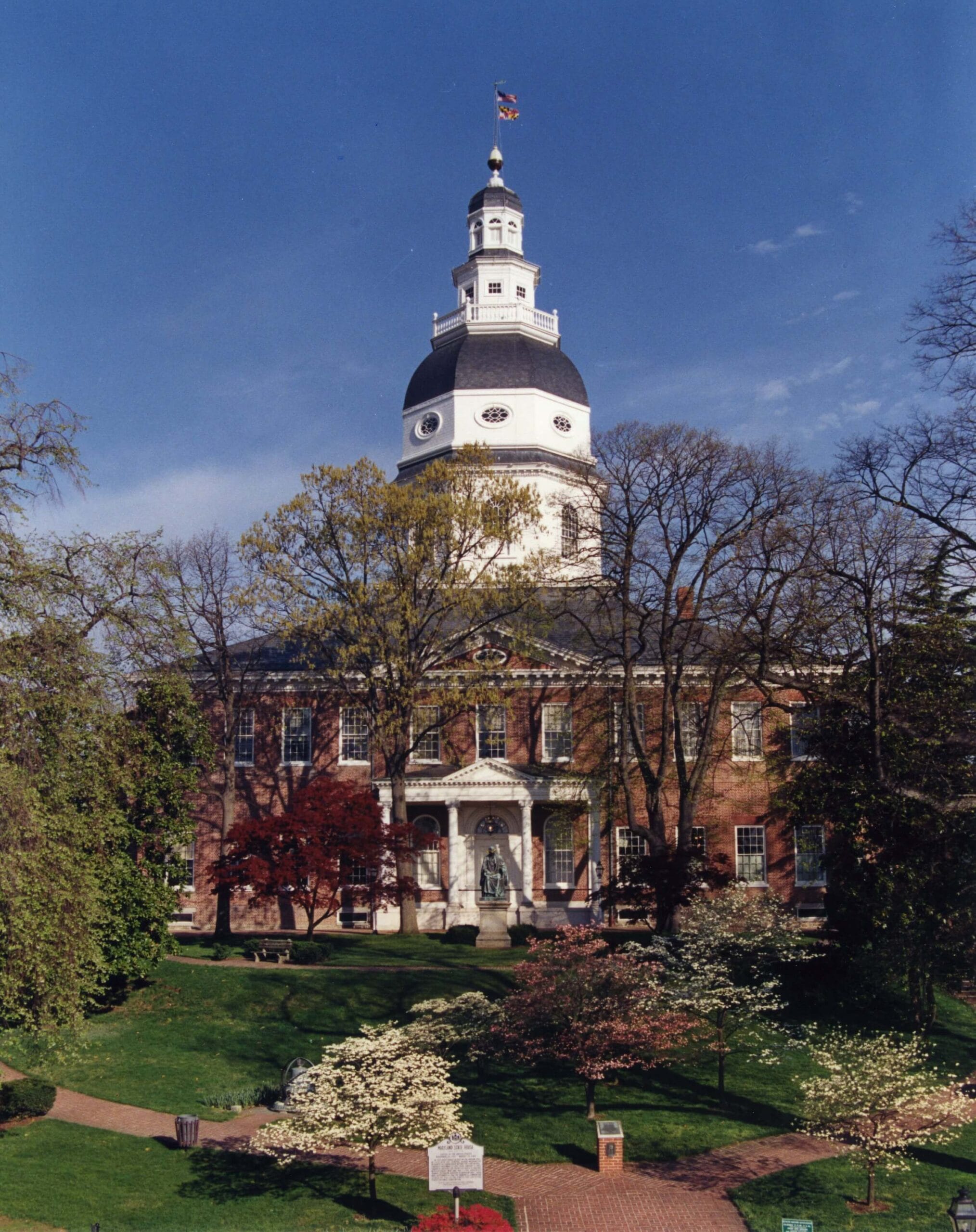
The State House consists of the original edifice with its extraordinary telescoping dome, completed in 1797, and a larger annex that dates to 1904. The dome holds pride of place on the Annapolis skyline. The annex complements the colonial style of the original, but features a large, monumental portico that houses what is now the main entrance. The original building reflects the emergence of a more ambitious American architecture from its colonial antecedents.
The annex is home to the Senate and House of Delegates chambers now used by the legislature. They are well worth a look. Their elegant classical design features an unusual Italian marble whose gold and black streaks correspond to colors on the state flag. Both chambers are crowned by large skylights designed by the studio of Louis Comfort Tiffany. Portraits of Maryland’s four signers of the Declaration of Independence hang in the Senate. Unfortunately, visitors cannot view the best of them—Thomas Sully’s portrait of Charles Carroll of Carrollton, the only Catholic signer—up close.
The old state house, onto which the annex is grafted, now houses a museum. Its Senate chamber, the scene of Washington’s resignation, has been restored to its original state. Even with the column- and pediment-framed apse at one end, where the Senate’s president sat, and the elevated ladies’ gallery at the other, the room conveys a sense of domestic elegance, both in scale and in refinement of architectural detail. The much larger, more amply furnished Delegates chamber on the other side of the central hall, now restored to its lushly polychromatic, Victorian appearance of the 1870s, has a more official or institutional character.
The onetime Senate Committee Room houses a picture gallery with portraits—originals and copies—of politically prominent Marylanders of the Revolutionary era, including nine who witnessed the resignation speech Washington delivered before Congress on December 23, 1783. The room’s most important painting is Charles Willson Peale’s group portrait of Washington, Lafayette, and a staff officer, Col. Tench Tilghman, after the victory at Yorktown. Washington dispatched the Marylander Tilghman with the terms of Cornwallis’s surrender to Philadelphia, where Congress was then quartered.
Also on the old Senate side, the Stairwell Room takes its name from the stairways to the dome and the ladies’ gallery. Cut-out silhouettes of Thomas Jefferson and James Madison start their ascent to the dome’s balcony during their visit to Annapolis in 1790. The balcony is now inaccessible to the public.
The old brick-paved, fire-resistant Archives Room features an exhibit about the State House dome, a wooden structure framed with cypress beams held together not by nails but by wooden pegs reinforced by iron straps. Astonishingly, the original lightning rod of a type devised by Benjamin Franklin is still moored to the dome’s crowning acorn, a copper-clad finial whose upper portion is gilt. The U.S. and Maryland flags fly from the lightning rod, which is crowned by a weathervane.
The most important item on display is Washington’s handwritten copy of his resignation speech, located in the State House Rotunda. Particularly noteworthy are two deletions in the final paragraph that make it clear Washington decided not to rule out the possibility of a future role in the new nation’s public life. It is also interesting that he handed the revealing manuscript to a Maryland legislator who had served on his staff, James McHenry, before leaving the State House for Mount Vernon.
Artworks on view in the State House include:
- A marble bust of Benjamin Franklin, who served as American minister to France from 1776 until 1785, by the French sculptor Jean-Jacques Caffieri. At Franklin’s request, Caffieri produced eight plaster versions of the clay original, which the Founder passed along to friends and family. The marble bust is displayed in the Archives Room.
- A particularly fine portrait of the second Lord Baltimore, Cecilius Calvert (1605–1675), who obtained the charter of Maryland from Charles I. The portrait shows Calvert and his little grandson, both holding a map of Maryland (which Cecilius never visited), and a young black servant. The portrait hangs over an entrance to the old Delegates’ chamber.
- A large canvas showing Washington’s resignation as imagined by a Massachusetts painter, Edward White. Painted in 1858, it now adorns the annex’s grand staircase.
The State House exhibits reflect an abiding awareness of the immense historic import of the Founding and the Revolution. Treatment of Maryland’s history as a slave state is not polemical. The poignant eloquence of Frederick Douglass’s 1868 letter to Harriet Tubman paying tribute to her unheralded labors on the Underground Railroad, an excerpt from which is on display in the old House chamber, is bound to impress adult visitors, whatever they might make of the almost photographic bronze statues of Douglass and Tubman, both natives of Maryland’s Eastern Shore, that stand on the old House of Delegates carpet.
The State House exhibits are not ideologically abrasive.
There are interactive exhibits to engage youngsters’ interest. Families visiting the Maryland State House might take the opportunity to wander around Annapolis (though that would involve a lot of walking for small children). A tour might conclude with the U.S. Naval Academy’s spacious campus, known as “The Yard.” Here the monumental impulse in American architecture, which found early expression in the State House’s dome, was amplified—largely in granite—in buildings designed around the turn of the last century by the brilliant Ernest Flagg. These include Bancroft Hall, an immense dormitory and mess hall celebrated for the stupendous horseshoe-shaped ramp at its entrance; Dahlgren Hall, once the academy’s armory, later home to its hockey rink, and now a venue for a variety of activities, gatherings, and ceremonies; and the Chapel. This superb domed temple, originally laid out on a Greek cross plan and expanded decades later to form a Latin cross, is the USNA’s classical counterpart to West Point’s majestic Gothic chapel.
The Naval Academy Chapel’s crypt houses the 21-ton marble tomb of John Paul Jones—a naval officer during the Revolutionary War who famously proclaimed, “I have not yet begun to fight” —profusely decorated in bronze with sea plants and the tomb’s supporting dolphins. A niche harbors an unforgettable plaster bust of Jones by one of the greatest French sculptors, Jean-Antoine Houdon.
The Maryland State House is the nation’s longest-serving state capitol in continuous use. George Washington resigned his commission as commander of the Continental Army there in December 1783, thus affirming the subordination of the military power to civil authority. A display case, situated in the State House’s gorgeous rotunda, contains Washington’s personal copy of his speech, which the state Archives acquired in 2007. Historians consider it the nation’s fourth most important document, surpassed only by the Declaration, the Constitution, and the Bill of Rights.
Congress met in the Maryland State House from November 1783 until August 1784. Aside from receiving Washington’s resignation, it ratified the Treaty of Paris concluding the Revolutionary War there in January 1784. The State House thus briefly served as the nation’s first peacetime capitol.
State House visitors should also be mindful of the important place Annapolis holds in the nation’s architectural history. During the colonial period, it flourished as a port wedded to the export of tobacco. In 1702, a provincial governor, Francis Nicholson, gave Annapolis a new town plan with streets radiating from State Circle, where the State House stands, and Church Circle, with the two situated close to one another on the town’s highest ground. This sophisticated plan endowed the city with a distinctive spatial character.
During the 18th century, elegant Georgian houses were built in Annapolis, which was noted for its exceptionally large number of brick residences. Frame construction was the norm in the northern colonies.
- The William Paca House and Garden (the property of one of the city’s three native signers of the Declaration) and the Hammond-Harwood House were built during the 1760s and ’70s, respectively, on five-part Palladian plans. Both, like the State House, are National Historic Landmarks and are open to the public.
After the Revolution, Annapolis was eclipsed by Baltimore, largely due to the decline of Maryland’s tobacco trade and the surge in wheat cultivation and diversification of the state’s economy. Fortunately, the human scale of the capital’s historic streets has been maintained, while they inevitably witnessed a succession of architectural styles during the 19th and 20th centuries. The result is a built environment of exceptionally high quality, and a leisurely stroll along streets radiating from State and Church Circles is both pleasant and edifying.
Owned By: State of Maryland
Operated By: State of Maryland
Government Funded: Yes
Did you know?
The State House boasts the nation’s oldest dome.
Recommended Reading
- The Maryland State House: 250 Years of History by Mimi Scrivener Calver
- Annapolis by John L. Conley
Reviewed By
Catesby Leigh
Art and architecture critic and past Chair and Research Fellow of the National Civic Art Society
The opinions expressed above are those of the Reviewer who is providing a good-faith historical assessment to educate the public. Reasonable opinions can vary, and the Reviewer’s opinion is not necessarily the opinion of The Heritage Foundation or its affiliates.